Eremogone kingii var. glabrescens
King's sandwort, King's Sandwort
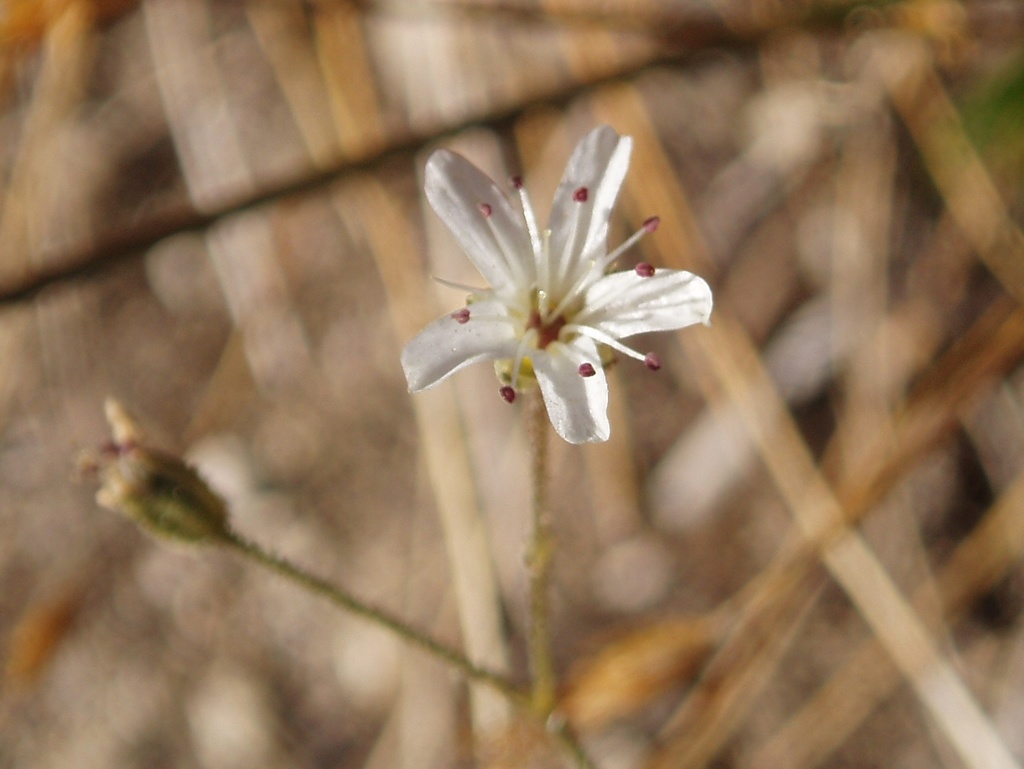
(c) Tom Hilton, some rights reserved (CC BY) · licence
Family: Caryophyllaceae · Type: Perennial · Native
Eremogone kingii var. glabrescens (King's sandwort) is a native California perennial in the Caryophyllaceae family, recognized by very short leaves and small alpine habit.
King's sandwort is a California native perennial found in the high Sierra Nevada, northern Sierra Nevada, eastern Sierra Nevada, and San Bernardino Mountains on rocky slopes, summits, and canyon floors at elevations of 2,100 to 4,050 meters. Flowering from June to September, this plant produces white flowers in small clusters with delicate petals 4 to 7 millimeters long. Growing in tufted or funnel-shaped clusters with stems 1 to 20 centimeters tall, the plant has a delicate, glandular-hairy appearance. Its thin, sharp-pointed leaves are 3 to 20 millimeters long and less than 1.2 millimeters wide, with a single prominent vein. The fruit contains 2 to 5 seeds that are elliptic-oblong and range from red-brown to dark purple or black.
Identification and appearance
Key characters: 10 sympatric species, distinguished by very short leaves and small alpine habit
Habitat and range
Habitat: Rocky slopes, summits, canyon floors
Elevation: 2100-4050 m
California counties: Inyo, San Bernardino, Mono, El Dorado, Ventura, Amador, Butte, Fresno, Shasta, Madera, Tuolumne, Sierra, Alpine, Mariposa, Nevada, Plumas, Tulare, Lassen, Placer, Siskiyou
Outside California: to Oregon, Idaho, Utah
Bloom period
Eremogone kingii var. glabrescens blooms Jun-Sep.
How to tell it apart
vs Sabulina: Eremogone has rigid, spine-tipped needle leaves in dense cushions; Sabulina has softer, narrower leaves more scattered on stems.; vs Minuartia: Eremogone cushions have spine-tipped needles that prick; Minuartia has softer, more flexible narrow leaves.; vs Ivesia: Eremogone has simple needle leaves in cushions; Ivesia has compound, fern-like leaves in rosettes.; vs Hesperolinon: Eremogone forms cushions of sharp needle leaves; Hesperolinon is upright with scattered narrow leaves.; vs Linanthus: Eremogone has dense needle-leaf cushions; Linanthus has palmate-divided leaves like tiny hands.
Frequently asked questions
Is Eremogone kingii var. glabrescens native to California?
Yes. Eremogone kingii var. glabrescens is native to California (recorded as native).
When does Eremogone kingii var. glabrescens bloom?
Eremogone kingii var. glabrescens blooms Jun-Sep.
Where in California does Eremogone kingii var. glabrescens grow?
Eremogone kingii var. glabrescens occurs in Inyo, San Bernardino, Mono, El Dorado, Ventura, Amador, Butte, Fresno and other counties, at elevations of 2100-4050 m.
What plant family does Eremogone kingii var. glabrescens belong to?
Eremogone kingii var. glabrescens is in the Caryophyllaceae family, genus Eremogone.
What habitat does Eremogone kingii var. glabrescens grow in?
Eremogone kingii var. glabrescens grows in Rocky slopes, summits, canyon floors.
Related species
Other California species in the same genus, family, or bioregion.
Sources: Jepson eFlora · Index of California Plant Names · CalPhotos
Last updated 2026-10-06
Data from The California Species Project — 14,000+ California species with verified data from CNPS, CDFW, USFWS, Cal-IPC, and more.