Eremogone macradenia var. macradenia
Desert sandwort
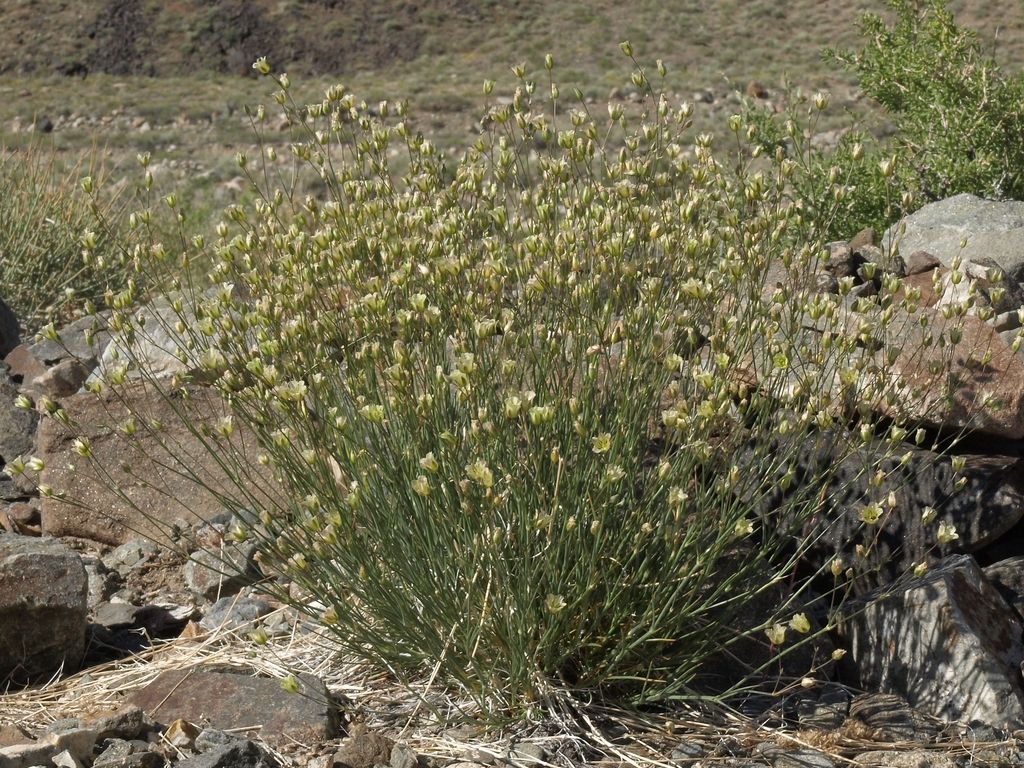
(c) Jim Morefield, some rights reserved (CC BY), uploaded by Jim Morefield · licence
Family: Caryophyllaceae · Type: Perennial · Native
Eremogone macradenia var. macradenia (Desert sandwort) is a native California perennial in the Caryophyllaceae family, recognized by ascending leaves, glabrous inflorescence, and large rectangular nectaries.
Desert sandwort is a California native perennial found in southern Sierra Nevada, San Gabriel Mountains, San Bernardino Mountains, northeastern Sierra Nevada, and eastern Mojave Desert in open woodland, sagebrush flats, and dry rocky slopes at elevations of 1,100 to 2,200 meters. Flowering from April to June, this plant produces white flowers in delicate, open clusters. Growing with slender, ascending stems 15 to 30 centimeters tall, it forms loose, branching clumps. Its narrow leaves are approximately 0.8 to 1.2 millimeters wide, ascending and clustered along the stems. The plant's sepals are 4.5 to 7.2 millimeters long, remaining compact even when fruit develops.
Identification and appearance
Key characters: 10 sympatric species, distinguished by ascending leaves, glabrous inflorescence, and large rectangular nectaries
Habitat and range
Habitat: Open woodland, sagebrush flats, dry rocky slopes, alluvial deposits, often on carbonates
Elevation: 1100-2200 m
California counties: San Bernardino, Inyo, Kern, Los Angeles, Riverside, Tulare, Mono, Plumas, Ventura
Outside California: to Utah, Arizona
Bloom period
Eremogone macradenia var. macradenia blooms Apr-Jun.
How to tell it apart
vs Sabulina: Eremogone has rigid, spine-tipped needle leaves in dense cushions; Sabulina has softer, narrower leaves more scattered on stems.; vs Minuartia: Eremogone cushions have spine-tipped needles that prick; Minuartia has softer, more flexible narrow leaves.; vs Ivesia: Eremogone has simple needle leaves in cushions; Ivesia has compound, fern-like leaves in rosettes.; vs Hesperolinon: Eremogone forms cushions of sharp needle leaves; Hesperolinon is upright with scattered narrow leaves.; vs Linanthus: Eremogone has dense needle-leaf cushions; Linanthus has palmate-divided leaves like tiny hands.
Frequently asked questions
Is Eremogone macradenia var. macradenia native to California?
Yes. Eremogone macradenia var. macradenia is native to California (recorded as native).
When does Eremogone macradenia var. macradenia bloom?
Eremogone macradenia var. macradenia blooms Apr-Jun.
Where in California does Eremogone macradenia var. macradenia grow?
Eremogone macradenia var. macradenia occurs in San Bernardino, Inyo, Kern, Los Angeles, Riverside, Tulare, Mono, Plumas and other counties, at elevations of 1100-2200 m.
What plant family does Eremogone macradenia var. macradenia belong to?
Eremogone macradenia var. macradenia is in the Caryophyllaceae family, genus Eremogone.
What habitat does Eremogone macradenia var. macradenia grow in?
Eremogone macradenia var. macradenia grows in Open woodland, sagebrush flats, dry rocky slopes, alluvial deposits, often on carbonates.
Related species
Other California species in the same genus, family, or bioregion.
- Eremogone sp. — Sandwort
- Eremogone ursina — Bear valley sandwort
- Eremogone aculeata — Prickly sandwort
- Eremogone cliftonii — Clifton's eremogone
- Eremogone congesta — Ballhead sandwort
- Eremogone congesta var. charlestonensis — Charleston sandwort
- Gypsophila elegans — Showy baby's-breath
- Gypsophila paniculata — Baby's-breath
Sources: Jepson eFlora · Index of California Plant Names · CalPhotos
Last updated 2026-10-06
Data from The California Species Project — 14,000+ California species with verified data from CNPS, CDFW, USFWS, Cal-IPC, and more.