Eremothera boothii subsp. boothii
Booth's evening-primrose, Booth's Evening-Primrose
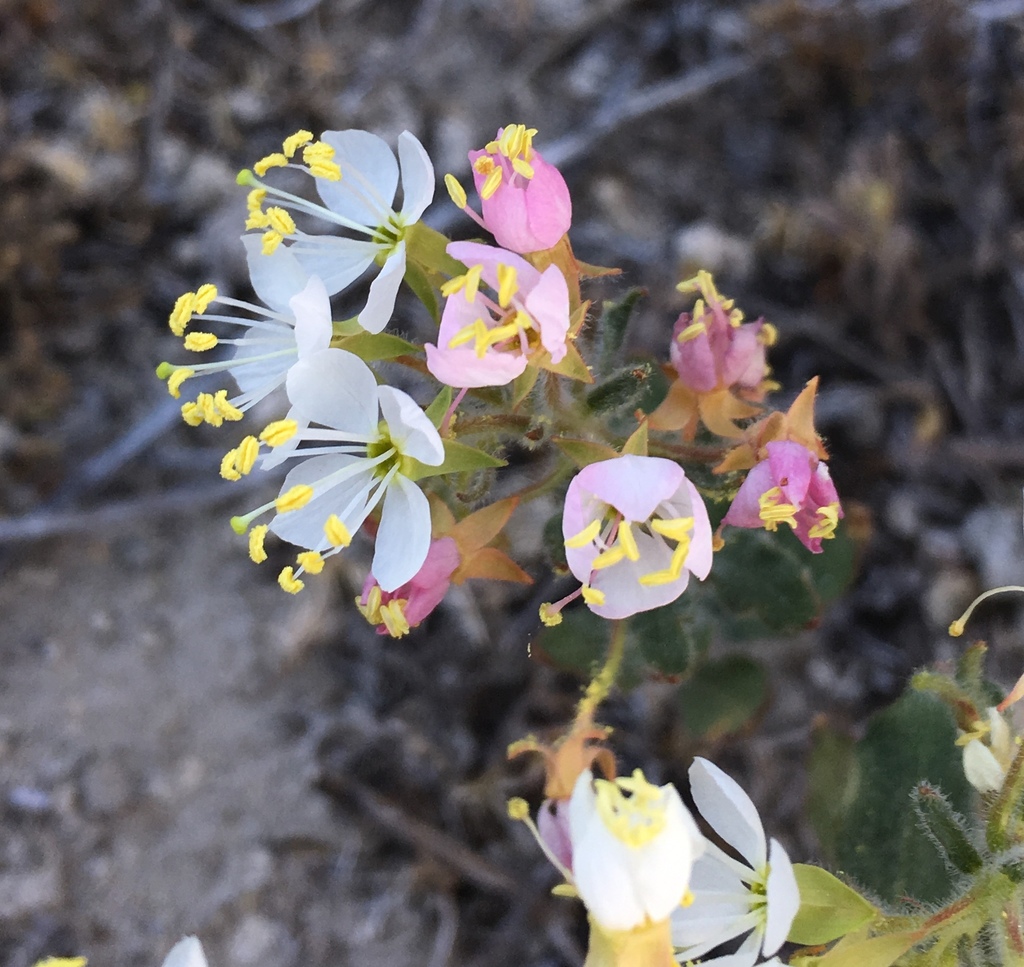
(c) Matt Berger, some rights reserved (CC BY), uploaded by Matt Berger · licence
Family: Onagraceae · Type: Herb · Native
Conservation status: CNPS 2B.3
Eremothera boothii subsp. boothii (Booth's evening-primrose) is a native California herb in the Onagraceae family, recognized by . Key features: large serrate leaves, glandular hairs, fruit width.
Booth's evening-primrose is a native annual found in the southern eastern California deserts in sandy flats, steep loose slopes, and Joshua-tree and pinyon/juniper woodland at elevations of 900 to 2,400 meters. Flowering from June to August, this plant produces delicate yellow flowers with distinctive spreading glandular hairs. Growing 15 to 40 centimeters tall with erect, branching stems that are covered in glandular pubescence, it has a slender and delicate appearance. Its leaves are 30 to 80 millimeters long, lanceolate to narrowly ovate with serrated edges, creating a fine, textured foliage. The fruit is uniquely characterized by being 1.4 to 2 millimeters wide with strongly wavy and twisted surfaces.
Identification and appearance
Key characters: 3 sympatric species. Key features: large serrate leaves, glandular hairs, fruit width
Habitat and range
Habitat: Sandy flats, steep loose slopes, Joshua-tree and pinyon/juniper woodland
Elevation: 900-2400 m
California counties: San Bernardino, Inyo, Kern, Lassen, Mono, Imperial, Fresno
Outside California: to Washington, northwestern Arizona
Bloom period
Eremothera boothii subsp. boothii blooms Jun-Aug.
Conservation status
CNPS 2B.3
How to tell it apart
vs Chylismia: Eremothera has white/pink flowers opening at night; Chylismia has yellow day flowers.; vs Chorizanthe: Eremothera has regular 4-petaled flowers; Chorizanthe has tiny flowers in papery involucres (buckwheat family).; vs Oenothera: Eremothera has white/pink flowers; Oenothera typically has yellow flowers with 4-lobed stigma.; vs Camissonia: Eremothera has white/pink night flowers; Camissonia has yellow day flowers.; vs Gayophytum: Eremothera has larger white/pink flowers; Gayophytum has tiny thread-like stems and minute flowers.
Frequently asked questions
Is Eremothera boothii subsp. boothii native to California?
Yes. Eremothera boothii subsp. boothii is native to California (recorded as native).
When does Eremothera boothii subsp. boothii bloom?
Eremothera boothii subsp. boothii blooms Jun-Aug.
Where in California does Eremothera boothii subsp. boothii grow?
Eremothera boothii subsp. boothii occurs in San Bernardino, Inyo, Kern, Lassen, Mono, Imperial, Fresno, at elevations of 900-2400 m.
What plant family does Eremothera boothii subsp. boothii belong to?
Eremothera boothii subsp. boothii is in the Onagraceae family, genus Eremothera.
Is Eremothera boothii subsp. boothii rare or endangered?
Eremothera boothii subsp. boothii carries California Rare Plant Rank 2B.3, state rank S3.
Related species
Other California species in the same genus, family, or bioregion.
Sources: Jepson eFlora · CNPS Rare Plant Inventory · Index of California Plant Names · CalPhotos · CDFW CNDDB
Last updated 2026-10-07
Data from The California Species Project — 14,000+ California species with verified data from CNPS, CDFW, USFWS, Cal-IPC, and more.