Eremothera nevadensis
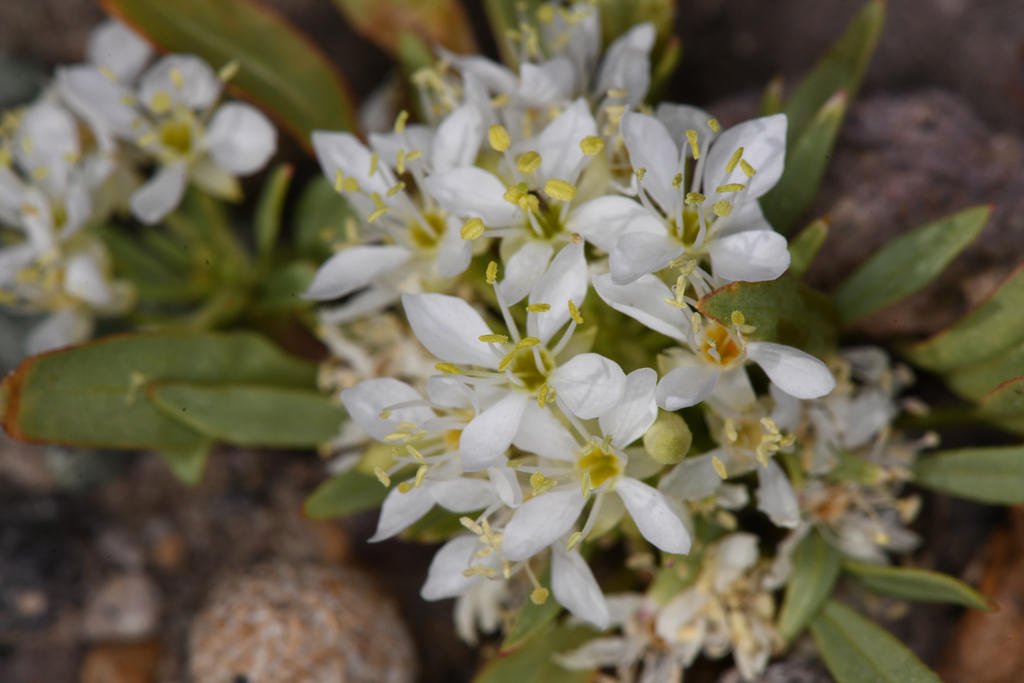
(c) Trevor Van Loon, some rights reserved (CC BY) · licence
Family: Onagraceae · Type: Herb · Native
Eremothera nevadensis is a native California herb in the Onagraceae family, recognized by . Key features: unique branching pattern, high elevation.
Nevada evening-primrose is a California native annual found in the Sierra Nevada Mountains on clay, sandy, or gravelly soils in pine-juniper-sagebrush habitat at elevations of 2,100 to 2,150 meters. Flowering from April to June, this plant produces delicate white petals 3 to 5 millimeters long with a distinctive reddish overall coloration. Growing with decumbent lateral stems and a short primary stem, it forms a tuft of leaves toward the stem tip with oblanceolate leaves. Its narrow leaves have entire margins and the plant is minutely strigose, with hairs that are sometimes nearly absent. The fruit is a cylindric, strongly wavy and twisted structure 8 to 14 millimeters long that persists after flowering.
Identification and appearance
Key characters: 0 sympatric species - geographically isolated. Key features: unique branching pattern, high elevation
Habitat and range
Habitat: Local and colonial on clay, sandy, or gravelly soils, often vernally wet sites, somewhat tolerant of alkali soils in pine-juniper-sagebrush habitat
Elevation: 2100-2150 m
Outside California: to west-central Nevada
Bloom period
Eremothera nevadensis blooms Apr-Jun.
How to tell it apart
vs Chylismia: Eremothera has white/pink flowers opening at night; Chylismia has yellow day flowers.; vs Chorizanthe: Eremothera has regular 4-petaled flowers; Chorizanthe has tiny flowers in papery involucres (buckwheat family).; vs Oenothera: Eremothera has white/pink flowers; Oenothera typically has yellow flowers with 4-lobed stigma.; vs Camissonia: Eremothera has white/pink night flowers; Camissonia has yellow day flowers.; vs Gayophytum: Eremothera has larger white/pink flowers; Gayophytum has tiny thread-like stems and minute flowers.
Frequently asked questions
Is Eremothera nevadensis native to California?
Yes. Eremothera nevadensis is native to California (recorded as native).
When does Eremothera nevadensis bloom?
Eremothera nevadensis blooms Apr-Jun.
What plant family does Eremothera nevadensis belong to?
Eremothera nevadensis is in the Onagraceae family, genus Eremothera.
What habitat does Eremothera nevadensis grow in?
Eremothera nevadensis grows in Local and colonial on clay, sandy, or gravelly soils, often vernally wet sites, somewhat tolerant of alkali soils in pine-juniper-sagebrush habitat.
Related species
Other California species in the same genus, family, or bioregion.
- Eremothera refracta — Narrow leaved primrose
- Eremothera sp.
- Eremothera boothii — Booth's sun cup
- Eremothera boothii subsp. alyssoides — Pine creek evening-primrose
- Eremothera boothii subsp. boothii — Booth's evening-primrose
- Eremothera boothii subsp. condensata
- Eulobus californicus — California primrose
- Eulobus sp.
Sources: Jepson eFlora · Index of California Plant Names · CalPhotos
Last updated 2026-10-07
Data from The California Species Project — 14,000+ California species with verified data from CNPS, CDFW, USFWS, Cal-IPC, and more.