Eremothera refracta
Narrow leaved primrose
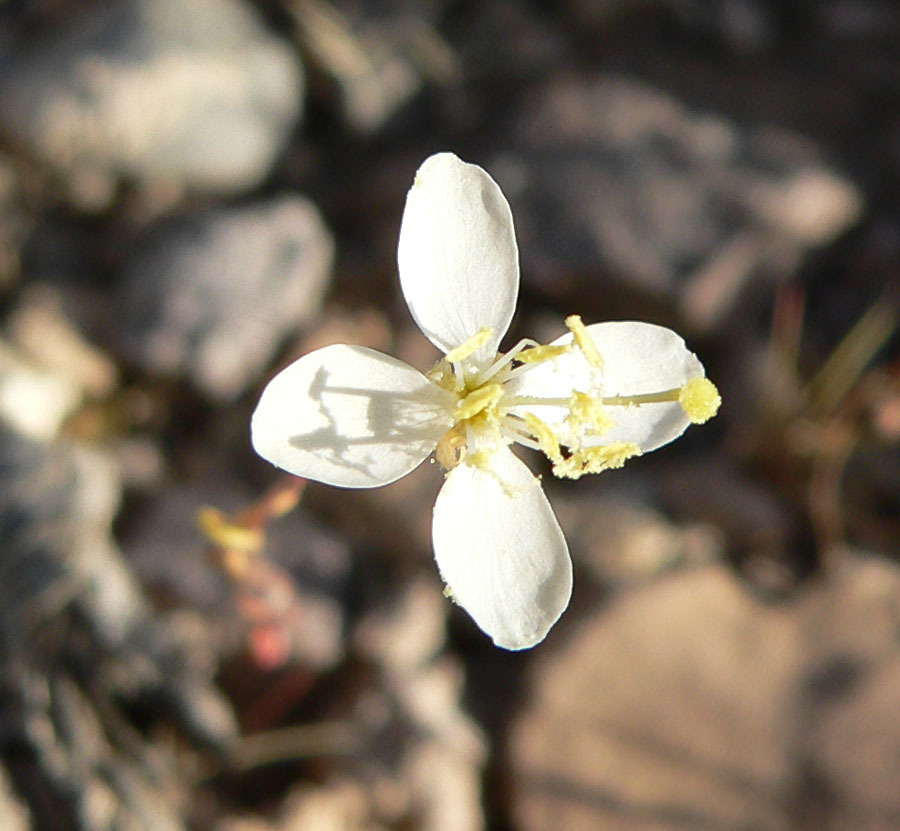
(c) Stan Shebs, some rights reserved (CC BY-SA) · licence
Family: Onagraceae · Type: Herb · Native
Eremothera refracta (Narrow leaved primrose) is a native California herb in the Onagraceae family, recognized by . Key features: medium flowers, spreading/reflexed fruits, angled pollen.
Narrow leaved primrose is a California native annual found in desert regions, particularly in the Mojave Desert, on sandy slopes and desert scrub at elevations from 30 meters below sea level to 1,300 meters. Flowering from March to May, this plant produces white flowers that gradually fade to reddish tones, with delicate petals 3.5 to 7 millimeters long. Growing with erect stems 6 to 45 centimeters tall that have a distinctive peeling characteristic, the plant develops a reddish tint and appears sparsely hairy. Its leaves are narrow and elongated, ranging less than 60 millimeters long, with narrowly elliptic to lanceolate shapes and occasional subtle teeth along the margins. The plant's fruits are cylindrical, spreading or reflexed, measuring 20 to 50 millimeters in length and remarkably slender at just 0.7 to 1 millimeter wide.
Identification and appearance
Key characters: 5 sympatric species. Key features: medium flowers, spreading/reflexed fruits, angled pollen
Habitat and range
Habitat: Sandy slopes, flats, desert scrub
Elevation: -30-1300 m
California counties: Riverside, San Bernardino, Inyo, Imperial, San Diego, Los Angeles, Kern, Monterey, Ventura, San Luis Obispo
Outside California: to southern Nevada, southwestern Utah, western Arizona
Bloom period
Eremothera refracta blooms Mar-May.
How to tell it apart
vs Chylismia: Eremothera has white/pink flowers opening at night; Chylismia has yellow day flowers.; vs Chorizanthe: Eremothera has regular 4-petaled flowers; Chorizanthe has tiny flowers in papery involucres (buckwheat family).; vs Oenothera: Eremothera has white/pink flowers; Oenothera typically has yellow flowers with 4-lobed stigma.; vs Camissonia: Eremothera has white/pink night flowers; Camissonia has yellow day flowers.; vs Gayophytum: Eremothera has larger white/pink flowers; Gayophytum has tiny thread-like stems and minute flowers.
Frequently asked questions
Is Eremothera refracta native to California?
Yes. Eremothera refracta is native to California (recorded as native).
When does Eremothera refracta bloom?
Eremothera refracta blooms Mar-May.
Where in California does Eremothera refracta grow?
Eremothera refracta occurs in Riverside, San Bernardino, Inyo, Imperial, San Diego, Los Angeles, Kern, Monterey and other counties, at elevations of -30-1300 m.
What plant family does Eremothera refracta belong to?
Eremothera refracta is in the Onagraceae family, genus Eremothera.
What habitat does Eremothera refracta grow in?
Eremothera refracta grows in Sandy slopes, flats, desert scrub.
Related species
Other California species in the same genus, family, or bioregion.
- Eremothera sp.
- Eremothera boothii — Booth's sun cup
- Eremothera boothii subsp. alyssoides — Pine creek evening-primrose
- Eremothera boothii subsp. boothii — Booth's evening-primrose
- Eremothera boothii subsp. condensata
- Eremothera boothii subsp. decorticans — Shredding evening-primrose
- Eulobus californicus — California primrose
- Eulobus sp.
- Gayophytum decipiens — Deceiving gayophytum
Sources: Jepson eFlora · Index of California Plant Names · CalPhotos
Last updated 2026-10-07
Data from The California Species Project — 14,000+ California species with verified data from CNPS, CDFW, USFWS, Cal-IPC, and more.