Eriastrum densifolium subsp. mohavense
Mojave woolly-star
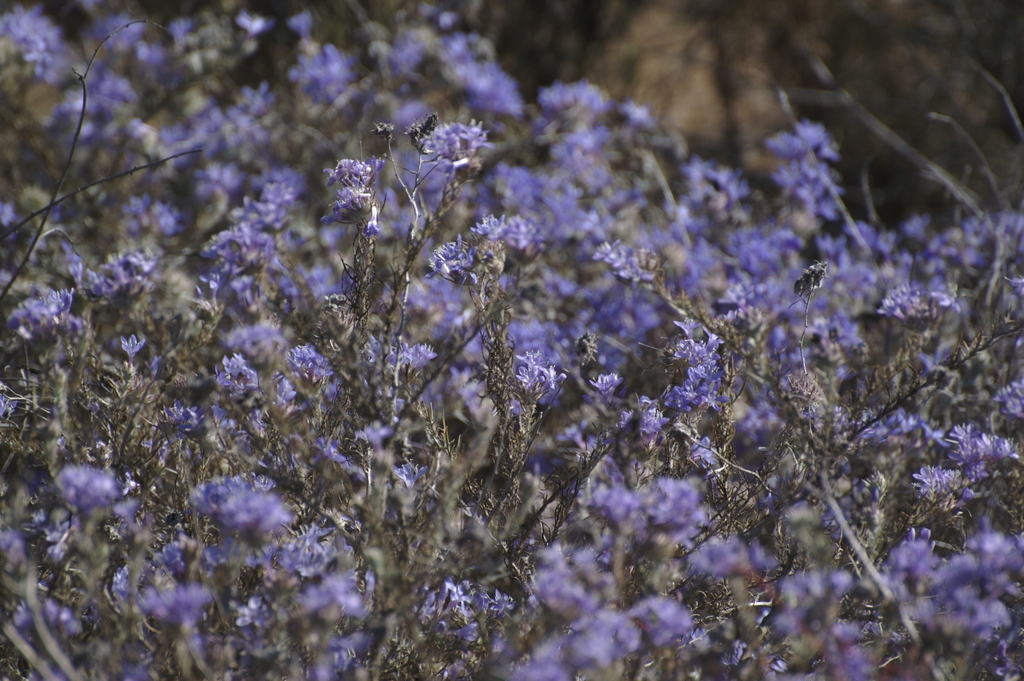
(c) Jerry Kirkhart, some rights reserved (CC BY) · licence
Family: Polemoniaceae · Type: Perennial · Native
Eriastrum densifolium subsp. mohavense (Mojave woolly-star) is a native California perennial in the Polemoniaceae family, recognized by flaking bark and spine-tipped curved leaves diagnostic.
Mojave woolly-star is a California native perennial found in the southern eastern desert and western Mojave Desert regions in desert scrub habitats on floodplains, washes, and open slopes at elevations of 700 to 1,100 meters. Flowering in June, this plant produces white to pale blue or purplish flowers with pale blue or pale lavender lobes arranged in densely woolly heads. Growing 8 to 30 centimeters tall with erect to ascending branches and woody stems that have flaking outer layers, it forms a distinctive white-woolly plant. Its rigid leaves are 10 to 32 millimeters long, white-woolly to gray-green, with primary axes 2 to 3.5 millimeters wide and often featuring 5 to 9 spine-tipped lobes. The fruits are small capsules approximately 2.5 to 4 millimeters long, containing tan elliptic seeds.
Identification and appearance
Key characters: 15 sympatric species; flaking bark and spine-tipped curved leaves diagnostic
Habitat and range
Habitat: Floodplains, washes, open slopes, in desert scrub
Elevation: 700-1100 m
California counties: Kern, San Bernardino, Riverside, Los Angeles, Inyo, Santa Barbara
Bloom period
Eriastrum densifolium subsp. mohavense blooms Jun.
How to tell it apart
vs Navarretia: Eriastrum has fluffy white woolly hairs; Navarretia has spine-tipped bracts and leaves without woolly hairs.; vs Gilia: Eriastrum flower clusters are densely woolly-hairy; Gilia flower clusters lack woolly hairs.; vs Loeseliastrum: Eriastrum has woolly tufted hairs and radial flowers; Loeseliastrum has simple hairs and bilateral flowers.; vs Langloisia: Eriastrum has woolly tufted white hairs; Langloisia has stiff branched bristly hairs.; vs Petalonyx: Eriastrum has opposite lobed leaves in Polemoniaceae; Petalonyx has alternate simple leaves in Loasaceae.
Frequently asked questions
Is Eriastrum densifolium subsp. mohavense native to California?
Yes. Eriastrum densifolium subsp. mohavense is native to California (recorded as native).
When does Eriastrum densifolium subsp. mohavense bloom?
Eriastrum densifolium subsp. mohavense blooms Jun.
Where in California does Eriastrum densifolium subsp. mohavense grow?
Eriastrum densifolium subsp. mohavense occurs in Kern, San Bernardino, Riverside, Los Angeles, Inyo, Santa Barbara, at elevations of 700-1100 m.
What plant family does Eriastrum densifolium subsp. mohavense belong to?
Eriastrum densifolium subsp. mohavense is in the Polemoniaceae family, genus Eriastrum.
What habitat does Eriastrum densifolium subsp. mohavense grow in?
Eriastrum densifolium subsp. mohavense grows in Floodplains, washes, open slopes, in desert scrub.
Related species
Other California species in the same genus, family, or bioregion.
- Eriastrum densifolium subsp. patens — Spreading woolly-star
- Eriastrum densifolium subsp. sanctorum — Santa ana river woolly-star
- Eriastrum diffusum — Spreading woolly-star
- Eriastrum diffusum subsp. coachellae — Coachella woolly-star
- Eriastrum diffusum subsp. diffusum — Spreading woolly-star
- Eriastrum eremicum subsp. eremicum — Desert woolly-star
Sources: Jepson eFlora · Index of California Plant Names · CalPhotos
Last updated 2026-10-06
Data from The California Species Project — 14,000+ California species with verified data from CNPS, CDFW, USFWS, Cal-IPC, and more.