Eriastrum eremicum subsp. eremicum
Desert woolly-star
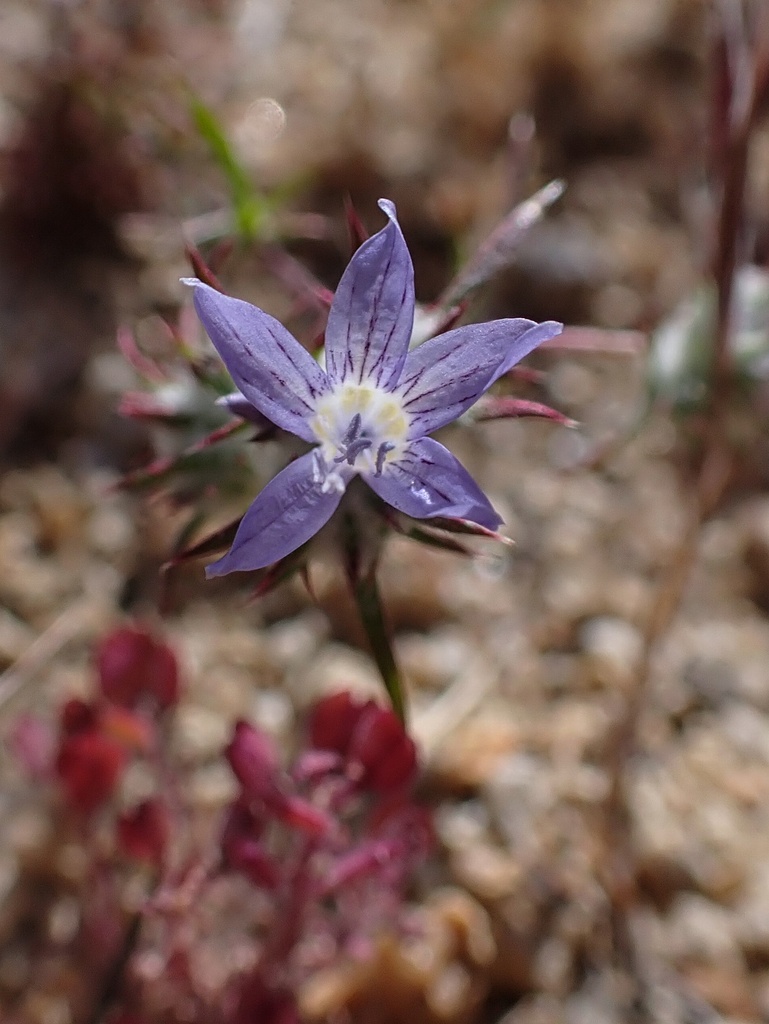
(c) Madeleine Claire, some rights reserved (CC BY), uploaded by Madeleine Claire · licence
Family: Polemoniaceae · Type: Herb · Native
Eriastrum eremicum subsp. eremicum (Desert woolly-star) is a native California herb in the Polemoniaceae family, recognized by bilateral flowers with unequal stamens diagnostic.
Desert woolly-star is a California native annual found in the Sonoran Desert and eastern Sierra Nevada in washes, flats, playas, and desert scrub habitats at elevations of 100 to 1,760 meters. Flowering from April to June, this plant produces white to lavender or pale blue flowers with violet, blue, or nearly white lobes, often featuring darker purplish or reddish streaks on the flower veins. Growing 2 to 30 centimeters tall with much-branched stems that are green and woolly when young and turning dark reddish-brown with age, it spreads up to 40 centimeters wide. Its leaves are lightly woolly, featuring 5 to 9 lobes with lateral lobes 2 to 10 millimeters long, sometimes becoming reddish-brown as the plant matures. The fruit is a small tan capsule approximately 2.5 to 3.1 millimeters long, containing angular, sand-colored seeds.
Identification and appearance
Key characters: 15 sympatric species; bilateral flowers with unequal stamens diagnostic
Habitat and range
Habitat: Washes, flats, playas, bajadas, hillsides, dunes, in desert scrub, arid woodland
Elevation: 100-1760 m
California counties: San Bernardino, Inyo, Kern, Riverside, San Diego, Imperial, Los Angeles, Mono, Nevada
Outside California: to Nevada, Arizona, Baja California
Bloom period
Eriastrum eremicum subsp. eremicum blooms Apr-Jun(Aug--Sep).
How to tell it apart
vs Navarretia: Eriastrum has fluffy white woolly hairs; Navarretia has spine-tipped bracts and leaves without woolly hairs.; vs Gilia: Eriastrum flower clusters are densely woolly-hairy; Gilia flower clusters lack woolly hairs.; vs Loeseliastrum: Eriastrum has woolly tufted hairs and radial flowers; Loeseliastrum has simple hairs and bilateral flowers.; vs Langloisia: Eriastrum has woolly tufted white hairs; Langloisia has stiff branched bristly hairs.; vs Petalonyx: Eriastrum has opposite lobed leaves in Polemoniaceae; Petalonyx has alternate simple leaves in Loasaceae.
Frequently asked questions
Is Eriastrum eremicum subsp. eremicum native to California?
Yes. Eriastrum eremicum subsp. eremicum is native to California (recorded as native).
When does Eriastrum eremicum subsp. eremicum bloom?
Eriastrum eremicum subsp. eremicum blooms Apr-Jun(Aug--Sep).
Where in California does Eriastrum eremicum subsp. eremicum grow?
Eriastrum eremicum subsp. eremicum occurs in San Bernardino, Inyo, Kern, Riverside, San Diego, Imperial, Los Angeles, Mono and other counties, at elevations of 100-1760 m.
What plant family does Eriastrum eremicum subsp. eremicum belong to?
Eriastrum eremicum subsp. eremicum is in the Polemoniaceae family, genus Eriastrum.
What habitat does Eriastrum eremicum subsp. eremicum grow in?
Eriastrum eremicum subsp. eremicum grows in Washes, flats, playas, bajadas, hillsides, dunes, in desert scrub, arid woodland.
Related species
Other California species in the same genus, family, or bioregion.
Sources: Jepson eFlora · Index of California Plant Names · CalPhotos
Last updated 2026-10-07
Data from The California Species Project — 14,000+ California species with verified data from CNPS, CDFW, USFWS, Cal-IPC, and more.