Eriastrum rosamondense
Rosamond woolly-star, rosamond eriastrum
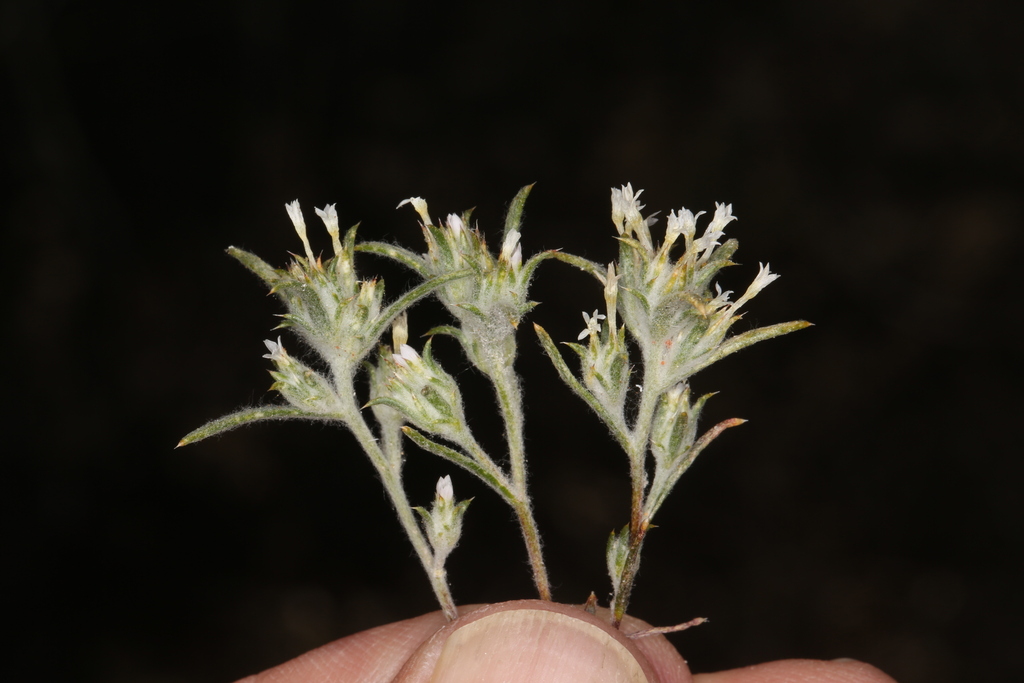
(c) Steve Matson, some rights reserved (CC BY) · licence
Family: Polemoniaceae · Type: Herb · Native
Conservation status: CNPS 1B.1
Eriastrum rosamondense (Rosamond woolly-star) is a native California herb in the Polemoniaceae family, recognized by very small size and inconspicuous flowers on alkali flats.
Rosamond woolly-star is a rare (CNPS 1B.1) California native annual found in western Mojave Desert near Rosamond Dry Lake area in flat alkali plains and alkaline scrub at elevations of 700 to 730 meters. Flowering from April to May, this plant produces white to pale blue flowers in small heads with delicate, sometimes translucent petals. Growing with erect stems 2 to 11 centimeters tall that are lightly woolly and occasionally branched, it forms compact clusters in hardpacked sandy cryptogamic soil. Its narrow leaves range from 4 to 13 millimeters long, primarily entire with occasional upper leaves showing 3-lobed variation, spreading in a sparse, delicate arrangement. The immature fruit develops with a distinctive reddish tip, containing 1 to 4 small tan seeds per chamber.
Identification and appearance
Key characters: 11 sympatric species; very small size and inconspicuous flowers on alkali flats
Habitat and range
Habitat: Flat alkali plains, especially hard-packed sandy cryptogamic soil among low hummocks with dry pools, alkaline scrub
Elevation: 700-730 m
Bloom period
Eriastrum rosamondense blooms Apr-May.
Conservation status
CNPS 1B.1
How to tell it apart
vs Navarretia: Eriastrum has fluffy white woolly hairs; Navarretia has spine-tipped bracts and leaves without woolly hairs.; vs Gilia: Eriastrum flower clusters are densely woolly-hairy; Gilia flower clusters lack woolly hairs.; vs Loeseliastrum: Eriastrum has woolly tufted hairs and radial flowers; Loeseliastrum has simple hairs and bilateral flowers.; vs Langloisia: Eriastrum has woolly tufted white hairs; Langloisia has stiff branched bristly hairs.; vs Petalonyx: Eriastrum has opposite lobed leaves in Polemoniaceae; Petalonyx has alternate simple leaves in Loasaceae.
Frequently asked questions
Is Eriastrum rosamondense native to California?
Yes. Eriastrum rosamondense is native to California (recorded as native).
When does Eriastrum rosamondense bloom?
Eriastrum rosamondense blooms Apr-May.
What plant family does Eriastrum rosamondense belong to?
Eriastrum rosamondense is in the Polemoniaceae family, genus Eriastrum.
Is Eriastrum rosamondense rare or endangered?
Eriastrum rosamondense carries California Rare Plant Rank 1B.1, state rank S1?.
What habitat does Eriastrum rosamondense grow in?
Eriastrum rosamondense grows in Flat alkali plains, especially hard-packed sandy cryptogamic soil among low hummocks with dry pools, alkaline scrub.
Related species
Other California species in the same genus, family, or bioregion.
Sources: Jepson eFlora · CNPS Rare Plant Inventory · Index of California Plant Names · CalPhotos · CDFW CNDDB
Last updated 2026-10-07
Data from The California Species Project — 14,000+ California species with verified data from CNPS, CDFW, USFWS, Cal-IPC, and more.