Erica lusitanica
Spanish heather
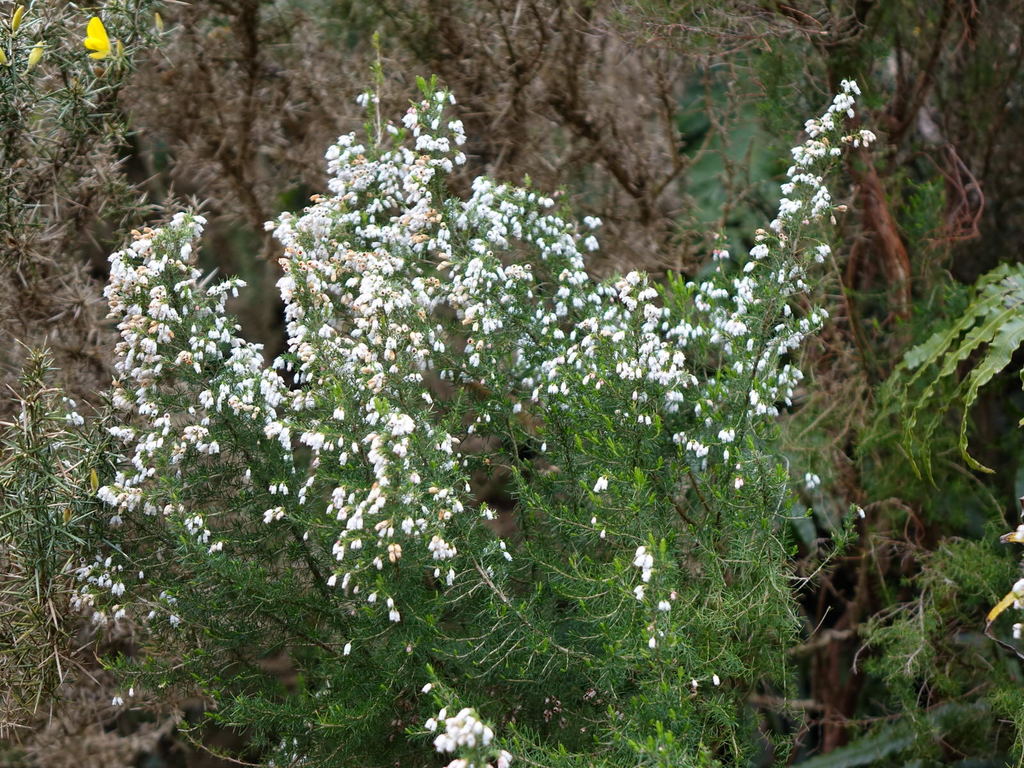
(c) Jacqui Geux, some rights reserved (CC BY), uploaded by Jacqui Geux · licence
Family: Ericaceae · Type: Shrub · Not Native
Conservation status: Cal-IPC Yes
Erica lusitanica (Spanish heather) is a non-native California shrub in the Ericaceae family, recognized by European genus representing Old World heath evolution; different from New World Ericaceae adaptations.
Spanish heather is a naturalized shrub found in northern coastal California, including Humboldt County, in disturbed, open, sandy areas at elevations below 50 meters. Flowering from March to July, this plant produces white to pale pink flowers in small clusters nestled in leaf axils. Growing up to 2 meters tall with dense, short branchlets, it forms a compact and intricate shrubby structure. Its leaves are bright green, needle-like, and extremely narrow, measuring less than one centimeter long and typically less than one millimeter wide. The plant has delicate sepals partially fused at the base, giving its flowers a distinctive petal-like appearance.
Identification and appearance
Key characters: European genus representing Old World heath evolution; different from New World Ericaceae adaptations
Habitat and range
Habitat: Disturbed, open, sandy areas
Elevation: < 50 m
Outside California: native to southwestern Europe
Bloom period
Erica lusitanica blooms Mar-Jul.
Conservation status
Cal-IPC Yes
How to tell it apart
vs Calluna: Erica has a true bell- to urn-shaped corolla of fused petals above a short calyx; Calluna (heather) has a deeply 4-parted corolla that is hidden by four large, colored, petal-like sepals.; vs Arctostaphylos: Erica leaves are needle-like, under 1 mm wide, in tight whorls on the twigs; manzanita leaves are broad, flat, leathery blades borne on smooth red bark.; vs Phyllodoce: Erica is a naturalized garden escape with white to pale-pink flowers clustered in the leaf axils; Phyllodoce is a native alpine heath with nodding rose-purple flowers on glandular stalks.; vs Cassiope: Erica bears free, spreading, needle-like leaves; Cassiope has minute scale-like leaves pressed flat against the stem in four ranks.; vs Kalmia: Erica flowers are small closed urns or bells; Kalmia flowers are open saucers with pouches that hold the anthers under spring tension.
Frequently asked questions
Is Erica lusitanica native to California?
No. Erica lusitanica is not native to California (recorded as not native).
When does Erica lusitanica bloom?
Erica lusitanica blooms Mar-Jul.
What plant family does Erica lusitanica belong to?
Erica lusitanica is in the Ericaceae family, genus Erica.
Is Erica lusitanica invasive in California?
Erica lusitanica is listed by Cal-IPC with an invasiveness rating of Yes.
What habitat does Erica lusitanica grow in?
Erica lusitanica grows in Disturbed, open, sandy areas.
Related species
Other California species in the same genus, family, or bioregion.
Sources: Jepson eFlora · CalPhotos
Last updated 2026-10-07
Data from The California Species Project — 14,000+ California species with verified data from CNPS, CDFW, USFWS, Cal-IPC, and more.