Ericameria palmeri var. palmeri
Palmer's goldenbush
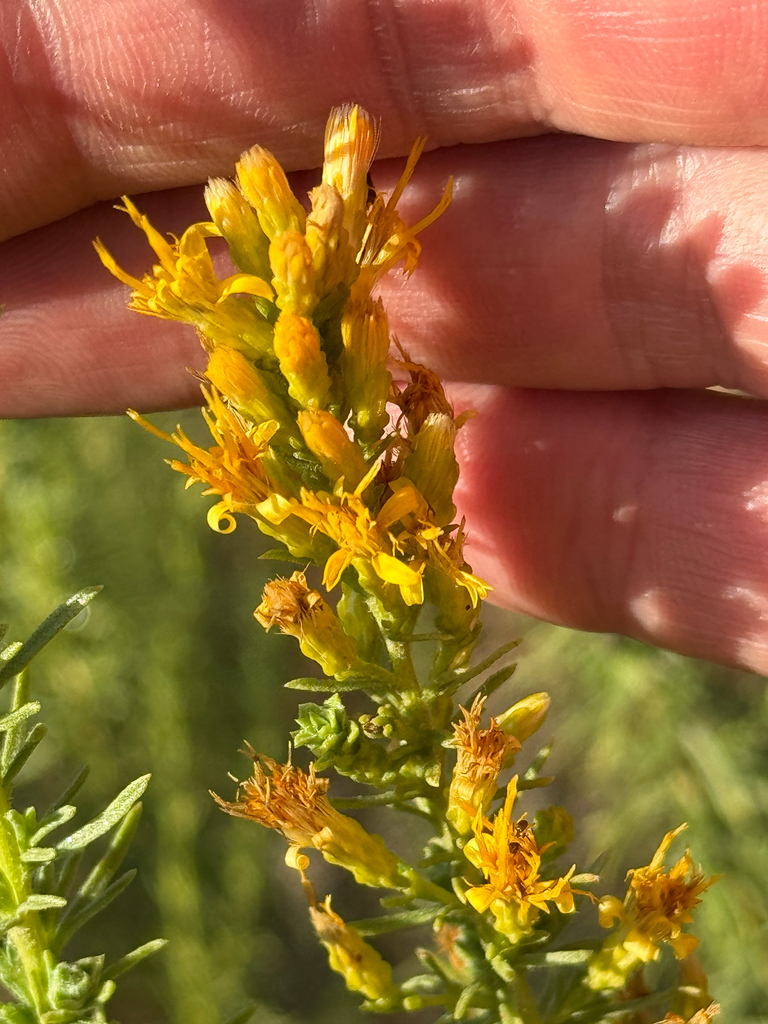
Photo: parent species Ericameria palmeri · (c) klicklo, some rights reserved (CC BY) · licence
Family: Asteraceae · Type: Shrub · Native
Conservation status: CNPS 1B.1
Ericameria palmeri var. palmeri (Palmer's goldenbush) is a native California shrub in the Asteraceae family, recognized by large stature and many-flowered heads.
Palmer's goldenbush is a rare (CNPS 1B.1) California native shrub found in southern San Diego County in coastal scrub habitats at elevations below 600 meters. Flowering from September to November, this plant produces yellow flowers in compact clusters with 12 to 30 individual blooms. Growing as a stout shrub 100 to 400 centimeters tall with substantial branching, it features distinctively curved leaves 20 to 40 millimeters long with 1 to 2 axillary leaves at each node. Its leaves have a unique curved structure, often growing slightly bent with prominent midveins along their lower half. The dense, compact flowering heads have involucres 5 to 6.5 millimeters wide with phyllary tips that are not strongly thickened.
Identification and appearance
Key characters: 5 sympatric species; distinguished by large stature and many-flowered heads
Habitat and range
Habitat: Coastal scrub
Elevation: < 600 m
Outside California: northern Baja California
Bloom period
Ericameria palmeri var. palmeri blooms Sep-Nov.
Conservation status
CNPS 1B.1
How to tell it apart
vs Isocoma: Ericameria has bracts in 5 vertical rows; Isocoma has randomly arranged bracts.; vs Chrysothamnus: Ericameria has woolly young stems and deep pitted glands; Chrysothamnus has smooth/slightly fuzzy stems and surface glands or none.; vs Baccharis: Ericameria has yellow bisexual flowers in each head; Baccharis has separate male/female plants with whitish flowers.; vs Artemisia: Ericameria has yellow flowers and gland-dotted leaves; Artemisia has greenish flowers and aromatic gray-hairy leaves.; vs Lepidospartum: Ericameria has small narrow leaves; Lepidospartum has scale-like leaves on green rush-like stems.
Frequently asked questions
Is Ericameria palmeri var. palmeri native to California?
Yes. Ericameria palmeri var. palmeri is native to California (recorded as native).
When does Ericameria palmeri var. palmeri bloom?
Ericameria palmeri var. palmeri blooms Sep-Nov.
What plant family does Ericameria palmeri var. palmeri belong to?
Ericameria palmeri var. palmeri is in the Asteraceae family, genus Ericameria.
Is Ericameria palmeri var. palmeri rare or endangered?
Ericameria palmeri var. palmeri carries California Rare Plant Rank 1B.1, state rank S2.
What habitat does Ericameria palmeri var. palmeri grow in?
Ericameria palmeri var. palmeri grows in Coastal scrub.
Related species
Other California species in the same genus, family, or bioregion.
Sources: Jepson eFlora · CalPhotos · CDFW CNDDB
Last updated 2026-10-07
Data from The California Species Project — 14,000+ California species with verified data from CNPS, CDFW, USFWS, Cal-IPC, and more.