Ericameria parryi var. monocephala
One-headed rabbitbrush, One-Headed Rabbitbrush
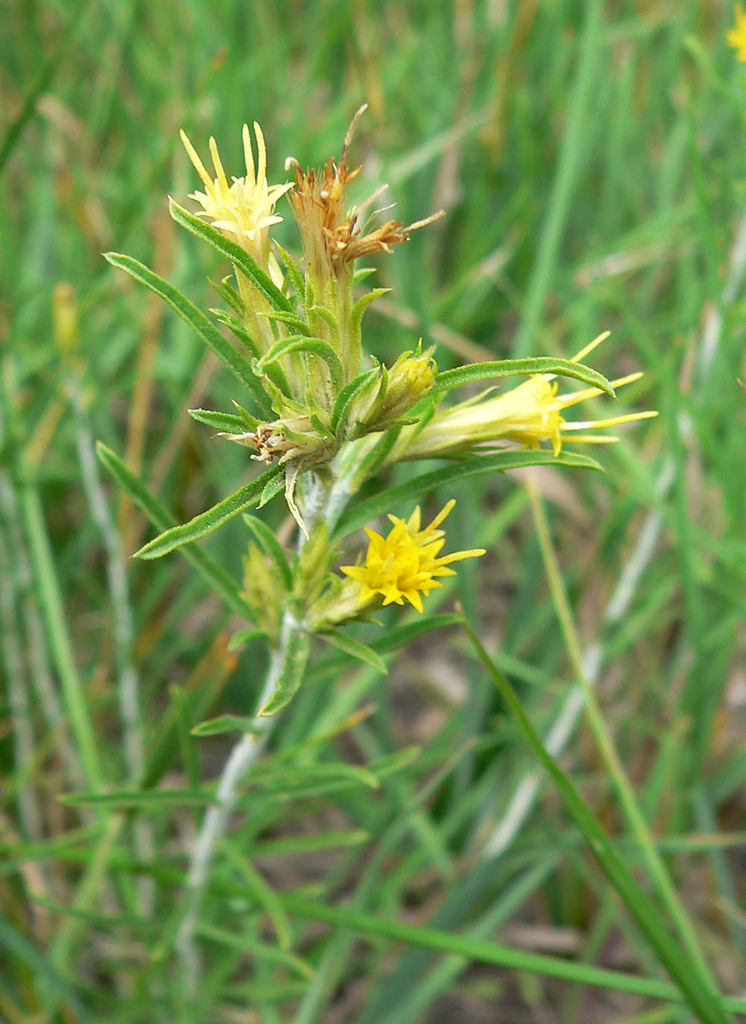
(c) Stan Shebs, some rights reserved (CC BY-SA) · licence
Family: Asteraceae · Type: Shrub · Native
Ericameria parryi var. monocephala (One-headed rabbitbrush) is a native California shrub in the Asteraceae family, recognized by solitary heads.
One-headed rabbitbrush is a California native shrub found in central Sierra Nevada and northern Sierra Eastern Mountains in the Sweetwater Mountains, inhabiting open subalpine forests, talus, and alpine barrens at elevations of 2,800 to 3,700 meters. Flowering from July to September, this plant produces yellow flowers in small clusters of one to two heads. Growing as a rigid plant 0.5 to 4 decimeters tall with spreading white to grayish stems, it forms a compact and distinctive subalpine form. Its leaves are green, elongated to 10 to 30 centimeters long, with the uppermost leaves typically extending beyond the flower heads. The shrub displays a sparse, architectural growth pattern characteristic of high-elevation alpine environments.
Identification and appearance
Key characters: 21 sympatric species; solitary heads are diagnostic
Habitat and range
Habitat: Common. Open subalpine forest, talus, alpine barrens
Elevation: 2800-3700 m
California counties: Mono, Madera, Tuolumne, Alpine
Outside California: western Nevada
Bloom period
Ericameria parryi var. monocephala blooms Jul-Sep.
How to tell it apart
vs Isocoma: Ericameria has bracts in 5 vertical rows; Isocoma has randomly arranged bracts.; vs Chrysothamnus: Ericameria has woolly young stems and deep pitted glands; Chrysothamnus has smooth/slightly fuzzy stems and surface glands or none.; vs Baccharis: Ericameria has yellow bisexual flowers in each head; Baccharis has separate male/female plants with whitish flowers.; vs Artemisia: Ericameria has yellow flowers and gland-dotted leaves; Artemisia has greenish flowers and aromatic gray-hairy leaves.; vs Lepidospartum: Ericameria has small narrow leaves; Lepidospartum has scale-like leaves on green rush-like stems.
Frequently asked questions
Is Ericameria parryi var. monocephala native to California?
Yes. Ericameria parryi var. monocephala is native to California (recorded as native).
When does Ericameria parryi var. monocephala bloom?
Ericameria parryi var. monocephala blooms Jul-Sep.
Where in California does Ericameria parryi var. monocephala grow?
Ericameria parryi var. monocephala occurs in Mono, Madera, Tuolumne, Alpine, at elevations of 2800-3700 m.
What plant family does Ericameria parryi var. monocephala belong to?
Ericameria parryi var. monocephala is in the Asteraceae family, genus Ericameria.
What habitat does Ericameria parryi var. monocephala grow in?
Ericameria parryi var. monocephala grows in Common. Open subalpine forest, talus, alpine barrens.
Related species
Other California species in the same genus, family, or bioregion.
Sources: Jepson eFlora · Index of California Plant Names · CalPhotos
Last updated 2026-10-07
Data from The California Species Project — 14,000+ California species with verified data from CNPS, CDFW, USFWS, Cal-IPC, and more.