Erigeron inornatus
Western rayless fleabane, Western Rayless Fleabane
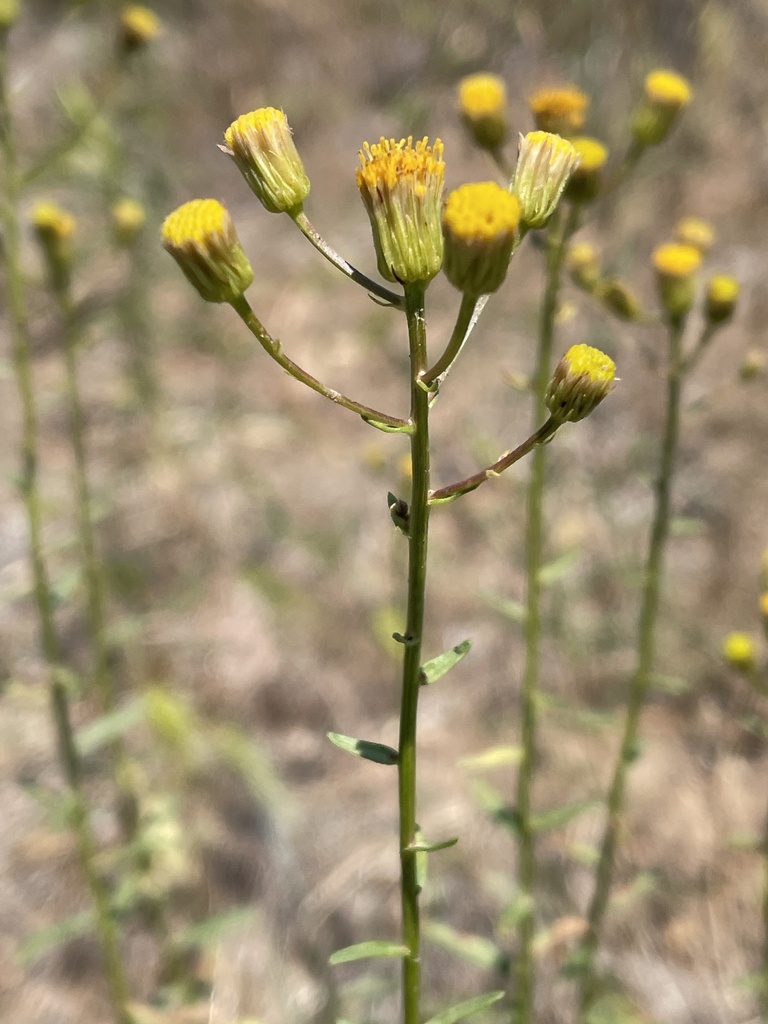
no rights reserved, uploaded by Leah Gardner · CC0
Family: Asteraceae · Type: Herb · Native
Erigeron inornatus (Western rayless fleabane) is a native California herb in the Asteraceae family.
Western rayless fleabane is a California native perennial found in dry, rocky habitats at elevations of 100 to 2,000 meters. Flowering from April to July, this plant produces small whitish to pale greenish flower heads without ray flowers, forming compact clusters. Growing with decumbent to ascending stems 10 to 90 centimeters tall, it develops from a woody taproot with branches near the stem tips. Its leaves are linear to narrowly oblanceolate, 1 to 6 centimeters long, with ciliate edges and surfaces that range from glabrous to sparsely hairy. The plant forms distinctive discoid flower heads 7 to 12 millimeters in diameter, with graduated involucral phyllaries that are generally glabrous.
Identification and appearance
Key characters: Geographically isolated - no sympatric species
How to tell it apart
vs Bellis: Erigeron has double-layered pappus (outer scales + inner bristles); Bellis completely lacks pappus.; vs Symphyotrichum: Erigeron has double pappus (2 layers); Symphyotrichum has single layer of uniform bristles.; vs Corethrogyne: Erigeron has simple unbranched stems; Corethrogyne has branched stems.; vs Pseudognaphalium: Erigeron has flat button-like flower heads; Pseudognaphalium has woolly clustered heads without rays.; vs Artemisia: Erigeron has obvious ray petals around yellow disk; Artemisia lacks ray petals entirely.
Frequently asked questions
Is Erigeron inornatus native to California?
Yes. Erigeron inornatus is native to California (recorded as native).
What plant family does Erigeron inornatus belong to?
Erigeron inornatus is in the Asteraceae family, genus Erigeron.
Related species
Other California species in the same genus, family, or bioregion.
Sources: Jepson eFlora · Index of California Plant Names · CalPhotos
Last updated 2026-10-07
Data from The California Species Project — 14,000+ California species with verified data from CNPS, CDFW, USFWS, Cal-IPC, and more.