Erigeron petrophilus var. petrophilus
Cliff fleabane
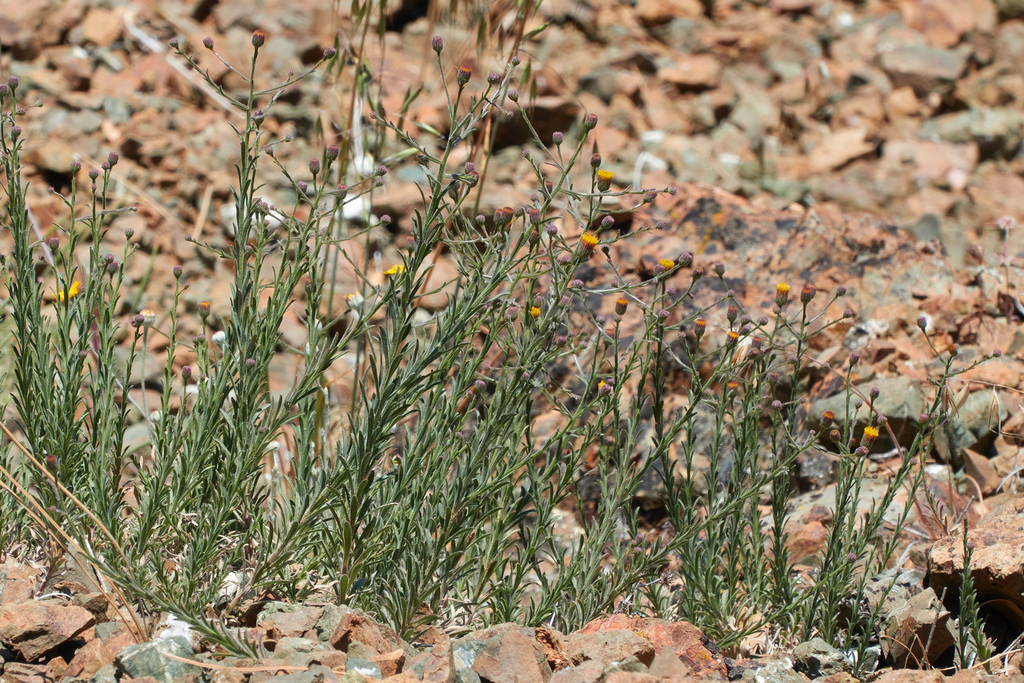
Photo: parent species Erigeron petrophilus · (c) Ken-ichi Ueda, some rights reserved (CC BY) · licence
Family: Asteraceae · Type: Herb · Native
Erigeron petrophilus var. petrophilus (Cliff fleabane) is a native California herb in the Asteraceae family, recognized by rayless with purple-tipped bracts.
Cliff fleabane is a California native perennial found in the northern Coast Ranges, northern Coast Range foothills, San Francisco Bay Area, and southern Coast Ranges in rocky foothills and montane forest habitats at elevations of 500 to 2,100 meters. Flowering from May to September, this plant produces white to lavender ray flowers with purple-tipped phyllaries in compact clusters. Growing with loosely arranged stems 10 to 40 centimeters tall, it features distinctively crinkly and glandular-hairy herbage. Its leaves are generally oblanceolate to spatulate, covered in soft, crinkly hairs that give the plant a distinctive textured appearance. The plant's dense glandular hair coverage and purple-tipped flower bracts make it particularly recognizable in its rocky montane habitats.
Identification and appearance
Key characters: 20 sympatric species - rayless with purple-tipped bracts
Habitat and range
Habitat: Rocky foothills to montane forest, sometimes on serpentine
Elevation: 500-2100 m
California counties: Contra Costa, Lake, Glenn, Mendocino, Napa, San Benito, San Luis Obispo, Santa Cruz, Trinity, Marin, Monterey, Santa Clara, Colusa, Siskiyou, Alameda, Sonoma, Tehama, Merced
Bloom period
Erigeron petrophilus var. petrophilus blooms May-Sep.
How to tell it apart
vs Bellis: Erigeron has double-layered pappus (outer scales + inner bristles); Bellis completely lacks pappus.; vs Symphyotrichum: Erigeron has double pappus (2 layers); Symphyotrichum has single layer of uniform bristles.; vs Corethrogyne: Erigeron has simple unbranched stems; Corethrogyne has branched stems.; vs Pseudognaphalium: Erigeron has flat button-like flower heads; Pseudognaphalium has woolly clustered heads without rays.; vs Artemisia: Erigeron has obvious ray petals around yellow disk; Artemisia lacks ray petals entirely.
Frequently asked questions
Is Erigeron petrophilus var. petrophilus native to California?
Yes. Erigeron petrophilus var. petrophilus is native to California (recorded as native).
When does Erigeron petrophilus var. petrophilus bloom?
Erigeron petrophilus var. petrophilus blooms May-Sep.
Where in California does Erigeron petrophilus var. petrophilus grow?
Erigeron petrophilus var. petrophilus occurs in Contra Costa, Lake, Glenn, Mendocino, Napa, San Benito, San Luis Obispo, Santa Cruz and other counties, at elevations of 500-2100 m.
What plant family does Erigeron petrophilus var. petrophilus belong to?
Erigeron petrophilus var. petrophilus is in the Asteraceae family, genus Erigeron.
What habitat does Erigeron petrophilus var. petrophilus grow in?
Erigeron petrophilus var. petrophilus grows in Rocky foothills to montane forest, sometimes on serpentine.
Related species
Other California species in the same genus, family, or bioregion.
- Erigeron petrophilus var. sierrensis — Northern sierra daisy
- Erigeron petrophilus var. viscidulus — Klamath rock daisy
- Erigeron philadelphicus var. philadelphicus — Philadelphia fleabane
- Erigeron pumilus var. intermedius — Shaggy fleabane
- Erigeron pygmaeus — Pygmy fleabane
- Erigeron reductus — Little rayless fleabane
Sources: Jepson eFlora · Index of California Plant Names · CalPhotos
Last updated 2026-10-07
Data from The California Species Project — 14,000+ California species with verified data from CNPS, CDFW, USFWS, Cal-IPC, and more.