Erigeron petrophilus var. viscidulus
Klamath rock daisy, Klamath Rock Daisy
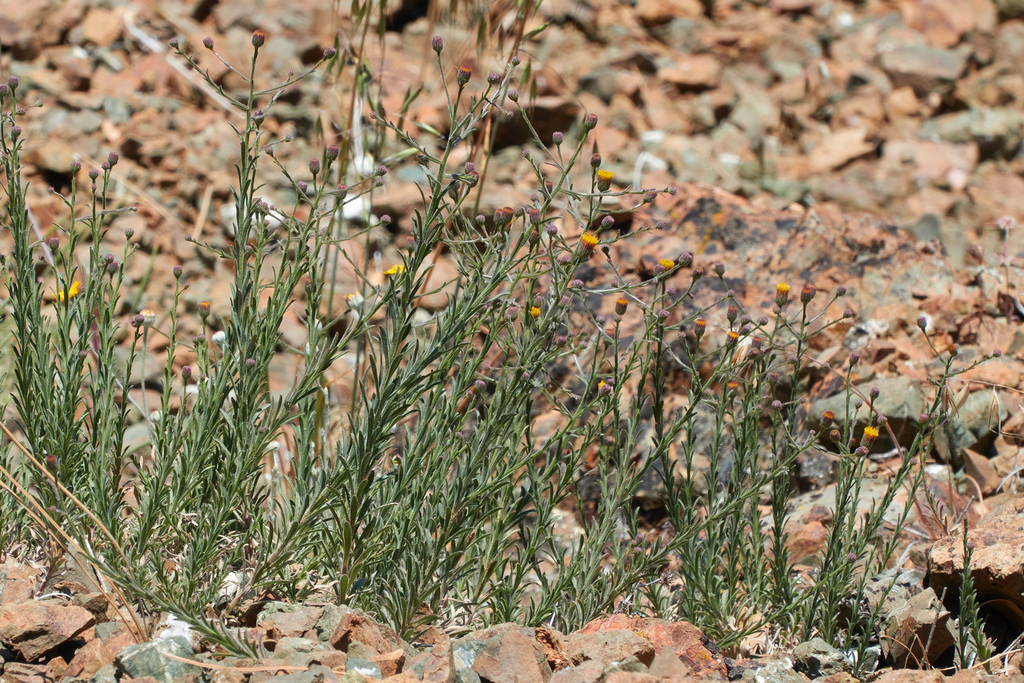
Photo: parent species Erigeron petrophilus · (c) Ken-ichi Ueda, some rights reserved (CC BY) · licence
Family: Asteraceae · Type: Herb · Native
Conservation status: CNPS 4.3
Erigeron petrophilus var. viscidulus (Klamath rock daisy) is a native California herb in the Asteraceae family, recognized by stiff non-glandular hairs, uniform bract coloration.
Klamath rock daisy is a rare (CNPS 4.3) California native perennial found in the Klamath Ranges, northern Coast Ranges, and Modoc Plateau in rocky foothills and montane forests at elevations of 1,500 to 2,700 meters. Flowering from July to September, this plant produces white to lavender daisy-like flowers with yellow centers, clustered in small heads with slender ray petals. Growing with stiff, curved stems 10 to 30 centimeters tall, it forms compact clumps with a somewhat woody base. Its leaves are narrow and lance-shaped, mostly basal, with stiff hairs giving the plant a rough, resilient texture. The dense herbage and distinctive hairy stems help distinguish this rock-loving daisy in its rugged mountain habitats.
Identification and appearance
Key characters: 43 sympatric species; key features are stiff non-glandular hairs, uniform bract coloration
Habitat and range
Habitat: Rocky foothills to montane forest, sometimes on serpentine
Elevation: 1500-2700 m
California counties: Siskiyou, Trinity, Marin, Mendocino, Shasta, Butte, Sierra, Del Norte
Outside California: southwestern Oregon
Bloom period
Erigeron petrophilus var. viscidulus blooms Jul-Sep.
Conservation status
CNPS 4.3
How to tell it apart
vs Bellis: Erigeron has double-layered pappus (outer scales + inner bristles); Bellis completely lacks pappus.; vs Symphyotrichum: Erigeron has double pappus (2 layers); Symphyotrichum has single layer of uniform bristles.; vs Corethrogyne: Erigeron has simple unbranched stems; Corethrogyne has branched stems.; vs Pseudognaphalium: Erigeron has flat button-like flower heads; Pseudognaphalium has woolly clustered heads without rays.; vs Artemisia: Erigeron has obvious ray petals around yellow disk; Artemisia lacks ray petals entirely.
Frequently asked questions
Is Erigeron petrophilus var. viscidulus native to California?
Yes. Erigeron petrophilus var. viscidulus is native to California (recorded as native).
When does Erigeron petrophilus var. viscidulus bloom?
Erigeron petrophilus var. viscidulus blooms Jul-Sep.
Where in California does Erigeron petrophilus var. viscidulus grow?
Erigeron petrophilus var. viscidulus occurs in Siskiyou, Trinity, Marin, Mendocino, Shasta, Butte, Sierra, Del Norte, at elevations of 1500-2700 m.
What plant family does Erigeron petrophilus var. viscidulus belong to?
Erigeron petrophilus var. viscidulus is in the Asteraceae family, genus Erigeron.
Is Erigeron petrophilus var. viscidulus rare or endangered?
Erigeron petrophilus var. viscidulus carries California Rare Plant Rank 4.3, state rank S4.
Related species
Other California species in the same genus, family, or bioregion.
- Erigeron philadelphicus var. philadelphicus — Philadelphia fleabane
- Erigeron pumilus var. intermedius — Shaggy fleabane
- Erigeron pygmaeus — Pygmy fleabane
- Erigeron reductus — Little rayless fleabane
- Erigeron reductus var. angustatus — Lesser California rayless fleabane
- Erigeron reductus var. reductus — California rayless daisy
Sources: Jepson eFlora · CNPS Rare Plant Inventory · Index of California Plant Names · CalPhotos · CDFW CNDDB
Last updated 2026-10-07
Data from The California Species Project — 14,000+ California species with verified data from CNPS, CDFW, USFWS, Cal-IPC, and more.