Erigeron sumatrensis
Tropical horseweed
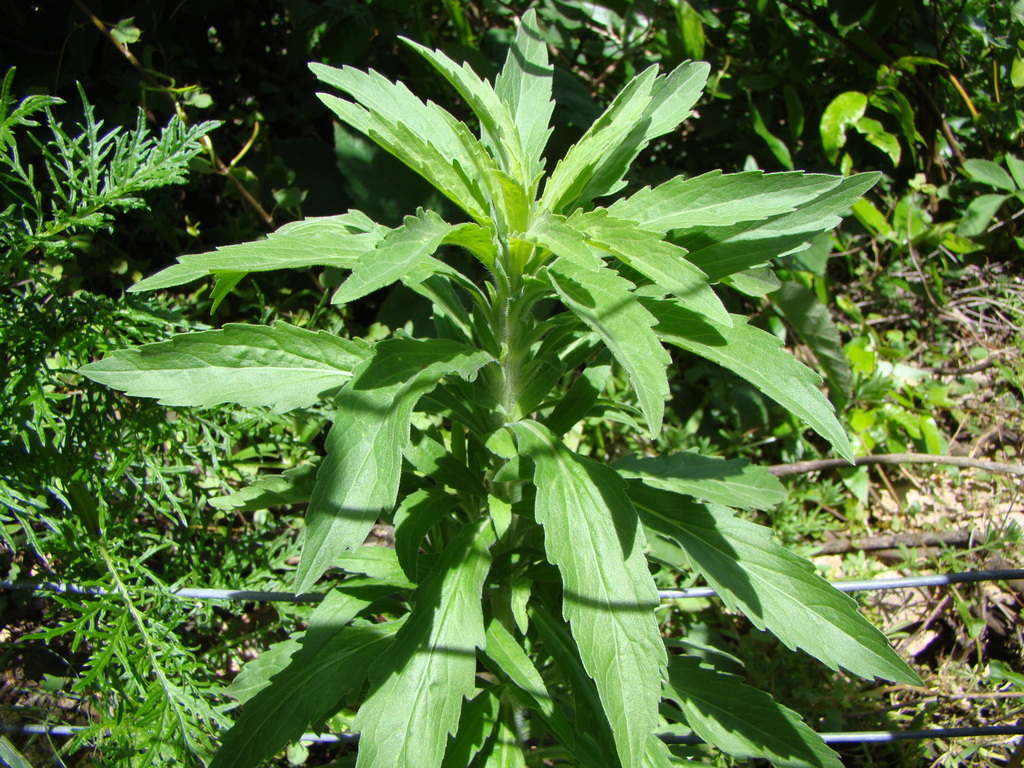
(c) Lisa Bennett, some rights reserved (CC BY), uploaded by Lisa Bennett · licence
Family: Asteraceae · Type: Herb · Not Native
Erigeron sumatrensis (Tropical horseweed) is a non-native California herb in the Asteraceae family, recognized by tall stature and rayless/nearly rayless heads diagnostic.
Tropical horseweed is a naturalized annual plant found in northwestern California, the northern Sierra Nevada foothills, Sacramento Valley, central western California, southern California coastal areas, Channel Islands, and Peninsular Ranges at elevations below 600 meters in disturbed sites. Flowering throughout the year, this plant produces white or cream flowers in small heads arranged in panicle-like clusters. Growing with erect, leafy stems 30 to 200 centimeters tall, it branches extensively and has stems covered in fine, ascending hairs with the central stem typically taller than its branches. Its leaves range from linear to elliptic or oblanceolate, with basal and lower stem leaves 5 to 10 centimeters long and 5 to 20 millimeters wide, often withering by flowering time. The fruit is pale tan, sometimes with reddish ribs, and measures 1 to 1.5 millimeters long with 15 to 25 cream to tan pappus bristles.
Identification and appearance
Key characters: 53 sympatric species; tall stature and rayless/nearly rayless heads diagnostic
Habitat and range
Habitat: Disturbed sites
Elevation: < 600+ m
California counties: Los Angeles, Monterey, San Bernardino, San Diego, Santa Barbara, Sonoma, Ventura, Orange, Riverside, El Dorado, Alameda, Santa Cruz, San Luis Obispo, Butte, Sutter, Glenn, Yuba, Colusa, Napa, San Mateo, Sacramento, San Francisco, Yolo, San Joaquin, Stanislaus, Placer, Merced
Outside California: widely naturalized, native to South America
Bloom period
Erigeron sumatrensis blooms All year.
How to tell it apart
vs Bellis: Erigeron has double-layered pappus (outer scales + inner bristles); Bellis completely lacks pappus.; vs Symphyotrichum: Erigeron has double pappus (2 layers); Symphyotrichum has single layer of uniform bristles.; vs Corethrogyne: Erigeron has simple unbranched stems; Corethrogyne has branched stems.; vs Pseudognaphalium: Erigeron has flat button-like flower heads; Pseudognaphalium has woolly clustered heads without rays.; vs Artemisia: Erigeron has obvious ray petals around yellow disk; Artemisia lacks ray petals entirely.
Frequently asked questions
Is Erigeron sumatrensis native to California?
No. Erigeron sumatrensis is not native to California (recorded as not native).
When does Erigeron sumatrensis bloom?
Erigeron sumatrensis blooms All year.
Where in California does Erigeron sumatrensis grow?
Erigeron sumatrensis occurs in Los Angeles, Monterey, San Bernardino, San Diego, Santa Barbara, Sonoma, Ventura, Orange and other counties, at elevations of < 600+ m.
What plant family does Erigeron sumatrensis belong to?
Erigeron sumatrensis is in the Asteraceae family, genus Erigeron.
What habitat does Erigeron sumatrensis grow in?
Erigeron sumatrensis grows in Disturbed sites.
Related species
Other California species in the same genus, family, or bioregion.
Sources: Jepson eFlora · Index of California Plant Names · CalPhotos
Last updated 2026-10-07
Data from The California Species Project — 14,000+ California species with verified data from CNPS, CDFW, USFWS, Cal-IPC, and more.