Eriodictyon altissimum
Indian knob mountainbalm, Indian Knob Mountainbalm
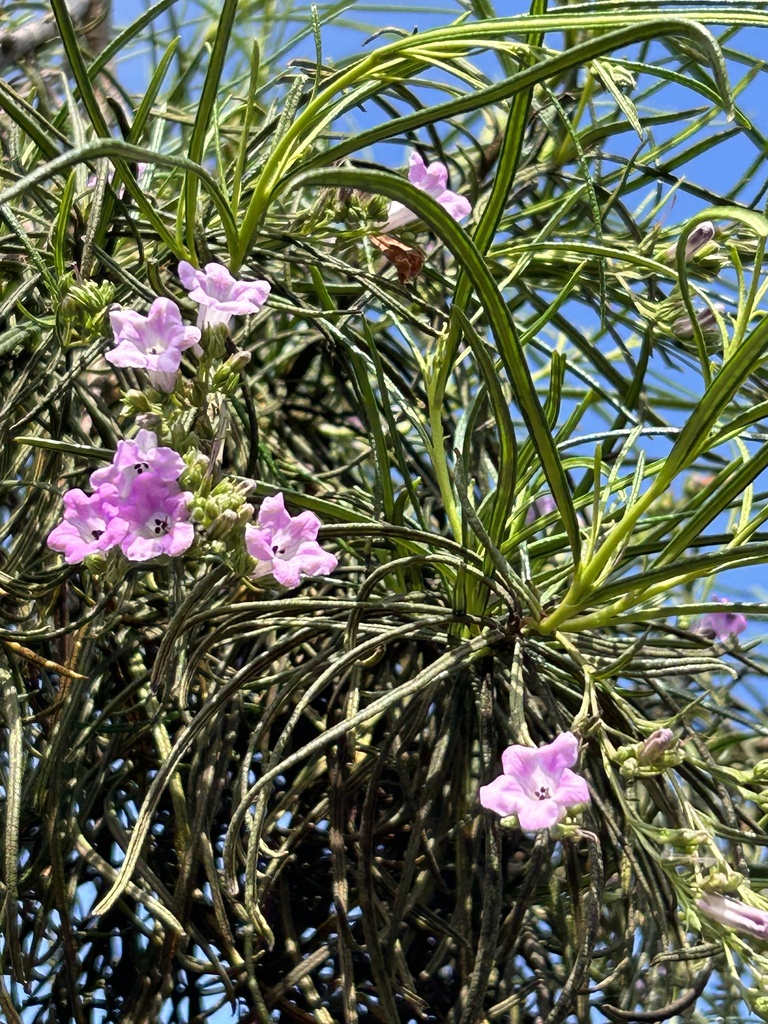
no rights reserved, uploaded by Alex Heyman · CC0
Family: Namaceae · Type: Shrub · Native
Conservation status: CNPS 1B.1 · Endangered
Eriodictyon altissimum (Indian knob mountainbalm) is a native California shrub in the Namaceae family, recognized by . Key features: very narrow leaves, tall stature, sticky glabrous twigs.
Indian knob mountainbalm is a rare (CNPS 1B.1) California native shrub found in southwestern San Luis Obispo County's chaparral on sandstone ridges at elevations below 270 meters. Flowering from March to June, this plant produces lavender flowers in funnel-shaped corollas 11 to 16 millimeters long. Growing two to four meters tall with glabrous, sticky twigs, it forms an upright shrub with distinctive foliage. Its linear leaves are five to nine centimeters long, extremely narrow at 0.2 to 0.4 centimeters wide, with strongly rolled margins and a white-tomentose undersurface that obscures most leaf veins. The shrub's sticky stems and leaves, combined with its lavender flowers, make it a distinctive chaparral species.
Identification and appearance
Key characters: 8 sympatric species. Key features: very narrow leaves, tall stature, sticky glabrous twigs
Habitat and range
Habitat: Sandstone ridges, chaparral
Elevation: < 270 m
California counties: San Luis Obispo, San Bernardino
Bloom period
Eriodictyon altissimum blooms Mar-Jun.
Conservation status
CNPS 1B.1 · Endangered
How to tell it apart
vs Salvia: Eriodictyon has tubular flowers in branched clusters; Salvia has 2-lipped flowers in whorled spikes.; vs Baccharis: Eriodictyon has showy tubular flowers with petals; Baccharis has tiny flowers in fuzzy white/tan heads without petals.; vs Eriogonum: Eriodictyon has tubular flowers with petals; Eriogonum has tiny petal-less flowers in ball-like clusters.; vs Heteromeles: Eriodictyon has tubular flowers; Heteromeles has flat-topped clusters of white 5-petaled flowers with red berries.; vs Pseudognaphalium: Eriodictyon is a woody shrub with tubular flowers; Pseudognaphalium is an herb with fuzzy leaves and papery flower heads.
Frequently asked questions
Is Eriodictyon altissimum native to California?
Yes. Eriodictyon altissimum is native to California (recorded as native).
When does Eriodictyon altissimum bloom?
Eriodictyon altissimum blooms Mar-Jun.
Where in California does Eriodictyon altissimum grow?
Eriodictyon altissimum occurs in San Luis Obispo, San Bernardino, at elevations of < 270 m.
What plant family does Eriodictyon altissimum belong to?
Eriodictyon altissimum is in the Namaceae family, genus Eriodictyon.
Is Eriodictyon altissimum rare or endangered?
Eriodictyon altissimum carries California Rare Plant Rank 1B.1, state rank S1.
Related species
Other California species in the same genus, family, or bioregion.
- Eriodictyon angustifolium — Narrow-leaved yerba santa
- Eriodictyon californicum — California yerba santa
- Eriodictyon capitatum — Lompoc yerba santa
- Eriodictyon crassifolium — Felt leaved yerba santa
- Eriodictyon crassifolium var. crassifolium — Thick-leaved yerba santa
- Eriodictyon crassifolium var. nigrescens — Bicolored yerba santa
Sources: Jepson eFlora · CNPS Rare Plant Inventory · Index of California Plant Names · CalPhotos · CDFW CNDDB
Last updated 2026-10-07
Data from The California Species Project — 14,000+ California species with verified data from CNPS, CDFW, USFWS, Cal-IPC, and more.