Eriodictyon crassifolium var. nigrescens
Bicolored yerba santa
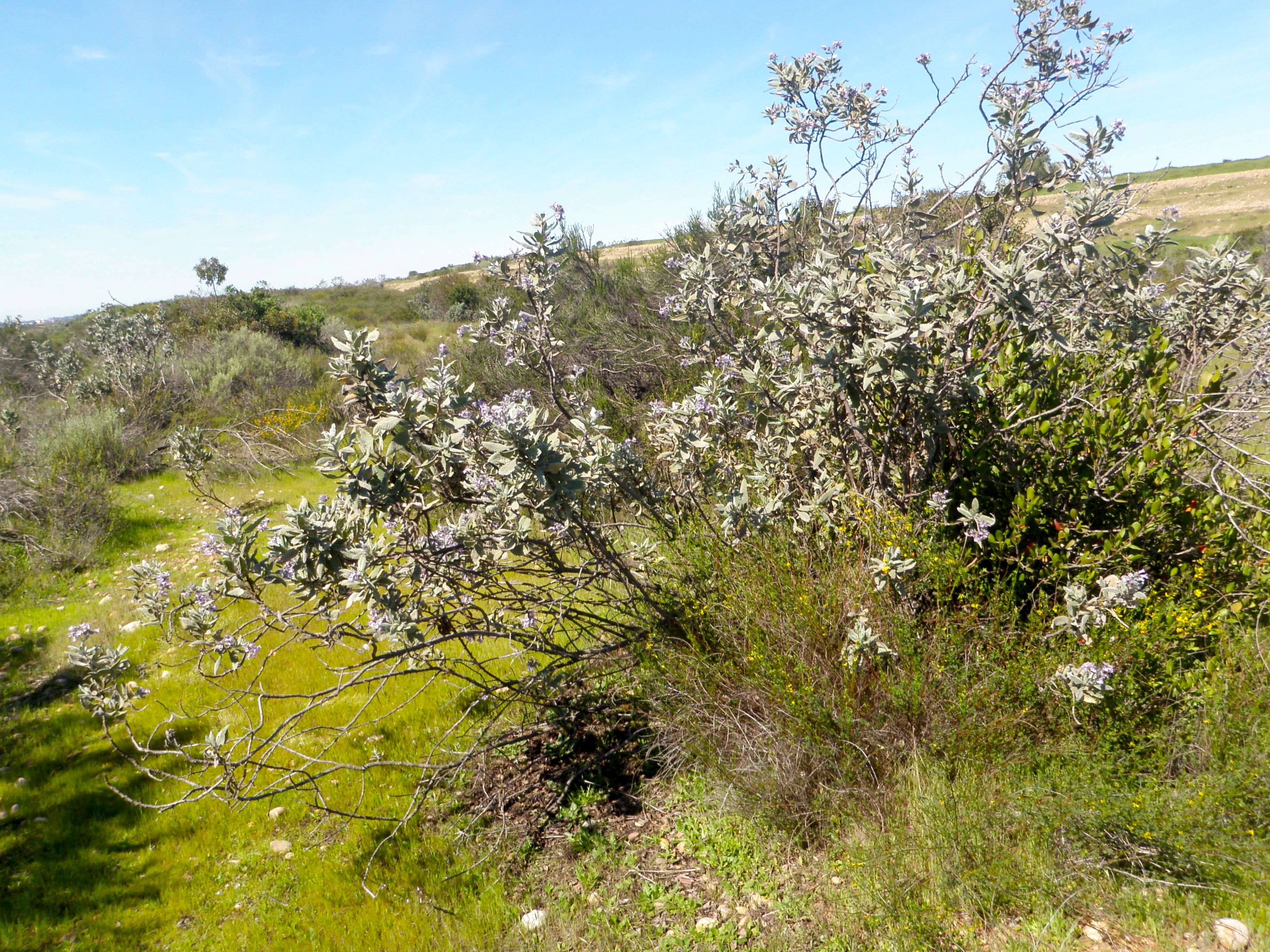
Photo: parent species Eriodictyon crassifolium · Photo by Chez Brungraber
Family: Namaceae · Type: Shrub · Native
Eriodictyon crassifolium var. nigrescens (Bicolored yerba santa) is a native California shrub in the Namaceae family, recognized by . Key features: greenish sticky stems, lanceolate sticky leaves.
Bicolored yerba santa is a California native shrub found in the Tehachapi Mountains, southern Coast Ranges, southern California, western Transverse Ranges, San Gabriel Mountains, and San Jacinto Mountains in slopes, roadsides, washes, river bottoms, mesas, chaparral, and woodland at elevations of 100 to 2,440 meters. Flowering from April to July, this plant produces pale flowers with corollas 6 to 10 millimeters long. Growing with sticky, dull green stems that are moderately hairy and brown, it reaches a moderate height with dense branching. Its lanceolate leaves are sticky between hairs, sparsely to moderately short-hairy on the upper surface, and densely tomentose on the lower surface with prominent net veining. The shrub's distinctive sticky, hairy foliage and pale flowers make it a notable component of its native chaparral and woodland habitats.
Identification and appearance
Key characters: 12 sympatric species. Key features: greenish sticky stems, lanceolate sticky leaves
Habitat and range
Habitat: Slopes, roadsides, washes, river bottoms, mesas, chaparral, woodland
Elevation: 100-2440 m
California counties: Los Angeles, Ventura, Santa Barbara, Riverside, Kern, San Luis Obispo, San Diego
Bloom period
Eriodictyon crassifolium var. nigrescens blooms Apr-Jul.
How to tell it apart
vs Salvia: Eriodictyon has tubular flowers in branched clusters; Salvia has 2-lipped flowers in whorled spikes.; vs Baccharis: Eriodictyon has showy tubular flowers with petals; Baccharis has tiny flowers in fuzzy white/tan heads without petals.; vs Eriogonum: Eriodictyon has tubular flowers with petals; Eriogonum has tiny petal-less flowers in ball-like clusters.; vs Heteromeles: Eriodictyon has tubular flowers; Heteromeles has flat-topped clusters of white 5-petaled flowers with red berries.; vs Pseudognaphalium: Eriodictyon is a woody shrub with tubular flowers; Pseudognaphalium is an herb with fuzzy leaves and papery flower heads.
Frequently asked questions
Is Eriodictyon crassifolium var. nigrescens native to California?
Yes. Eriodictyon crassifolium var. nigrescens is native to California (recorded as native).
When does Eriodictyon crassifolium var. nigrescens bloom?
Eriodictyon crassifolium var. nigrescens blooms Apr-Jul.
Where in California does Eriodictyon crassifolium var. nigrescens grow?
Eriodictyon crassifolium var. nigrescens occurs in Los Angeles, Ventura, Santa Barbara, Riverside, Kern, San Luis Obispo, San Diego, at elevations of 100-2440 m.
What plant family does Eriodictyon crassifolium var. nigrescens belong to?
Eriodictyon crassifolium var. nigrescens is in the Namaceae family, genus Eriodictyon.
What habitat does Eriodictyon crassifolium var. nigrescens grow in?
Eriodictyon crassifolium var. nigrescens grows in Slopes, roadsides, washes, river bottoms, mesas, chaparral, woodland.
Related species
Other California species in the same genus, family, or bioregion.
Sources: Jepson eFlora · Index of California Plant Names · CalPhotos
Last updated 2026-10-07
Data from The California Species Project — 14,000+ California species with verified data from CNPS, CDFW, USFWS, Cal-IPC, and more.