Eriogonum alpinum
Trinity buckwheat
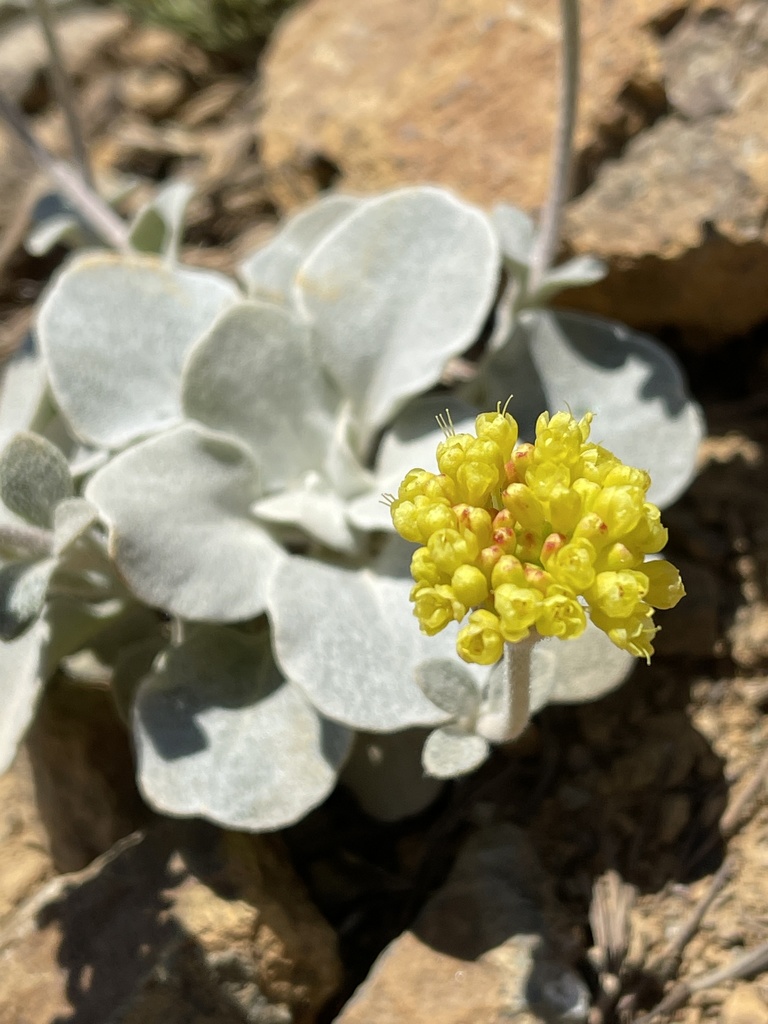
(c) Dee Shea Himes, some rights reserved (CC BY) · licence
Family: Polygonaceae · Type: Subshrub · Native
Conservation status: CNPS 1B.2
Eriogonum alpinum (Trinity buckwheat) is a native California subshrub in the Polygonaceae family, recognized by serpentine habitat, yellow flowers in head-like clusters, and specific Klamath Range location.
Trinity buckwheat is a rare (CNPS 1B.2) California native perennial found in the eastern Klamath Ranges in the Mount Eddy area of southern Siskiyou and northeastern Trinity counties, growing on serpentine terrain at elevations of 2,000 to 2,800 meters. Flowering from July to September, this plant produces bright yellow flowers in compact head-like clusters 1 to 2.5 centimeters wide. Growing as a low, spreading mat only 2 to 6 centimeters tall and up to 10 centimeters in diameter, it forms a dense ground-hugging perennial with sparse tomentose stems. Its basal leaves are nearly round, 1 to 3 centimeters long and covered in a dense white tomentose surface. The plant's distinctive yellow flowers are 4 to 8 millimeters long, with oblong-obovate perianth lobes emerging from small tomentose involucres.
Identification and appearance
Key characters: Co-occurs with 45 species; key features are serpentine habitat, yellow flowers in head-like clusters, and specific Klamath Range location
Habitat and range
Habitat: Serpentine
Elevation: 2000-2800 m
California counties: Siskiyou, Trinity
Bloom period
Eriogonum alpinum blooms Jul-Sep.
Conservation status
CNPS 1B.2
How to tell it apart
vs Adenostoma: Eriogonum has flowers in cup-like involucres; Adenostoma has tiny white rose-family flowers in spikes.; vs Salvia: Eriogonum has six similar perianth parts; Salvia has two-lipped tubular flowers.; vs Fagopyrum: Eriogonum has flowers in involucred clusters; Fagopyrum has loose branching sprays without involucres.; vs Artemisia: Eriogonum has cup-surrounded flower clusters; Artemisia has tiny inconspicuous heads in drooping sprays.; vs Chorizanthe: Eriogonum has multiple flowers per involucre; Chorizanthe has one flower per involucre with spiny teeth.
Frequently asked questions
Is Eriogonum alpinum native to California?
Yes. Eriogonum alpinum is native to California (recorded as native).
When does Eriogonum alpinum bloom?
Eriogonum alpinum blooms Jul-Sep.
Where in California does Eriogonum alpinum grow?
Eriogonum alpinum occurs in Siskiyou, Trinity, at elevations of 2000-2800 m.
What plant family does Eriogonum alpinum belong to?
Eriogonum alpinum is in the Polygonaceae family, genus Eriogonum.
Is Eriogonum alpinum rare or endangered?
Eriogonum alpinum carries California Rare Plant Rank 1B.2, state rank S2.
Related species
Other California species in the same genus, family, or bioregion.
Sources: Jepson eFlora · CNPS Rare Plant Inventory · Index of California Plant Names · CalPhotos · CDFW CNDDB
Last updated 2026-10-07
Data from The California Species Project — 14,000+ California species with verified data from CNPS, CDFW, USFWS, Cal-IPC, and more.