Eriogonum angulosum
Angle-stem wild buckwheat
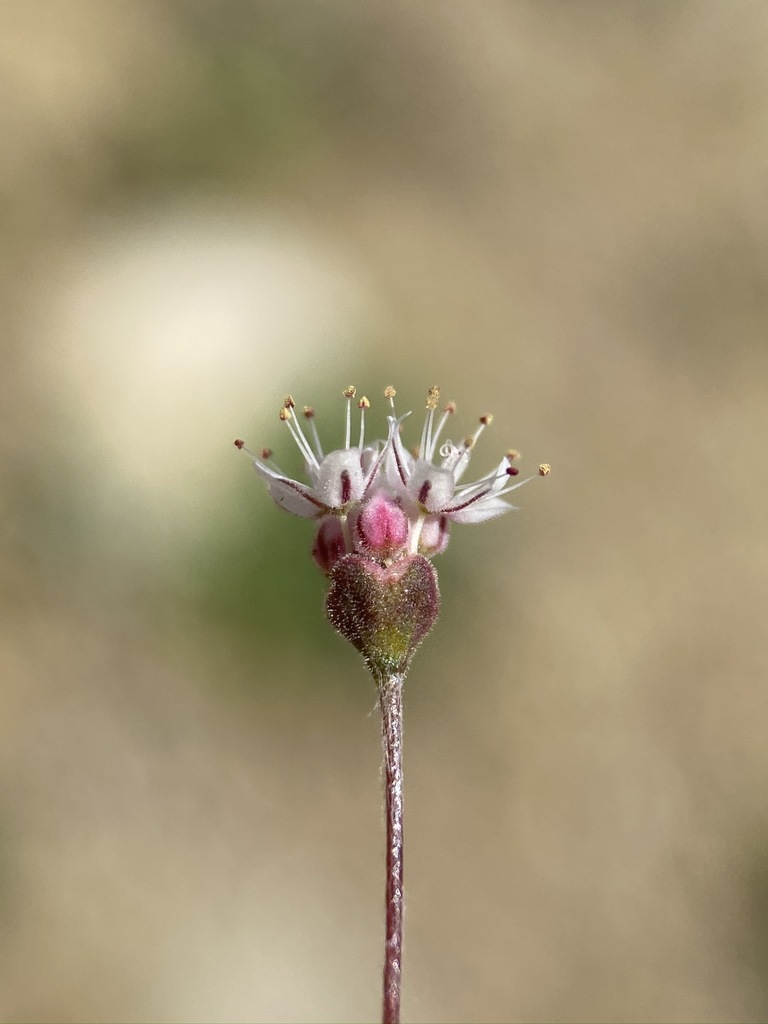
(c) Matt Berger, some rights reserved (CC BY), uploaded by Matt Berger · licence
Family: Polygonaceae · Type: Herb · Native
Eriogonum angulosum (Angle-stem wild buckwheat) is a native California herb in the Polygonaceae family, recognized by angled stems, clay habitat preference, and inflated outer flower segments.
Angle-stem wild buckwheat is a California native annual found in the central Sierra Nevada Foothills, Tehama County, San Joaquin Valley, Central West, Transverse Ranges, southern Peninsular Ranges, and western Mojave Desert in clay habitats at elevations below 800 meters. Flowering throughout the year, this plant produces white to rose-colored flowers that are small and delicate, with perianth lobes typically elliptic to obovate. Growing 1 to 5 decimeters tall with generally tomentose stems that are 0.5 to 1 decimeter long, it has a slender and erect growth habit. Its leaves are both basal and stem-based, with blades 1 to 4 centimeters long and 0.5 to 1 centimeter wide, covered in a soft, woolly tomentose texture. The inflorescence is expansive, reaching 5 to 80 centimeters long and 10 to 60 centimeters wide, with branches that are generally tomentose to slightly glabrous.
Identification and appearance
Key characters: Co-occurs with 123 species; key features are angled stems, clay habitat preference, and inflated outer flower segments
Habitat and range
Habitat: Common. Clay
Elevation: < 800 m
California counties: Kern, Ventura, San Diego, San Bernardino, Los Angeles, Tulare, San Benito, San Luis Obispo, Fresno, Monterey, San Joaquin, Alameda, Stanislaus, Santa Barbara, Contra Costa, Kings, Riverside, Merced, Santa Clara, Inyo, Madera
Bloom period
Eriogonum angulosum blooms All year.
How to tell it apart
vs Adenostoma: Eriogonum has flowers in cup-like involucres; Adenostoma has tiny white rose-family flowers in spikes.; vs Salvia: Eriogonum has six similar perianth parts; Salvia has two-lipped tubular flowers.; vs Fagopyrum: Eriogonum has flowers in involucred clusters; Fagopyrum has loose branching sprays without involucres.; vs Artemisia: Eriogonum has cup-surrounded flower clusters; Artemisia has tiny inconspicuous heads in drooping sprays.; vs Chorizanthe: Eriogonum has multiple flowers per involucre; Chorizanthe has one flower per involucre with spiny teeth.
Frequently asked questions
Is Eriogonum angulosum native to California?
Yes. Eriogonum angulosum is native to California (recorded as native).
When does Eriogonum angulosum bloom?
Eriogonum angulosum blooms All year.
Where in California does Eriogonum angulosum grow?
Eriogonum angulosum occurs in Kern, Ventura, San Diego, San Bernardino, Los Angeles, Tulare, San Benito, San Luis Obispo and other counties, at elevations of < 800 m.
What plant family does Eriogonum angulosum belong to?
Eriogonum angulosum is in the Polygonaceae family, genus Eriogonum.
What habitat does Eriogonum angulosum grow in?
Eriogonum angulosum grows in Common. Clay.
Related species
Other California species in the same genus, family, or bioregion.
Sources: Jepson eFlora · Index of California Plant Names · CalPhotos
Last updated 2026-10-07
Data from The California Species Project — 14,000+ California species with verified data from CNPS, CDFW, USFWS, Cal-IPC, and more.