Eriogonum elatum var. elatum
Tall wild buckwheat
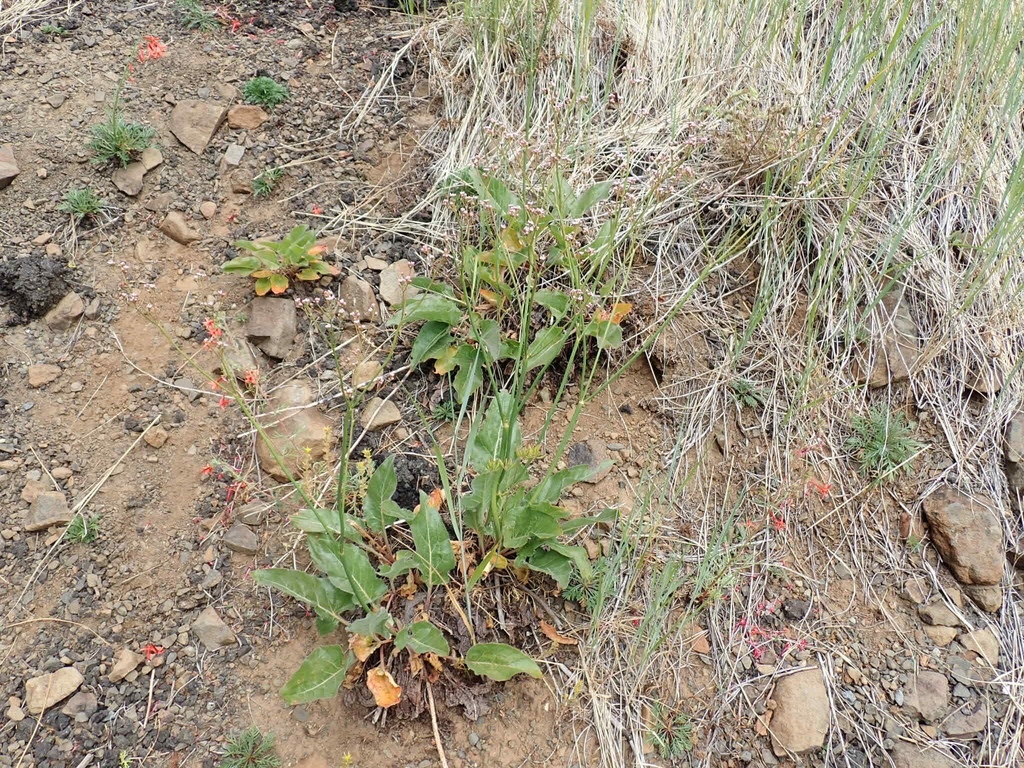
Photo: parent species Eriogonum elatum · (c) John Brew, some rights reserved (CC BY) · licence
Family: Polygonaceae · Type: Subshrub · Native
Eriogonum elatum var. elatum (Tall wild buckwheat) is a native California subshrub in the Polygonaceae family, recognized by glabrous stems distinguish from var. villosum, large size from most annuals.
Tall wild buckwheat is a California native perennial found in northern California in sandy or gravelly habitats at elevations of 600 to 3,000 meters. Flowering from May to October, this plant produces white to cream-colored flowers in distinctive branching clusters. Growing with erect stems 30 to 100 centimeters tall, it forms an open and relatively tall structure characteristic of its species. Its leaves are typically arranged near the base of the plant, with green to grayish blades that support the plant's adaptation to open, dry environments. The plant is notable for its glabrous (smooth and hairless) stems and inflorescence, which contribute to its clean, architectural appearance in its native landscape.
Identification and appearance
Key characters: 220 sympatric species; glabrous stems distinguish from var. villosum, large size from most annuals
Habitat and range
Habitat: Common. Sand or gravel
Elevation: 600-3000 m
California counties: Modoc, Mono, Plumas, Siskiyou, Lassen, Alpine, Tulare, El Dorado, Inyo, Kern, Nevada, Sierra, Trinity, Placer
Outside California: to Washington, Idaho, central Nevada
Bloom period
Eriogonum elatum var. elatum blooms May-Oct.
How to tell it apart
vs Adenostoma: Eriogonum has flowers in cup-like involucres; Adenostoma has tiny white rose-family flowers in spikes.; vs Salvia: Eriogonum has six similar perianth parts; Salvia has two-lipped tubular flowers.; vs Fagopyrum: Eriogonum has flowers in involucred clusters; Fagopyrum has loose branching sprays without involucres.; vs Artemisia: Eriogonum has cup-surrounded flower clusters; Artemisia has tiny inconspicuous heads in drooping sprays.; vs Chorizanthe: Eriogonum has multiple flowers per involucre; Chorizanthe has one flower per involucre with spiny teeth.
Frequently asked questions
Is Eriogonum elatum var. elatum native to California?
Yes. Eriogonum elatum var. elatum is native to California (recorded as native).
When does Eriogonum elatum var. elatum bloom?
Eriogonum elatum var. elatum blooms May-Oct.
Where in California does Eriogonum elatum var. elatum grow?
Eriogonum elatum var. elatum occurs in Modoc, Mono, Plumas, Siskiyou, Lassen, Alpine, Tulare, El Dorado and other counties, at elevations of 600-3000 m.
What plant family does Eriogonum elatum var. elatum belong to?
Eriogonum elatum var. elatum is in the Polygonaceae family, genus Eriogonum.
What habitat does Eriogonum elatum var. elatum grow in?
Eriogonum elatum var. elatum grows in Common. Sand or gravel.
Related species
Other California species in the same genus, family, or bioregion.
- Eriogonum elatum var. villosum — Tall woolly wild buckwheat
- Eriogonum elegans — Elegant wild buckwheat
- Eriogonum elongatum var. elongatum — Long-stem wild buckwheat
- Eriogonum eremicola — Wildrose canyon buckwheat
- Eriogonum esmeraldense var. esmeraldense — Esmeralda wild buckwheat
- Eriogonum evanidum — Vanishing wild buckwheat
Sources: Jepson eFlora · Index of California Plant Names · CalPhotos
Last updated 2026-10-07
Data from The California Species Project — 14,000+ California species with verified data from CNPS, CDFW, USFWS, Cal-IPC, and more.