Eriogonum luteolum var. caninum
Tiburon buckwheat
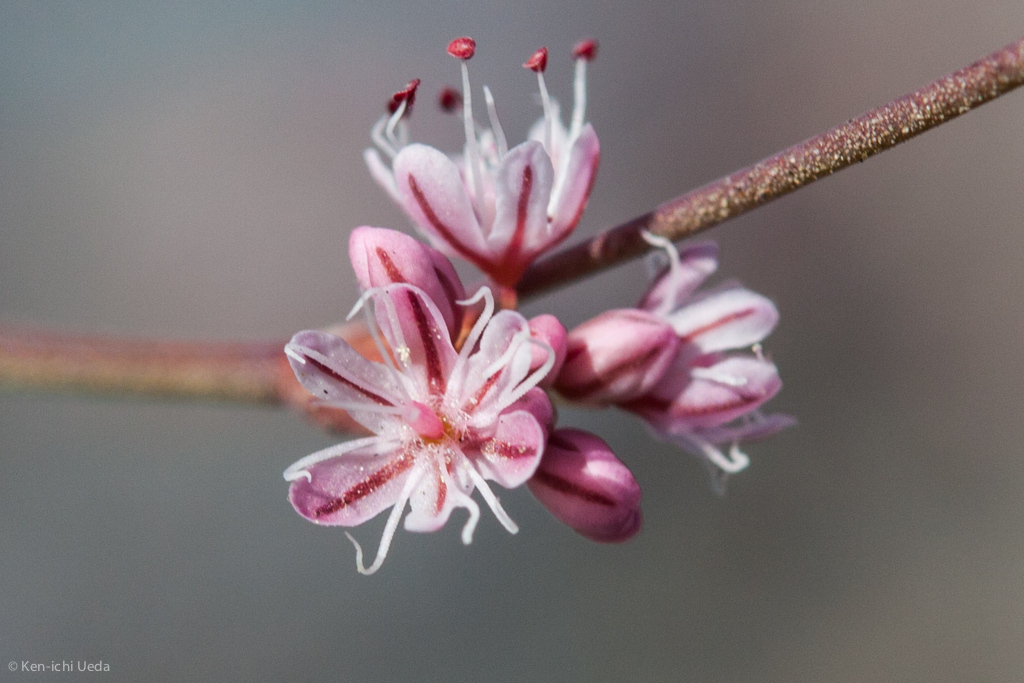
(c) Ken-ichi Ueda, some rights reserved (CC BY), uploaded by Ken-ichi Ueda · licence
Family: Polygonaceae · Type: Herb · Native
Conservation status: CNPS 1B.2
Eriogonum luteolum var. caninum (Tiburon buckwheat) is a native California herb in the Polygonaceae family, recognized by . Key features: Bay Area serpentine, annual, prostrate habit.
Tiburon buckwheat is a rare (CNPS 1B.2) California native annual found in central northern Coast Range Interior, northern Coast, and northern San Francisco Bay regions including Colusa, Marin, and Alameda counties, growing on serpentine landscapes at elevations below 700 meters. Flowering from May to October, this plant produces delicate white to rose-colored flowers in small clusters approximately 1.5 to 2.5 millimeters long. Growing with generally prostrate to weakly erect stems 2 to 10 centimeters tall, it forms low-spreading patches across its serpentine habitat. Its leaves are both basal and along the stem, with wide blades that provide ground-hugging coverage. The small fruits measure 1.4 to 1.6 millimeters, complementing the plant's diminutive and understated form.
Identification and appearance
Key characters: 39 sympatric species. Key features: Bay Area serpentine, annual, prostrate habit
Habitat and range
Habitat: Serpentine
Elevation: < 700 m
California counties: Marin, Alameda, Solano, Contra Costa, Sonoma, Monterey, Santa Barbara, Mendocino, Sierra, San Mateo, Napa
Bloom period
Eriogonum luteolum var. caninum blooms May-Oct.
Conservation status
CNPS 1B.2
How to tell it apart
vs Adenostoma: Eriogonum has flowers in cup-like involucres; Adenostoma has tiny white rose-family flowers in spikes.; vs Salvia: Eriogonum has six similar perianth parts; Salvia has two-lipped tubular flowers.; vs Fagopyrum: Eriogonum has flowers in involucred clusters; Fagopyrum has loose branching sprays without involucres.; vs Artemisia: Eriogonum has cup-surrounded flower clusters; Artemisia has tiny inconspicuous heads in drooping sprays.; vs Chorizanthe: Eriogonum has multiple flowers per involucre; Chorizanthe has one flower per involucre with spiny teeth.
Frequently asked questions
Is Eriogonum luteolum var. caninum native to California?
Yes. Eriogonum luteolum var. caninum is native to California (recorded as native).
When does Eriogonum luteolum var. caninum bloom?
Eriogonum luteolum var. caninum blooms May-Oct.
Where in California does Eriogonum luteolum var. caninum grow?
Eriogonum luteolum var. caninum occurs in Marin, Alameda, Solano, Contra Costa, Sonoma, Monterey, Santa Barbara, Mendocino and other counties, at elevations of < 700 m.
What plant family does Eriogonum luteolum var. caninum belong to?
Eriogonum luteolum var. caninum is in the Polygonaceae family, genus Eriogonum.
Is Eriogonum luteolum var. caninum rare or endangered?
Eriogonum luteolum var. caninum carries California Rare Plant Rank 1B.2, state rank S2.
Related species
Other California species in the same genus, family, or bioregion.
- Eriogonum luteolum var. luteolum — Golden-carpet wild buckwheat
- Eriogonum luteolum var. pedunculatum — Mokelumne hill wild buckwheat
- Eriogonum luteolum var. saltuarium — Jack's wild buckwheat
- Eriogonum maculatum — Spotted wild buckwheat
- Eriogonum marifolium — Marum leaved buckwheat
- Eriogonum marifolium var. cupulatum — Mccloud wild buckwheat
Sources: Jepson eFlora · CNPS Rare Plant Inventory · Index of California Plant Names · CalPhotos · CDFW CNDDB
Last updated 2026-10-07
Data from The California Species Project — 14,000+ California species with verified data from CNPS, CDFW, USFWS, Cal-IPC, and more.