Erodium brachycarpum
Foothill filaree
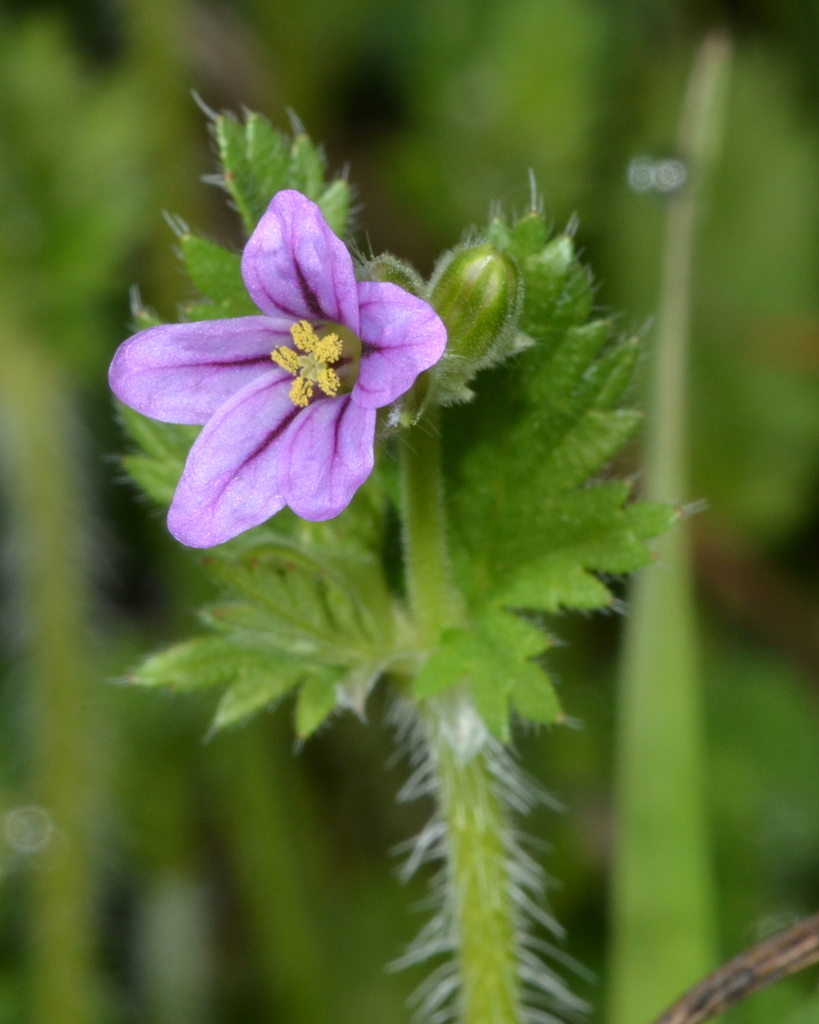
(c) Don Loarie, some rights reserved (CC BY), uploaded by Don Loarie · licence
Family: Geraniaceae · Type: Herb · Not Native
Erodium brachycarpum (Foothill filaree) is a non-native California herb in the Geraniaceae family, recognized by simple lobed leaves vs compound, round fruit pits, intermediate flower size.
Foothill filaree is a naturalized annual found in the California Floristic Province in dry, open or disturbed sites at elevations below 1,000 meters. Flowering from March to July, this plant produces delicate pink flowers with darker pink veins, each petal slightly larger than the bristly-tipped sepals. Growing with ascending stems 10 to 60 centimeters tall that are slightly glandular-hairy, it spreads across open ground with a branching habit. Its leaves are deeply lobed with segments 7 to 11 millimeters wide, forming an ovate outline with veins that are short and appressed-hairy. The distinctive fruit develops a body 6 to 8 millimeters long, featuring round pits and a style column extending 5 to 8 centimeters.
Identification and appearance
Key characters: 6 sympatric species; key features are simple lobed leaves vs compound, round fruit pits, intermediate flower size
Habitat and range
Habitat: Dry, open or disturbed sites
Elevation: < 1000 m
California counties: San Luis Obispo, Butte, Kern, Los Angeles, Orange, Santa Barbara, Riverside, Fresno, Ventura, Santa Clara, Humboldt, Sonoma, Marin, San Diego, Napa, Tuolumne, Amador, Santa Cruz, San Joaquin, San Francisco, Madera, Tulare, San Bernardino, Yuba, Colusa, Monterey, Mariposa, El Dorado, Sacramento, Placer, Solano, Tehama, Alameda, Sutter, Glenn, Merced, Stanislaus, Contra Costa, Kings, Shasta, Trinity, Lake, San Mateo, San Benito, Yolo, Mendocino
Outside California: Oregon, native to southern Europe
Bloom period
Erodium brachycarpum blooms Mar-Jul.
How to tell it apart
vs Geranium: Erodium leaves are pinnately divided like a feather; Geranium leaves are palmately divided like spread fingers.; vs Phacelia: Erodium has umbrella-like flower clusters and long-beaked fruits; Phacelia has coiled flower clusters and rounded capsules.; vs Malva: Erodium has pinnately-divided leaves and 5 petals; Malva has palmately-lobed leaves and many stamens fused in a column.; vs Sisyrinchium: Erodium has feathery divided leaves and pink umbel flowers; Sisyrinchium has grasslike leaves and blue-purple iris-like flowers.; vs Pelargonium: Erodium is herbaceous with pinnately-divided leaves; Pelargonium is shrubby with asymmetrical flowers.
Frequently asked questions
Is Erodium brachycarpum native to California?
No. Erodium brachycarpum is not native to California (recorded as not native).
When does Erodium brachycarpum bloom?
Erodium brachycarpum blooms Mar-Jul.
Where in California does Erodium brachycarpum grow?
Erodium brachycarpum occurs in San Luis Obispo, Butte, Kern, Los Angeles, Orange, Santa Barbara, Riverside, Fresno and other counties, at elevations of < 1000 m.
What plant family does Erodium brachycarpum belong to?
Erodium brachycarpum is in the Geraniaceae family, genus Erodium.
What habitat does Erodium brachycarpum grow in?
Erodium brachycarpum grows in Dry, open or disturbed sites.
Related species
Other California species in the same genus, family, or bioregion.
Sources: Jepson eFlora · Index of California Plant Names · CalPhotos
Last updated 2026-10-07
Data from The California Species Project — 14,000+ California species with verified data from CNPS, CDFW, USFWS, Cal-IPC, and more.