Eryngium spinosepalum
Spiny-sepaled button-celery
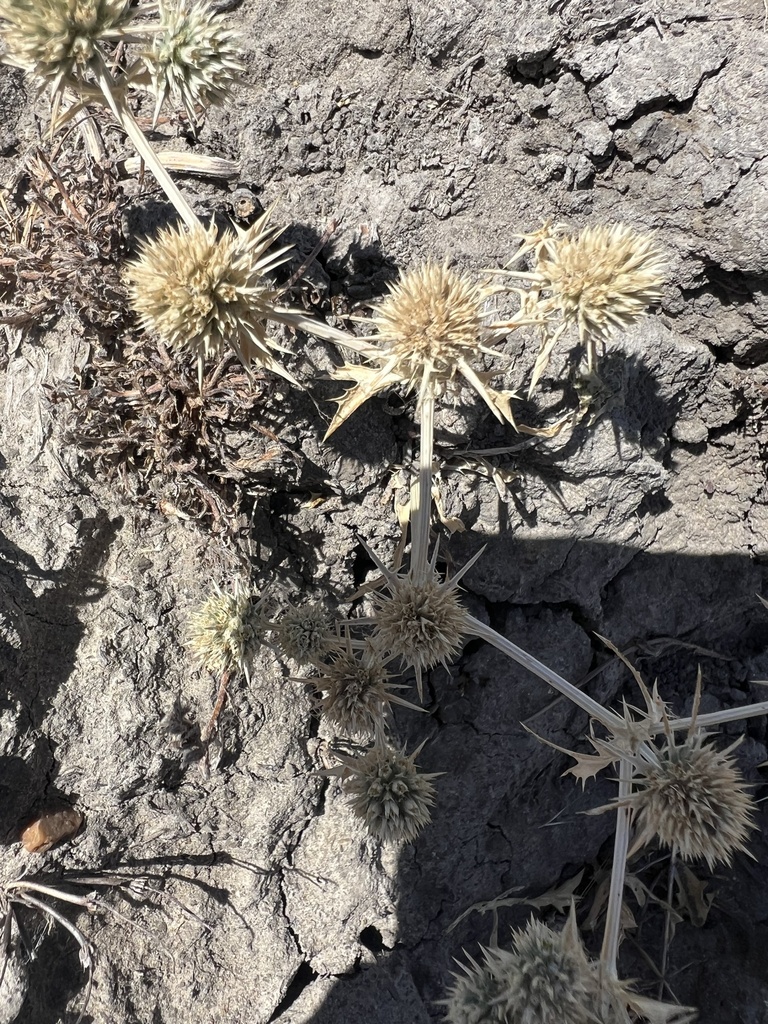
(c) nmoorhatch, some rights reserved (CC BY) · licence
Family: Apiaceae · Type: Herb · Native
Conservation status: CNPS 1B.2
Eryngium spinosepalum (Spiny-sepaled button-celery) is a native California herb in the Apiaceae family, recognized by sepal division pattern diagnostic.
Spiny-sepaled button-celery is a rare (CNPS 1B.2) California native perennial found in southern Sierra Nevada foothills and San Joaquin Valley in vernal pools, swales, and roadside ditches at elevations of 100 to 1,270 meters. Flowering from April to July, this plant produces white flowers in dense, spheric heads 0.8 to 2 centimeters wide with distinctive spiny bracts. Growing with erect, stout stems 30 to 75 centimeters tall that branch about 2 to 5 centimeters above the basal rosette, it has a robust and architectural form. Its leaves are large and complex, with oblong to oblanceolate blades 9 to 35 centimeters long that are pinnately lobed and significantly longer than their short petioles. The fruit is a small, narrowly elliptic structure 2.5 to 3 millimeters long, covered in dense, unequal scales.
Identification and appearance
Key characters: 4 sympatric species; sepal division pattern diagnostic
Habitat and range
Habitat: Vernal pools, swales, roadside ditches
Elevation: 100-1270 m
California counties: Fresno, Tulare, Monterey, Merced, Kern, San Luis Obispo, Contra Costa, Stanislaus, Madera
Bloom period
Eryngium spinosepalum blooms Apr-Jul.
Conservation status
CNPS 1B.2
How to tell it apart
vs Navarretia: Eryngium has compact button-like heads; Navarretia has looser clusters with spine-tipped bracts radiating outward.; vs Dipsacus: Eryngium flower heads are round or cylindrical when young; teasel heads are elongated egg-shaped from the start.; vs Cirsium: Eryngium leaves are firm and waxy; thistle leaves are softer with white woolly undersides.; vs Plantago: Eryngium grows in wetlands with spiny bracts under each flower; plantain has ribbed leaves and lacks spiny bracts.; vs Sanicula: Eryngium has a single bract under each flower and a thistle-like appearance; Sanicula lacks individual bracts.
Frequently asked questions
Is Eryngium spinosepalum native to California?
Yes. Eryngium spinosepalum is native to California (recorded as native).
When does Eryngium spinosepalum bloom?
Eryngium spinosepalum blooms Apr-Jul.
Where in California does Eryngium spinosepalum grow?
Eryngium spinosepalum occurs in Fresno, Tulare, Monterey, Merced, Kern, San Luis Obispo, Contra Costa, Stanislaus and other counties, at elevations of 100-1270 m.
What plant family does Eryngium spinosepalum belong to?
Eryngium spinosepalum is in the Apiaceae family, genus Eryngium.
Is Eryngium spinosepalum rare or endangered?
Eryngium spinosepalum carries California Rare Plant Rank 1B.2, state rank S2.
Related species
Other California species in the same genus, family, or bioregion.
Sources: Jepson eFlora · CNPS Rare Plant Inventory · Index of California Plant Names · CalPhotos · CDFW CNDDB
Last updated 2026-10-07
Data from The California Species Project — 14,000+ California species with verified data from CNPS, CDFW, USFWS, Cal-IPC, and more.