Erythranthe diffusa
Palomar monkeyflower
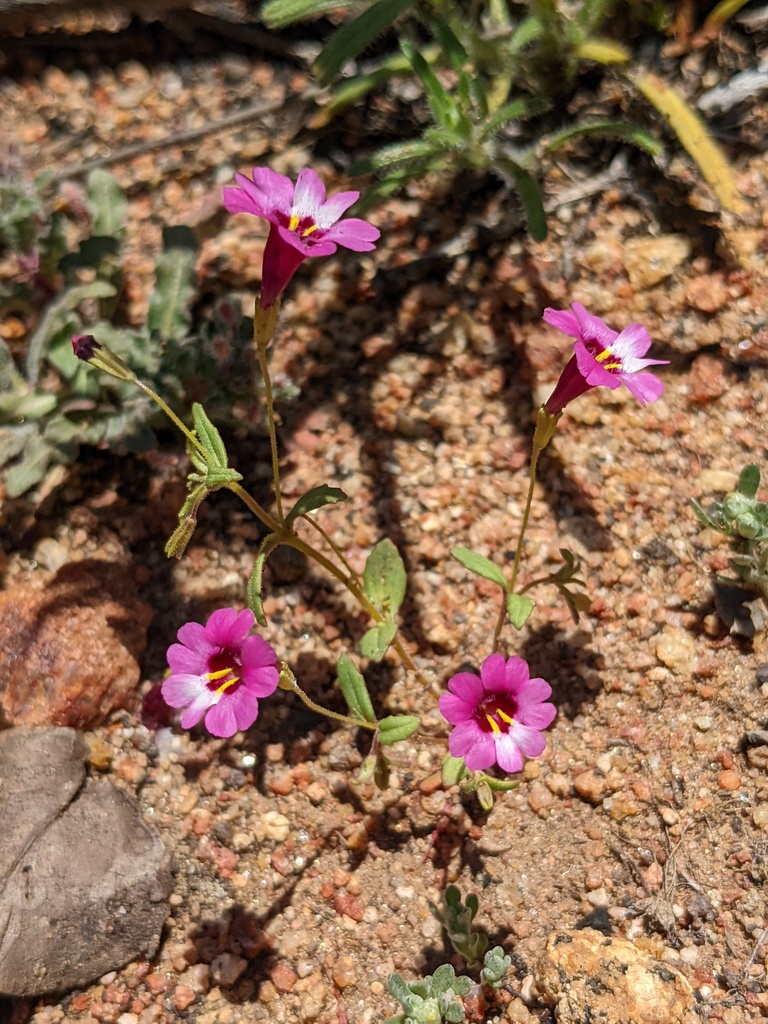
(c) Trevor Van Loon, some rights reserved (CC BY) · licence
Family: Phrymaceae · Type: Herb · Native
Conservation status: CNPS 4.3
Erythranthe diffusa (Palomar monkeyflower) is a native California herb in the Phrymaceae family, recognized by pink to purple flowers with long, often horizontally spreading flower stalks.
Palomar monkeyflower is a California native annual herb found in the southern California mountains in openings of chaparral and meadows within pine and oak woodlands at elevations of 300 to 2,100 meters. Flowering from April to June, this delicate plant produces pink to purple flowers with notched petals and slender pedicels that spread horizontally as they mature. Growing with tiny puberulent stems 1 to 19 centimeters tall, it forms a compact and delicate annual form. Its leaves are small and variable, ranging from linear-oblanceolate to ovate, measuring 2 to 18 millimeters long and 1 to 10 millimeters wide. The fruit capsules are 3 to 6 millimeters long, developing within a membranous calyx with small, acute lobes.
Identification and appearance
Key characters: Geographically isolated; pink to purple flowers with long, often horizontally spreading flower stalks
Habitat and range
Habitat: Openings in chaparral, meadows in pine and oak woodland, generally in granitic soils
Elevation: 300-2100 m
Outside California: northern Baja California
Bloom period
Erythranthe diffusa blooms Apr-Jun.
Conservation status
CNPS 4.3
Frequently asked questions
Is Erythranthe diffusa native to California?
Yes. Erythranthe diffusa is native to California (recorded as native).
When does Erythranthe diffusa bloom?
Erythranthe diffusa blooms Apr-Jun.
What plant family does Erythranthe diffusa belong to?
Erythranthe diffusa is in the Phrymaceae family, genus Erythranthe.
Is Erythranthe diffusa rare or endangered?
Erythranthe diffusa carries California Rare Plant Rank 4.3, state rank S3.
What habitat does Erythranthe diffusa grow in?
Erythranthe diffusa grows in Openings in chaparral, meadows in pine and oak woodland, generally in granitic soils.
Related species
Other California species in the same genus, family, or bioregion.
- Erythranthe discolor — Two-colored monkeyflower
- Erythranthe erubescens — California blushing monkeyflower
- Erythranthe exigua — San bernardino mountains monkeyflower
- Erythranthe filicaulis — Slender-stemmed monkeyflower
- Erythranthe filicifolia — Fernleaf monkeyflower
- Erythranthe floribunda — Many-flowered monkeyflower
Sources: Jepson eFlora · CDFW CNDDB
Last updated 2026-10-07
Data from The California Species Project — 14,000+ California species with verified data from CNPS, CDFW, USFWS, Cal-IPC, and more.