Erythranthe nasuta
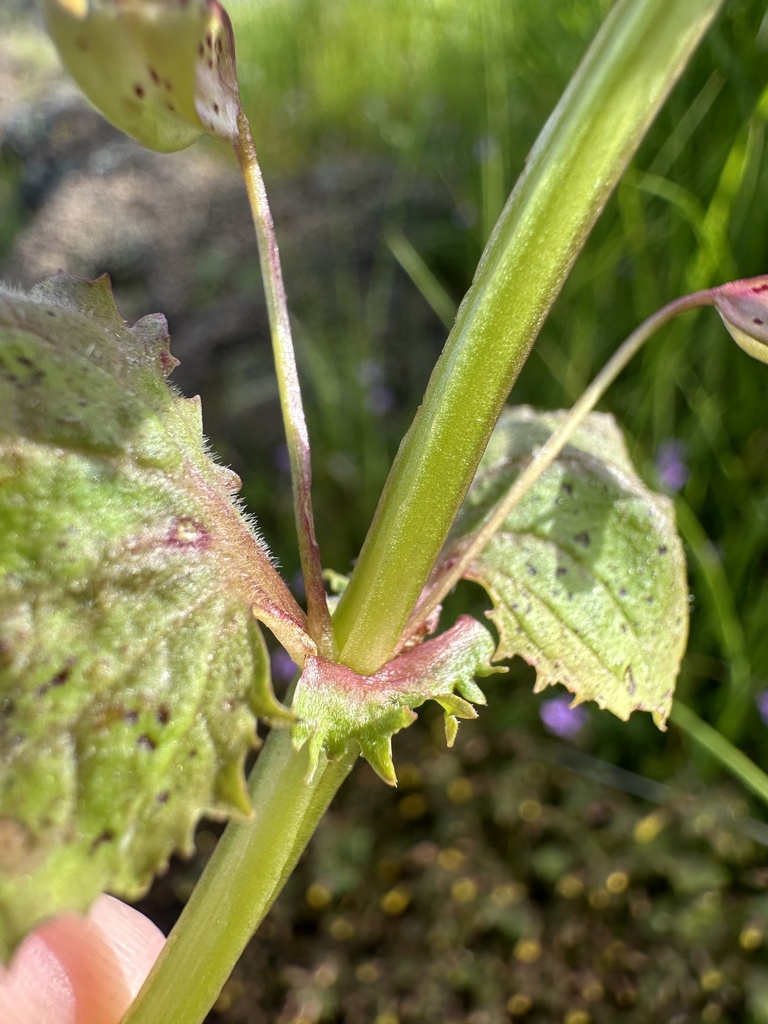
(c) Matt Berger, some rights reserved (CC BY) · licence
Family: Phrymaceae · Type: Annual · Native
Erythranthe nasuta is a native California annual in the Phrymaceae family, recognized by annual with flowers distributed from base to top.
Erythranthe nasuta is a native annual herb found in seeps, rock outcrops, streams, and creeks at elevations of 600 to 3,200 meters. Flowering from March to July, this plant produces yellow flowers with a tube-throat 8 to 12 millimeters long, emerging just slightly beyond the calyx. Growing 2 to 35 centimeters tall with fibrous roots, it has an essentially smooth stem with glandular hairs near the nodes. Its leaves are elliptic to ovate, 3 to 25 millimeters long, with petioles 3 to 35 millimeters in length and pairs of leaves at each node that remain unfused. Fruits develop 4 to 10 millimeters long, with a calyx that becomes asymmetrically swollen, featuring unequal lobes with the lowest two curving upward.
Identification and appearance
Key characters: Geographically isolated; annual with flowers distributed from base to top
Habitat and range
Habitat: Seeps in rock outcrops, streams and creeks
Elevation: 600-3200 m
Outside California: to western Canada, Idaho, Utah, New Mexico, Baja California
Bloom period
Erythranthe nasuta blooms Mar-Jul.
Frequently asked questions
Is Erythranthe nasuta native to California?
Yes. Erythranthe nasuta is native to California (recorded as native).
When does Erythranthe nasuta bloom?
Erythranthe nasuta blooms Mar-Jul.
What plant family does Erythranthe nasuta belong to?
Erythranthe nasuta is in the Phrymaceae family, genus Erythranthe.
What habitat does Erythranthe nasuta grow in?
Erythranthe nasuta grows in Seeps in rock outcrops, streams and creeks.
Related species
Other California species in the same genus, family, or bioregion.
Sources: Jepson eFlora
Last updated 2026-10-06
Data from The California Species Project — 14,000+ California species with verified data from CNPS, CDFW, USFWS, Cal-IPC, and more.