Erythranthe palmeri
Palmer's monkeyflower
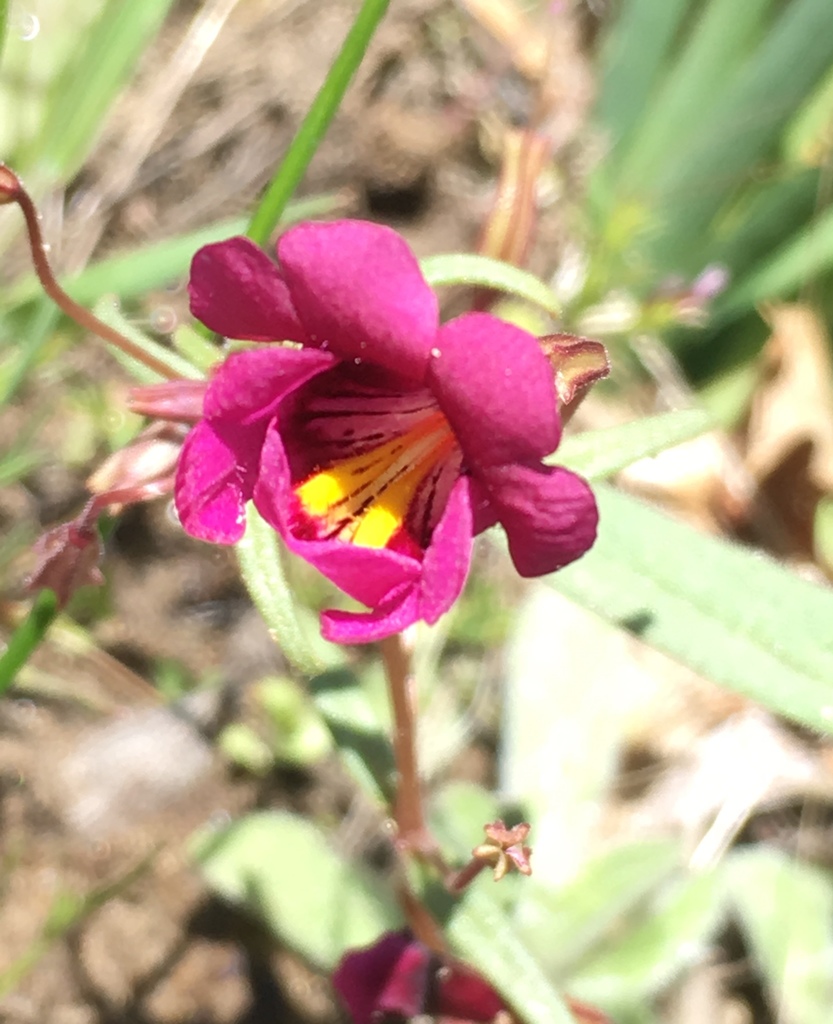
(c) Matt Berger, some rights reserved (CC BY) · licence
Family: Phrymaceae · Type: Herb · Native
Erythranthe palmeri (Palmer's monkeyflower) is a native California herb in the Phrymaceae family, recognized by pink/purple flowers and linear leaves.
Palmer's monkeyflower is a California native annual found in southern Sierra Nevada Foothills, Tehachapi, northern South Coast Ranges, Transverse Ranges, Peninsular Ranges, and western Desert Mountains on granitic soils in vernally wet depressions and creek edges at elevations of 1,000 to 2,200 meters. Flowering from April to July, this delicate plant produces deep pink to purple flowers with yellow throat folds, marked with variable darker patterns. Growing with slender stems 4 to 17 centimeters tall and slightly hairy, the plant has a compact and modest form. Its leaves are narrow, ranging from 3 to 17 millimeters long, linear to lanceolate and entirely edged. The flower pedicels extend 4 to 32 millimeters, with calyx lobes that are small, acute, and delicately ciliate.
Identification and appearance
Key characters: 20 sympatric species; distinguished by pink/purple flowers and linear leaves
Habitat and range
Habitat: Granitic soils in vernally wet depressions, edges of creeks
Elevation: 1000-2200 m
Outside California: northern Baja California.
Bloom period
Erythranthe palmeri blooms Apr-Jul.
Frequently asked questions
Is Erythranthe palmeri native to California?
Yes. Erythranthe palmeri is native to California (recorded as native).
When does Erythranthe palmeri bloom?
Erythranthe palmeri blooms Apr-Jul.
What plant family does Erythranthe palmeri belong to?
Erythranthe palmeri is in the Phrymaceae family, genus Erythranthe.
What habitat does Erythranthe palmeri grow in?
Erythranthe palmeri grows in Granitic soils in vernally wet depressions, edges of creeks.
Related species
Other California species in the same genus, family, or bioregion.
Sources: Jepson eFlora · CalPhotos
Last updated 2026-10-07
Data from The California Species Project — 14,000+ California species with verified data from CNPS, CDFW, USFWS, Cal-IPC, and more.