Erythranthe primuloides
Primrose monkeyflower
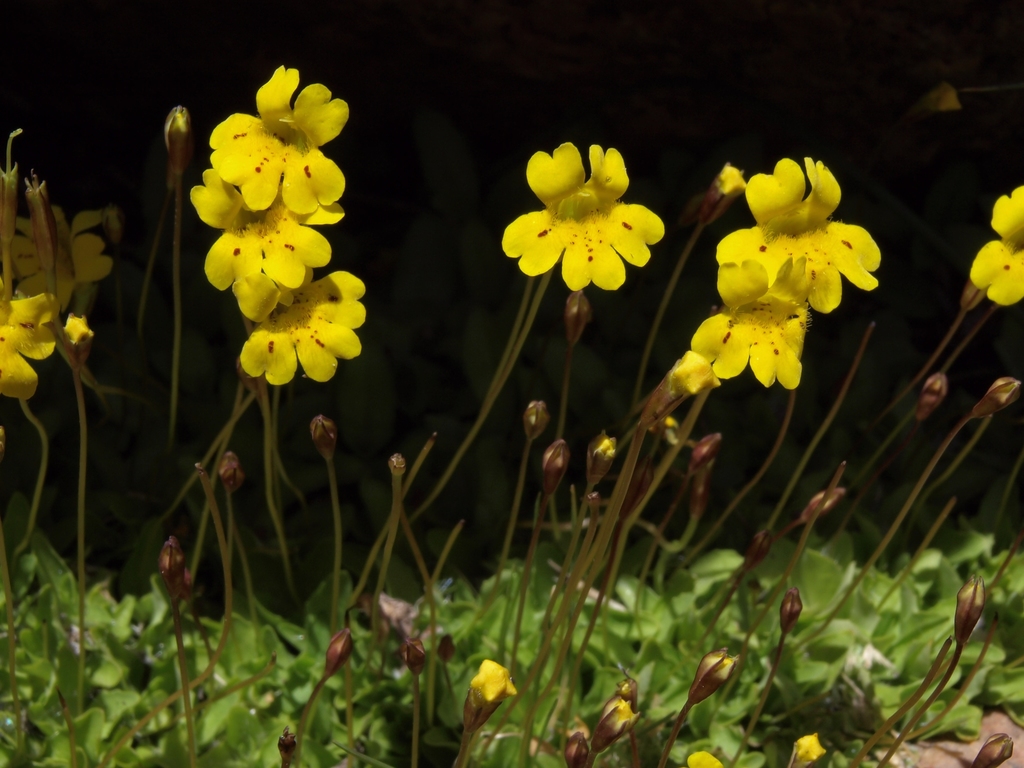
(c) Jim Morefield, some rights reserved (CC BY) · licence
Family: Phrymaceae · Type: Herb · Native
Erythranthe primuloides (Primrose monkeyflower) is a native California herb in the Phrymaceae family, recognized by distinctive rosette growth and palmately veined leaves.
Primrose monkeyflower is a California native perennial found in northwestern California, the Cascade Range, Sierra Nevada, western Transverse Ranges, San Bernardino Mountains, San Jacinto Mountains, and Great Basin in wet meadows, seeps, and streambanks at elevations of 600 to 3,400 meters. Flowering from June to August, this plant produces yellow flowers with distinctive red spots at the base of the lower lip, borne on stiffly erect pedicels 10 to 120 millimeters long. Growing in low mats of distinct rosettes with rhizomes or stolons, the plant forms small bulblets in autumn and reaches heights of 0.5 to 4 centimeters. Its leaves are palmately three-veined, oblong to obovate, 7 to 40 millimeters long, and generally spreading in rosettes that are glabrous to densely long-hairy. The fruit is 6 to 7 millimeters long, complementing the plant's delicate alpine and meadow habitat.
Identification and appearance
Key characters: 29 sympatric species; distinctive rosette growth and palmately veined leaves
Habitat and range
Habitat: Wet meadows, seeps, streambanks
Elevation: 600-3400 m
Outside California: to Washington, Nevada
Bloom period
Erythranthe primuloides blooms Jun-Aug.
Frequently asked questions
Is Erythranthe primuloides native to California?
Yes. Erythranthe primuloides is native to California (recorded as native).
When does Erythranthe primuloides bloom?
Erythranthe primuloides blooms Jun-Aug.
What plant family does Erythranthe primuloides belong to?
Erythranthe primuloides is in the Phrymaceae family, genus Erythranthe.
What habitat does Erythranthe primuloides grow in?
Erythranthe primuloides grows in Wet meadows, seeps, streambanks.
Related species
Other California species in the same genus, family, or bioregion.
Sources: Jepson eFlora · Index of California Plant Names · CalPhotos
Last updated 2026-10-07
Data from The California Species Project — 14,000+ California species with verified data from CNPS, CDFW, USFWS, Cal-IPC, and more.