Erythranthe rubella
Redstem monkeyflower
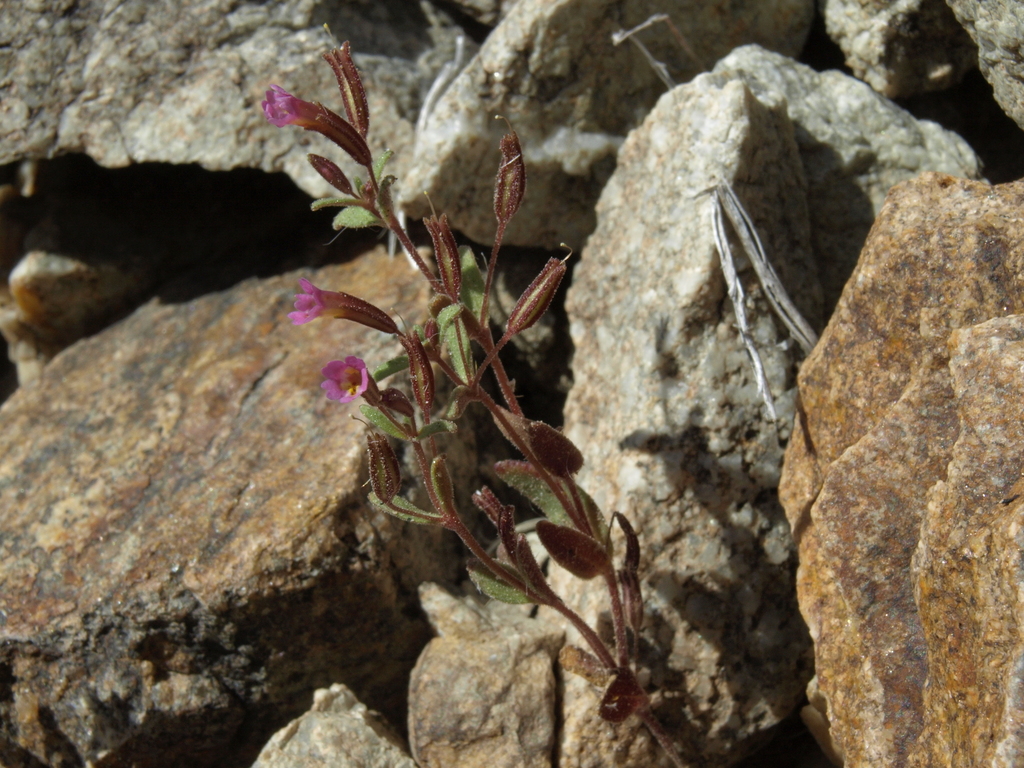
(c) Jim Morefield, some rights reserved (CC BY) · licence
Family: Phrymaceae · Type: Herb · Native
Erythranthe rubella (Redstem monkeyflower) is a native California herb in the Phrymaceae family, recognized by small corolla limb and brown-ribbed calyx.
Redstem monkeyflower is a California native annual found in the Tehachapi, Great Basin, and Desert Mountains in and around washes at elevations of 800 to 2,600 meters. Flowering from April to June, this plant produces yellow or purple-magenta flowers with a tube-throat 6 to 10 millimeters long and a delicate limb 3 to 4 millimeters wide. Growing with slender stems 2 to 32 centimeters tall and minutely puberulent throughout, it has a delicate and compact form. Its leaves range from 3 to 31 millimeters long and 1 to 5 millimeters wide, varying from linear to elliptic, with proximal leaves slightly petioled and distal leaves sessile. The fruit is 3.5 to 7 millimeters long, developing from ascending pedicels that emerge from a glandular-puberulent calyx with rounded, ciliate lobes.
Identification and appearance
Key characters: 16 sympatric species; key features are small corolla limb and brown-ribbed calyx
Habitat and range
Habitat: Generally around washes
Elevation: 800-2600 m
Outside California: to Wyoming, New Mexico, northern Baja California
Bloom period
Erythranthe rubella blooms Apr-Jun.
Frequently asked questions
Is Erythranthe rubella native to California?
Yes. Erythranthe rubella is native to California (recorded as native).
When does Erythranthe rubella bloom?
Erythranthe rubella blooms Apr-Jun.
What plant family does Erythranthe rubella belong to?
Erythranthe rubella is in the Phrymaceae family, genus Erythranthe.
What habitat does Erythranthe rubella grow in?
Erythranthe rubella grows in Generally around washes.
Related species
Other California species in the same genus, family, or bioregion.
Sources: Jepson eFlora · CalPhotos
Last updated 2026-10-07
Data from The California Species Project — 14,000+ California species with verified data from CNPS, CDFW, USFWS, Cal-IPC, and more.