Erythronium taylorii
Pilot ridge fawn lily, Pilot Ridge Fawn Lily
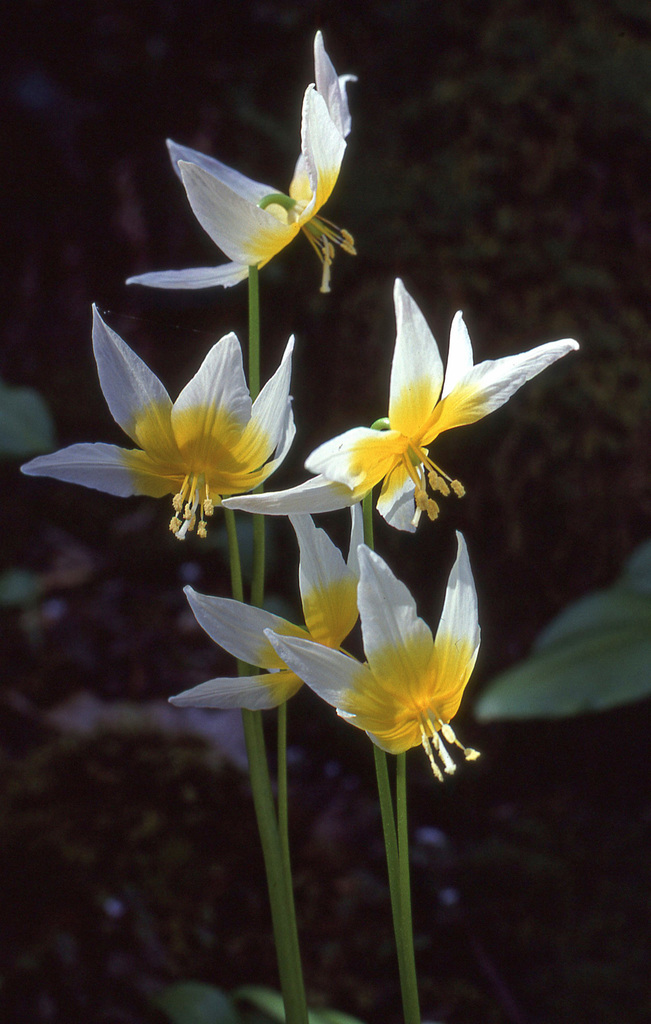
(c) Ed Alverson, some rights reserved (CC BY) · licence
Family: Liliaceae · Type: Herb · Native
Conservation status: CNPS 1B.2
Erythronium taylorii (Pilot ridge fawn lily) is a native California herb in the Liliaceae family, recognized by cream anthers vs yellow anthers of relatives.
Pilot ridge fawn lily is a rare (CNPS 1B.2) California native perennial found in central Sierra Nevada Mountains (Tuolumne County) in forest openings and rocky ledges at elevations of 1,300 to 1,400 meters. Flowering from March to May, this plant produces white flowers with a bright yellow lower third and delicate pink tinge, displaying elegant lanceolate perianth parts 25 to 45 millimeters long. Growing with slender green stems and a narrow bulb 40 to 70 millimeters tall, it emerges from rocky terrain with graceful presence. Its leaves are 18 to 35 centimeters long, elliptic to lanceolate in shape, displaying a distinctive wavy margin and vibrant green coloration. The flower features ten slender yellow stamens and a white to cream-colored style, creating a delicate and intricate botanical display.
Identification and appearance
Key characters: 3 sympatric species; cream anthers vs yellow anthers of relatives
Habitat and range
Habitat: Forest openings, rocky ledges
Elevation: 1300-1400 m
California counties: Tuolumne
Bloom period
Erythronium taylorii blooms Mar-May.
Conservation status
CNPS 1B.2
How to tell it apart
vs Lilium: Erythronium has two mottled basal leaves; Lilium has unmottled leaves arranged in whorls up the stem.; vs Scoliopus: Erythronium has nodding flowers with reflexed petals; Scoliopus has upright flowers with twisted, purple-striped petals.; vs Sparaxis: Erythronium has two basal leaves and nodding flowers; Sparaxis has grass-like leaves and upright flowers.; vs Fritillaria: Erythronium has mottled basal leaves; Fritillaria has unmottled narrow leaves arranged up the stem.; vs Tulipa: Erythronium has mottled leaves and nodding flowers with reflexed petals; Tulipa has plain leaves and upright cup-shaped flowers.
Frequently asked questions
Is Erythronium taylorii native to California?
Yes. Erythronium taylorii is native to California (recorded as native).
When does Erythronium taylorii bloom?
Erythronium taylorii blooms Mar-May.
Where in California does Erythronium taylorii grow?
Erythronium taylorii occurs in Tuolumne, at elevations of 1300-1400 m.
What plant family does Erythronium taylorii belong to?
Erythronium taylorii is in the Liliaceae family, genus Erythronium.
Is Erythronium taylorii rare or endangered?
Erythronium taylorii carries California Rare Plant Rank 1B.2, state rank S1.
Related species
Other California species in the same genus, family, or bioregion.
- Erythronium tuolumnense — Tuolumne fawn lily
- Erythronium californicum — California fawn lily
- Erythronium citrinum — Cream fawnlily
- Erythronium citrinum var. citrinum — Lemon-colored fawn lily
- Erythronium citrinum var. roderickii — Scott mountains fawn lily
- Erythronium grandiflorum subsp. grandiflorum — Glacier lily
- Fritillaria affinis — Checker lily
- Fritillaria agrestis — Stinkbells
- Fritillaria atropurpurea — Mountain fritillary
Sources: Jepson eFlora · CNPS Rare Plant Inventory · Index of California Plant Names · CalPhotos · CDFW CNDDB
Last updated 2026-10-07
Data from The California Species Project — 14,000+ California species with verified data from CNPS, CDFW, USFWS, Cal-IPC, and more.