Euphorbia ocellata subsp. arenicola
Dune spurge, Dune Spurge
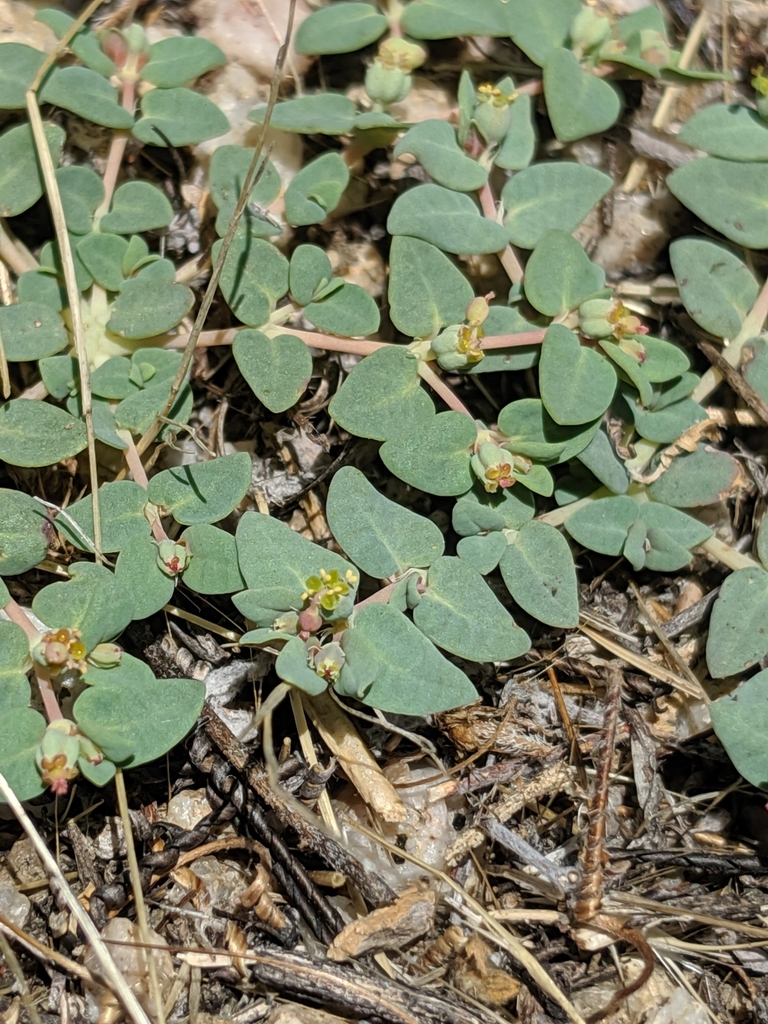
no rights reserved, uploaded by Alex Heyman · CC0
Family: Euphorbiaceae · Type: Herb · Native
Euphorbia ocellata subsp. arenicola (Dune spurge) is a native California herb in the Euphorbiaceae family, recognized by lack of gland appendages.
Dune spurge is a California native annual found in the southern Coast Ranges in sandy places at elevations below 800 meters. Flowering from May to September, this plant produces small, inconspicuous flowers with no notable color description. Growing with slender, glabrous stems less than 15 centimeters tall, it has a delicate, spreading habit. Its leaves are small, typically lanceolate to ovate and measuring up to 15 millimeters long, creating a sparse, open structure. The plant is characterized by its adaptation to sandy coastal environments, blending seamlessly into dune landscapes.
Identification and appearance
Key characters: 23 sympatric species; key feature is lack of gland appendages
Habitat and range
Habitat: Sandy places
Elevation: < 800 m
California counties: Los Angeles, Riverside, Fresno, Inyo
Outside California: to Utah, Arizona
Bloom period
Euphorbia ocellata subsp. arenicola blooms May-Sep.
How to tell it apart
vs Croton: Euphorbia bleeds milky white latex and packs its flowers into a tiny cup (cyathium) rimmed with nectar glands; Croton has watery sap, stellate or scaly hairs, and ordinary small separate male and female flowers.; vs Stillingia: Euphorbia flowers sit in a gland-bearing cyathium; Stillingia bears its flowers in a spike with a pair of glands flanking each subtending bract and has no cyathium cup.; vs Ditaxis: Euphorbia has latex and the cyathium; Ditaxis has clear sap, 5-parted petaled male and female flowers, and 2-forked (malpighiaceous) hairs.; vs Asclepias: Both ooze milky sap, but Euphorbia's minute flowers cluster in a cyathium and ripen into a 3-lobed capsule; milkweeds have showy 5-parted flowers with a crown and paired follicles of plumed seeds.; vs Polygonum: Prostrate mat spurges leak milky sap when torn and have paired stipules with opposite leaves at the nodes; knotweeds have clear sap and a papery sheath (ocrea) wrapping each node.
Frequently asked questions
Is Euphorbia ocellata subsp. arenicola native to California?
Yes. Euphorbia ocellata subsp. arenicola is native to California (recorded as native).
When does Euphorbia ocellata subsp. arenicola bloom?
Euphorbia ocellata subsp. arenicola blooms May-Sep.
Where in California does Euphorbia ocellata subsp. arenicola grow?
Euphorbia ocellata subsp. arenicola occurs in Los Angeles, Riverside, Fresno, Inyo, at elevations of < 800 m.
What plant family does Euphorbia ocellata subsp. arenicola belong to?
Euphorbia ocellata subsp. arenicola is in the Euphorbiaceae family, genus Euphorbia.
What habitat does Euphorbia ocellata subsp. arenicola grow in?
Euphorbia ocellata subsp. arenicola grows in Sandy places.
Related species
Other California species in the same genus, family, or bioregion.
Sources: Jepson eFlora · Index of California Plant Names · CalPhotos
Last updated 2026-10-07
Data from The California Species Project — 14,000+ California species with verified data from CNPS, CDFW, USFWS, Cal-IPC, and more.