Eurybia radulina
Roughleaf aster
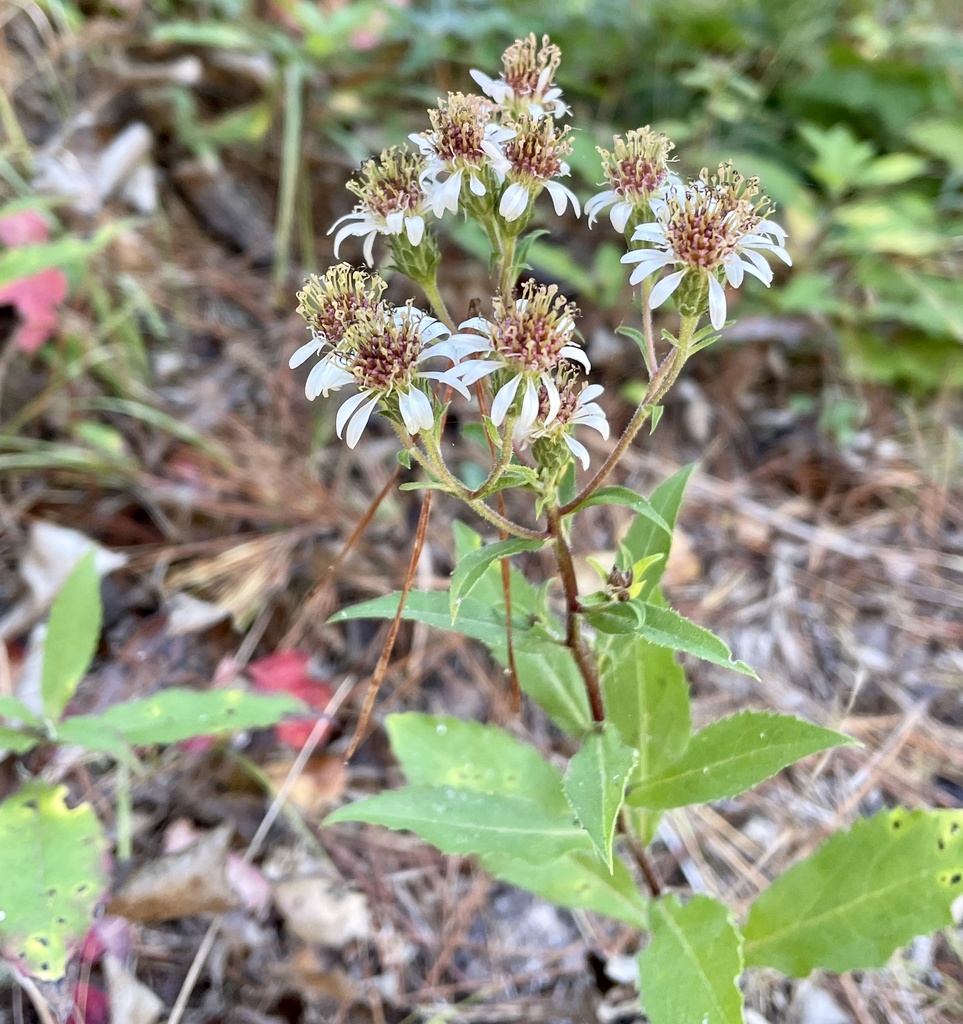
no rights reserved · CC0
Family: Asteraceae · Type: Subshrub · Native
Eurybia radulina (Roughleaf aster) is a native California subshrub in the Asteraceae family, recognized by . Key features: scabrous leaves, lower elevation, white to pale violet rays.
Roughleaf aster is a California native perennial found in northwestern California, the Cascade Range, northern and central Sierra Nevada, San Francisco Bay Area, southern Coast Ranges, and northern Channel Islands in dry forest, oak and pine woodlands, and brushy slopes at elevations of 100 to 1,600 meters. Flowering from July to September, this plant produces white to pale violet ray flowers in clusters, creating delicate daisy-like bloom heads 8 to 13 millimeters long. Growing with ascending to erect stems 10 to 70 centimeters tall, it has dense long soft wavy hairs covering its stems. Its cauline leaves are ovate to elliptic, 3 to 8 centimeters long, with coarsely serrated edges and a wedge-shaped base that often clasps the stem, feeling rough to the touch on the upper surface. The plant spreads through somewhat woody rhizomes, with outer phyllaries that are green in the distal third and sometimes purple-margined.
Identification and appearance
Key characters: 2 sympatric species. Key features: scabrous leaves, lower elevation, white to pale violet rays
Habitat and range
Habitat: dry forest, oak/pine woodland, brushy slopes
Elevation: 100-1600 m
California counties: Humboldt, Tuolumne, Sonoma, Del Norte, Plumas, San Luis Obispo, Shasta, Placer, Amador, Calaveras, Contra Costa, El Dorado, Lake, Mariposa, Napa, San Francisco, Santa Barbara, Nevada, Sierra, Trinity, Yuba, Alameda, Santa Clara, Butte, Santa Cruz, San Mateo, Siskiyou, Marin, Mendocino, Monterey, Tehama, Solano, Lassen, Madera, Yolo, San Benito
Outside California: to British Columbia
Bloom period
Eurybia radulina blooms Jul-Sep.
How to tell it apart
vs Symphyotrichum: Symphyotrichum has all-green bracts; Eurybia has two-toned bracts with white bases; vs Aster: Aster typically refers to Symphyotrichum; check if bracts have white bases for Eurybia; vs Erigeron: Erigeron has many thread-like rays; Eurybia has fewer broader rays and two-toned bracts; vs Chaetopappa: Chaetopappa is a tiny 2-6 inch desert plant; Eurybia is robust and forest-dwelling; vs Almutaster: Almutaster has all-green bracts and grows in alkaline meadows; Eurybia has two-toned bracts
Frequently asked questions
Is Eurybia radulina native to California?
Yes. Eurybia radulina is native to California (recorded as native).
When does Eurybia radulina bloom?
Eurybia radulina blooms Jul-Sep.
Where in California does Eurybia radulina grow?
Eurybia radulina occurs in Humboldt, Tuolumne, Sonoma, Del Norte, Plumas, San Luis Obispo, Shasta, Placer and other counties, at elevations of 100-1600 m.
What plant family does Eurybia radulina belong to?
Eurybia radulina is in the Asteraceae family, genus Eurybia.
What habitat does Eurybia radulina grow in?
Eurybia radulina grows in dry forest, oak/pine woodland, brushy slopes.
Related species
Other California species in the same genus, family, or bioregion.
Sources: Jepson eFlora · Index of California Plant Names · CalPhotos
Last updated 2026-10-07
Data from The California Species Project — 14,000+ California species with verified data from CNPS, CDFW, USFWS, Cal-IPC, and more.