Extriplex joaquinana
San joaquin spearscale, San Joaquin Spearscale
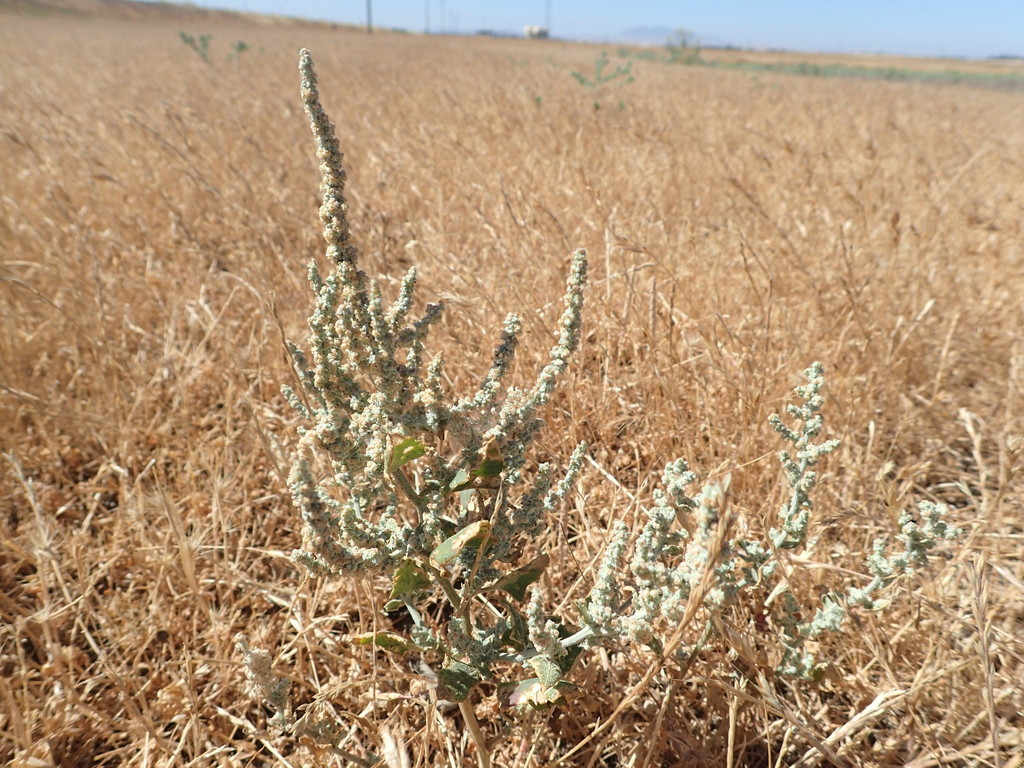
no rights reserved, uploaded by rockybajada · CC0
Family: Chenopodiaceae · Type: Herb · Native
Conservation status: CNPS 1B.2
Extriplex joaquinana (San joaquin spearscale) is a native California herb in the Chenopodiaceae family, recognized by . Key differences: plant size, leaf size/margins, habitat, CNPS rare status.
San joaquin spearscale is a rare (CNPS 1B.2) California native annual found in northern coastal interior California, the Great Valley, central coastal California, San Francisco Bay Area, and southern coastal interior eastern slopes in alkaline soils at elevations below 350 meters. Flowering from April to September, this plant produces white to green flowers with fine scales that become glabrous with age. Growing 1 to 10 decimeters tall with irregularly wavy-dentate leaves that have truncate to tapered bases, the plant features petioled leaves that become progressively smaller toward the stem tips. Its leaves measure 10 to 70 millimeters long, with distinctive irregular wave-like edges and a fine scaling that diminishes as the plant matures. The small dark brown to black seeds are approximately 1 to 1.5 millimeters in size.
Identification and appearance
Key characters: 1 sympatric species. Key differences: plant size, leaf size/margins, habitat, CNPS rare status
Habitat and range
Habitat: Alkaline soils
Elevation: < 350(840) m
California counties: Yolo, Alameda, Contra Costa, San Benito, Colusa
Bloom period
Extriplex joaquinana blooms Apr-Sep.
Conservation status
CNPS 1B.2
How to tell it apart
vs Atriplex: Extriplex has exactly 4 calyx lobes on male flowers and uniform dark seeds; Atriplex has 3-5 lobes and two seed colors.; vs Suaeda: Extriplex has flat scaly leaves; Suaeda has smooth cylindrical succulent leaves.; vs Acmispon: Extriplex has scaly leaves and wind-pollinated flowers; Acmispon has compound leaves and showy yellow pea flowers.; vs Cressa: Extriplex has scaly saltbush foliage; Cressa has small gray leaves and white funnel-shaped flowers.; vs Lavandula: Extriplex has greenish wind-pollinated flowers; Lavandula has showy purple spikes of fragrant tubular flowers.
Frequently asked questions
Is Extriplex joaquinana native to California?
Yes. Extriplex joaquinana is native to California (recorded as native).
When does Extriplex joaquinana bloom?
Extriplex joaquinana blooms Apr-Sep.
Where in California does Extriplex joaquinana grow?
Extriplex joaquinana occurs in Yolo, Alameda, Contra Costa, San Benito, Colusa, at elevations of < 350(840) m.
What plant family does Extriplex joaquinana belong to?
Extriplex joaquinana is in the Chenopodiaceae family, genus Extriplex.
Is Extriplex joaquinana rare or endangered?
Extriplex joaquinana carries California Rare Plant Rank 1B.2, state rank S2.
Related species
Other California species in the same genus, family, or bioregion.
Sources: Jepson eFlora · CNPS Rare Plant Inventory · Index of California Plant Names · CalPhotos · CDFW CNDDB
Last updated 2026-10-07
Data from The California Species Project — 14,000+ California species with verified data from CNPS, CDFW, USFWS, Cal-IPC, and more.