Fallopia convolvulus
Black bindweed
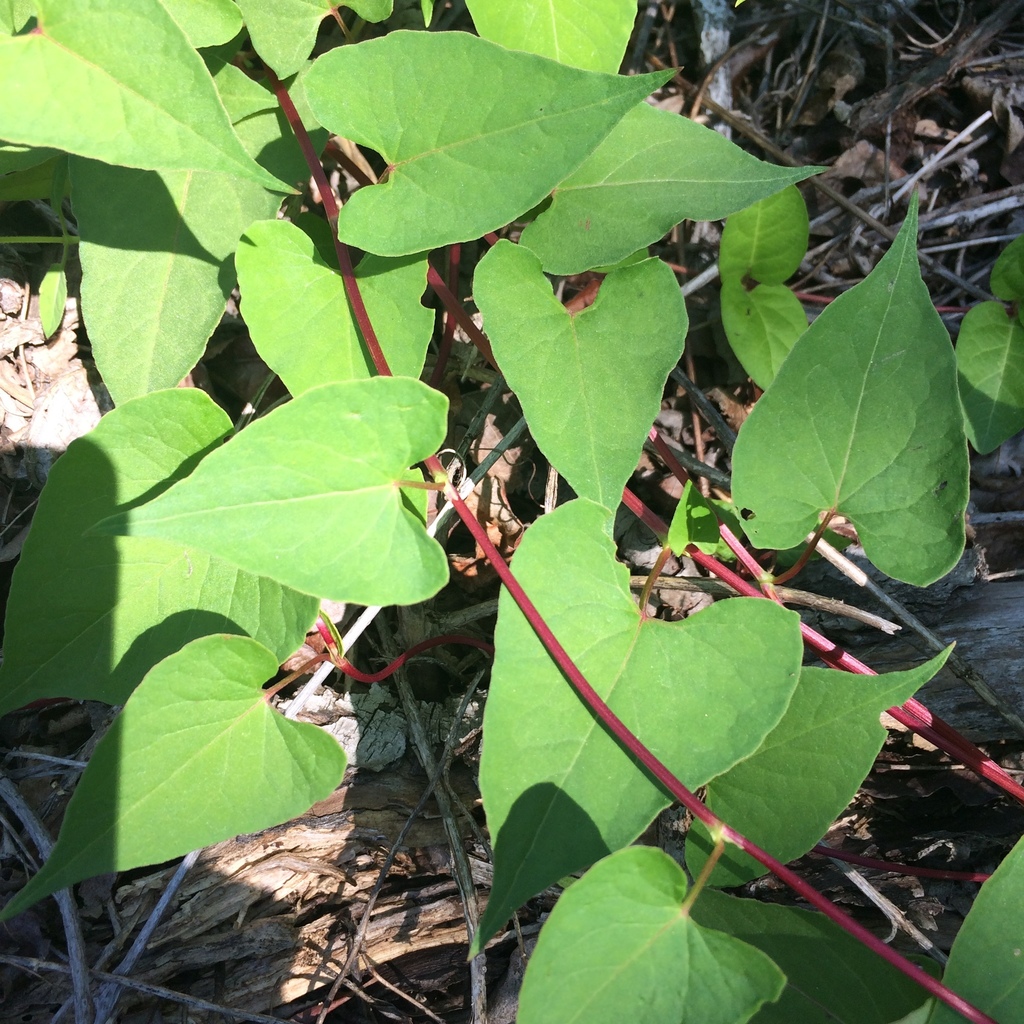
(c) Dilrukshan Priyantha Wijesinghe, some rights reserved (CC BY), uploaded by Dilrukshan Priyantha Wijesinghe · licence
Family: Polygonaceae · Type: Annual · Not Native
Fallopia convolvulus (Black bindweed) is a non-native California annual in the Polygonaceae family, recognized by only annual with black, granular-tubercled fruits.
Black bindweed is a naturalized annual found in California's Foothills and Mountains and North Coast Ranges in disturbed places at elevations below 1,000 meters. Flowering from May to December, this plant produces small green-white flowers with a pinkish base, clustered in spike-like inflorescences up to 10 centimeters long. Growing with trailing or twining stems 40 to 120 centimeters long that are lightly hairy, it spreads across ground or climbs nearby vegetation. Its leaves are roughly ovate, 2 to 6 centimeters long with distinctive hastate or sagittate bases, varying from smooth to slightly rough-textured. The mature fruit is small, black, and minutely granular, measuring 4 to 5 millimeters long.
Identification and appearance
Key characters: 3 sympatric species; only annual with black, granular-tubercled fruits
Habitat and range
Habitat: Disturbed places
Elevation: < 1000 m
California counties: Los Angeles, Sonoma, Alpine, Butte, Del Norte, Fresno, Humboldt, Kern, Lake, Lassen, Mendocino, Placer, San Bernardino, San Mateo, Santa Barbara, Santa Clara, Ventura, Yuba, Marin, Monterey, Plumas, San Francisco, Siskiyou, El Dorado, San Luis Obispo, San Diego, Riverside, Mariposa, Shasta, Yolo, Mono, Santa Cruz
Outside California: to eastern North America, native to Europe
Bloom period
Fallopia convolvulus blooms May-Dec.
How to tell it apart
vs Sonchus: Fallopia has smooth-edged leaves; Sonchus has deeply lobed leaves with prickly edges and milky sap.; vs Oxyria: Fallopia is a climbing vine; Oxyria is an upright herb with kidney-shaped basal leaves.; vs Bistorta: Fallopia climbs with heart-shaped leaves; Bistorta grows upright with dense flower spikes.; vs Persicaria: Fallopia is a climbing vine; Persicaria is upright or sprawling, not climbing.; vs Aconogonon: Fallopia climbs; Aconogonon forms upright clumps in high mountains.
Frequently asked questions
Is Fallopia convolvulus native to California?
No. Fallopia convolvulus is not native to California (recorded as not native).
When does Fallopia convolvulus bloom?
Fallopia convolvulus blooms May-Dec.
Where in California does Fallopia convolvulus grow?
Fallopia convolvulus occurs in Los Angeles, Sonoma, Alpine, Butte, Del Norte, Fresno, Humboldt, Kern and other counties, at elevations of < 1000 m.
What plant family does Fallopia convolvulus belong to?
Fallopia convolvulus is in the Polygonaceae family, genus Fallopia.
What habitat does Fallopia convolvulus grow in?
Fallopia convolvulus grows in Disturbed places.
Related species
Other California species in the same genus, family, or bioregion.
Sources: Jepson eFlora · Index of California Plant Names · CalPhotos
Last updated 2026-10-06
Data from The California Species Project — 14,000+ California species with verified data from CNPS, CDFW, USFWS, Cal-IPC, and more.