Festuca occidentalis
Western fescue
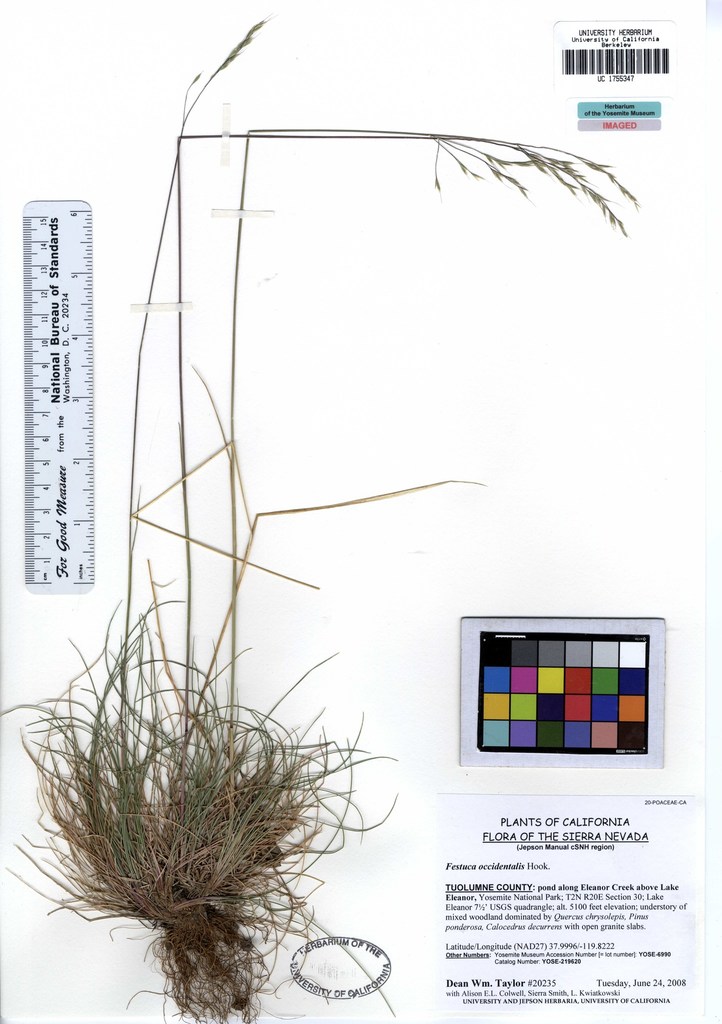
(c) Dean Wm. Taylor, some rights reserved (CC BY) · licence
Family: Poaceae · Type: Grass · Native
Festuca occidentalis (Western fescue) is a native California grass in the Poaceae family, recognized by . Distinguished by forest habitat, soft narrow leaves, drooping branches.
Western fescue is a California native perennial grass found in northwestern California, the Cascade Range, Sierra Nevada, northern and central Coast Ranges, Peninsular Ranges, and Modoc Plateau in open pine and oak woodlands, redwood forests at elevations generally below 1,900 meters. Flowering from April to July, this grass produces delicate drooping branches with small greenish-brown spikelets 6 to 12 millimeters long. Growing in loosely clumped clusters with slender stems 40 to 110 centimeters tall, its stems have visible nodes and a distinctive growth pattern. Its leaves are narrow, soft, and folded, typically 5 to 25 centimeters long and less than 1 millimeter wide, often forming a V-shape when viewed in cross-section. The plant's leaf sheaths gradually shred with age, and its flower lemmas feature sparse scabrous tips with awns 3 to 12 millimeters long.
Identification and appearance
Key characters: 18 sympatric species. Distinguished by forest habitat, soft narrow leaves, drooping branches
Habitat and range
Habitat: Open pine/oak woodland, redwood forest
Elevation: generally < 1900 m
California counties: Fresno, Sonoma, Trinity, Tulare, Shasta, Butte, Del Norte, Humboldt, Mariposa, Napa, Lake, Tuolumne, Mendocino, Plumas, Kern, Santa Cruz, Siskiyou, Marin, Modoc, El Dorado, Riverside, San Mateo, Tehama, San Diego, Placer, Nevada, Sierra, Calaveras, Glenn, Inyo, Monterey, Santa Barbara, Santa Clara, Yuba, Lassen, San Benito, San Luis Obispo, Amador, San Francisco, Madera
Outside California: to British Columbia, eastern North America
Bloom period
Festuca occidentalis blooms Apr-Jul.
How to tell it apart
vs Bromus: Festuca sheaths split open; Bromus sheaths stay closed around the stem.; vs Lolium: Festuca spikelets branch from multiple points; Lolium spikelets sit flat against one side of stem.; vs Aciphylla: Festuca is a grass with thin blade leaves; Aciphylla has rigid spine-tipped tufts.; vs Poa: Festuca lemmas have 5+ veins; Poa lemmas show only 3-5 veins with cobwebby hairs at base.; vs Muhlenbergia: Festuca has multi-flowered chunky spikelets; Muhlenbergia has delicate single-flowered tiny spikelets.
Frequently asked questions
Is Festuca occidentalis native to California?
Yes. Festuca occidentalis is native to California (recorded as native).
When does Festuca occidentalis bloom?
Festuca occidentalis blooms Apr-Jul.
Where in California does Festuca occidentalis grow?
Festuca occidentalis occurs in Fresno, Sonoma, Trinity, Tulare, Shasta, Butte, Del Norte, Humboldt and other counties, at elevations of generally < 1900 m.
What plant family does Festuca occidentalis belong to?
Festuca occidentalis is in the Poaceae family, genus Festuca.
What habitat does Festuca occidentalis grow in?
Festuca occidentalis grows in Open pine/oak woodland, redwood forest.
Related species
Other California species in the same genus, family, or bioregion.
Sources: Jepson eFlora · Index of California Plant Names · CalPhotos
Last updated 2026-10-07
Data from The California Species Project — 14,000+ California species with verified data from CNPS, CDFW, USFWS, Cal-IPC, and more.