Foeniculum vulgare
Fennel, Fennel
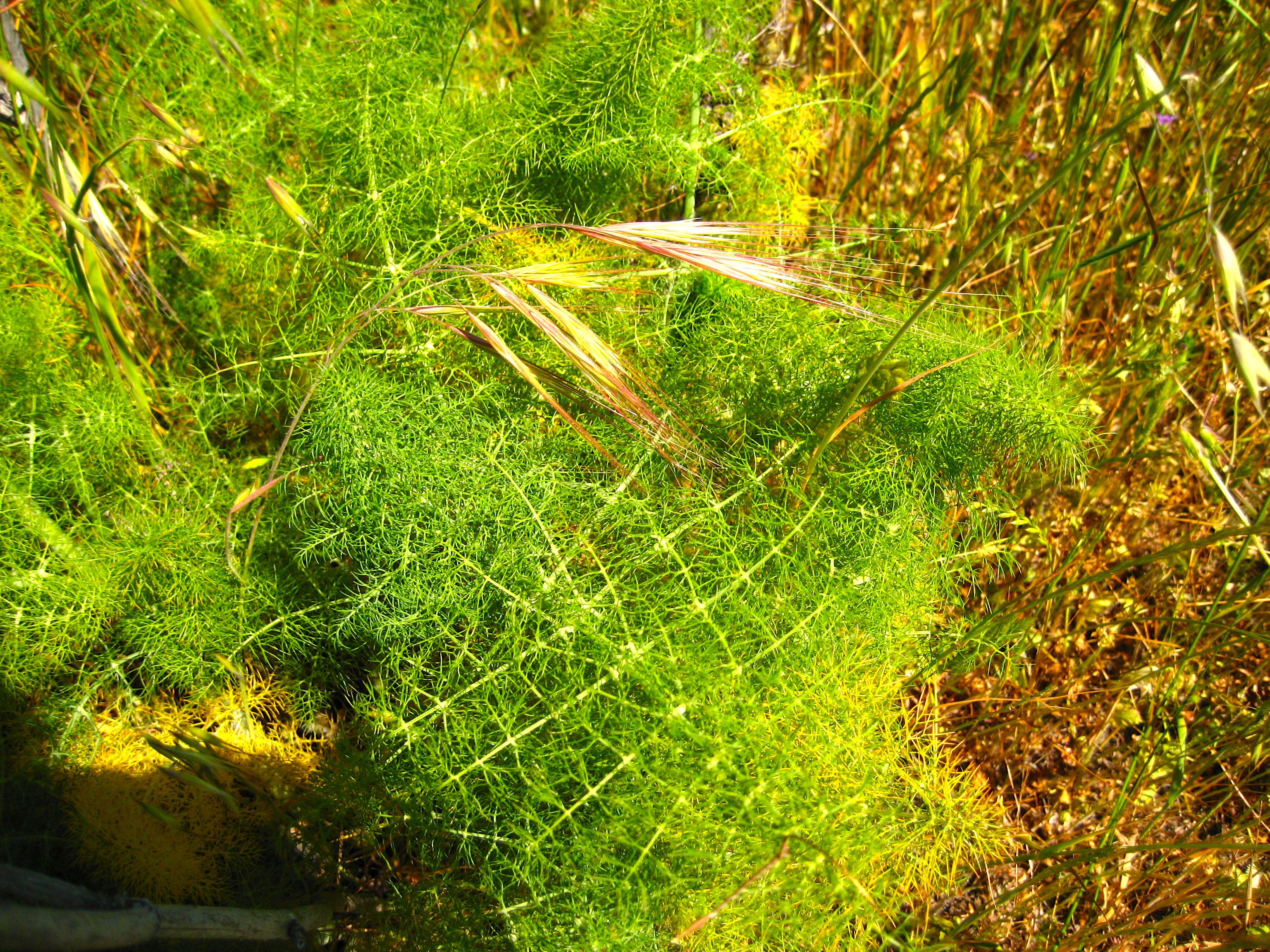
Photo by Chez Brungraber
Family: Apiaceae · Type: Herb · Not Native
Conservation status: Cal-IPC Yes
Foeniculum vulgare (Fennel) is a non-native California herb in the Apiaceae family, recognized by European introduction representing a monotypic genus now widely naturalized in California.
Fennel is a naturalized perennial herb found in California Floristic Province and Western and Interior Ranges on roadsides and disturbed sites at elevations below 1,600 meters. Flowering from May to September, this plant produces distinctive yellow flowers in large compound umbels with spreading rays. Growing to 0.9 to 2 meters tall with an erect, branched stem, it has a characteristic anise or licorice scent that distinguishes it from other herbs. Its finely divided leaves are triangular-ovate, extending up to 4 decimeters wide, with delicate thread-like segments 4 to 40 millimeters long. The fruit is an oblong-ovate structure 3.5 to 4 millimeters long with prominent, acute ribs and a single oil tube between each rib.
Identification and appearance
Key characters: European introduction representing a monotypic genus now widely naturalized in California
Habitat and range
Habitat: Roadsides, disturbed sites
Elevation: < 1600 m
California counties: Santa Barbara, San Diego, Riverside, Los Angeles, Fresno, Orange, Ventura, Marin, Kern, Lake, Inyo, San Bernardino, Santa Clara, Monterey, Solano, San Luis Obispo, Amador, Santa Cruz, Calaveras, El Dorado, Sutter, San Mateo, Alameda, Sacramento, Yolo, Mendocino, Kings, Butte, Glenn, Contra Costa, Shasta, San Joaquin, Stanislaus, Napa, Humboldt, San Francisco, Sonoma, Del Norte, Mariposa, Mono
Outside California: native to southern Europe, widely escaped from cultivation in western hemisphere
Bloom period
Foeniculum vulgare blooms May-Sep.
Conservation status
Cal-IPC Yes
How to tell it apart
vs Anethum: Fennel is a stout perennial smelling strongly of anise/licorice with solid stems and rounded ribbed fruits; dill is a slender annual smelling of dill with strongly flattened, wing-margined fruits.; vs Conium: Fennel is glaucous and sweet-anise-scented with plain green solid stems; poison hemlock has purple-blotched hollow stems and a rank, musty odor.; vs Daucus: Fennel has yellow flowers in umbels lacking bracts; Queen Anne's lace (Daucus) has white flowers over a conspicuous ruff of divided bracts.; vs Cyclospermum: Fennel is a tall robust plant with large umbels; Cyclospermum (marsh parsley) is a small weak annual with tiny umbels that often lack rays.; vs Coriandrum: Fennel foliage is thread-fine and licorice-scented throughout; coriander/cilantro has broader lower leaflets and a distinct pungent smell.
Frequently asked questions
Is Foeniculum vulgare native to California?
No. Foeniculum vulgare is not native to California (recorded as not native).
When does Foeniculum vulgare bloom?
Foeniculum vulgare blooms May-Sep.
Where in California does Foeniculum vulgare grow?
Foeniculum vulgare occurs in Santa Barbara, San Diego, Riverside, Los Angeles, Fresno, Orange, Ventura, Marin and other counties, at elevations of < 1600 m.
What plant family does Foeniculum vulgare belong to?
Foeniculum vulgare is in the Apiaceae family, genus Foeniculum.
Is Foeniculum vulgare invasive in California?
Foeniculum vulgare is listed by Cal-IPC with an invasiveness rating of Yes.
Related species
Other California species in the same genus, family, or bioregion.
Sources: Jepson eFlora · Index of California Plant Names · CalPhotos
Last updated 2026-10-07
Data from The California Species Project — 14,000+ California species with verified data from CNPS, CDFW, USFWS, Cal-IPC, and more.