Forestiera pubescens
Desert olive
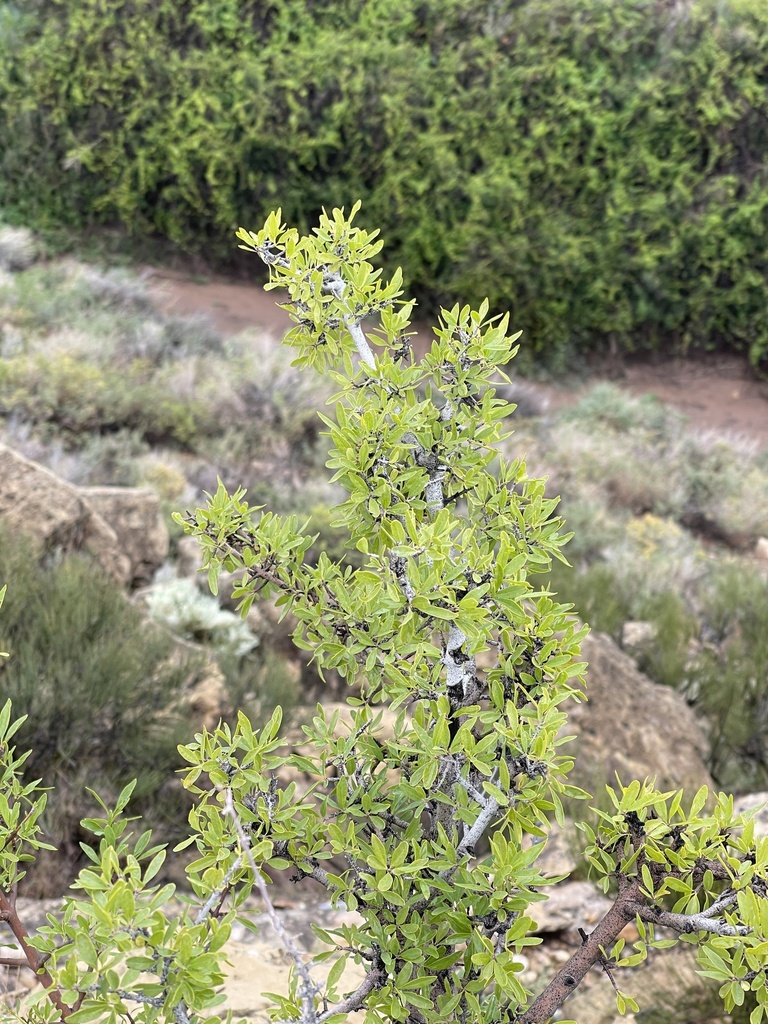
(c) CK2AZ, some rights reserved (CC BY) · licence
Family: Oleaceae · Type: Shrub · Native
Forestiera pubescens (Desert olive) is a native California shrub in the Oleaceae family, recognized by Southwestern US genus reaching its western range limit in California desert regions.
Desert olive is a California native shrub found in southeastern northern Coast Ranges, southern Sierra Nevada Foothills, central and eastern Sierra Nevada, Tehachapi, eastern San Francisco Bay Area, southern Coast Ranges, Transverse Ranges, Peninsular Ranges, southern Sierra Nevada, and Mojave Desert in streambanks, canyons, and washes at elevations of 100 to 1,800 meters. Flowering from March to April, this shrub produces small greenish-yellow flowers that emerge before its leaves. Growing 1.2 to 5 meters tall with many rounded stems featuring smooth tan-gray bark and short, rigidly thorny twigs, it develops a distinctive branching structure. Its leathery leaves are elliptic to ovate, 1.5 to 4 centimeters long, with entire or minutely toothed edges. The fruit is an elliptical, purple-black drupe 5 to 8 millimeters long that becomes slightly glaucous when mature.
Identification and appearance
Key characters: Southwestern US genus reaching its western range limit in California desert regions
Habitat and range
Habitat: Streambanks, canyons, washes
Elevation: 100-1800 m
California counties: San Bernardino, Kern, Los Angeles, Monterey, Riverside, Inyo, San Joaquin, Merced, Contra Costa, Santa Barbara, Alameda, San Diego, San Luis Obispo, Colusa, Sutter, Ventura, Stanislaus, San Benito, Santa Clara, Napa
Outside California: to Colorado, Texas, northern Mexico
Bloom period
Forestiera pubescens blooms Mar-Apr.
How to tell it apart
vs Rhaphiolepis: Forestiera flowers lack petals entirely; Rhaphiolepis has showy white five-petaled flowers.; vs Prunus: Forestiera flowers have no petals and sit directly on stems; Prunus has stalked flowers with five petals.; vs Quercus: Forestiera has opposite leaves and tiny flowers; Quercus has alternate leaves and dangly catkins.; vs Salix: Forestiera has opposite leaves; Salix has alternate leaves arranged spirally on stems.; vs Ligustrum: Forestiera flowers lack petals and sit directly on branches; Ligustrum has tubular white flowers on stalks.
Frequently asked questions
Is Forestiera pubescens native to California?
Yes. Forestiera pubescens is native to California (recorded as native).
When does Forestiera pubescens bloom?
Forestiera pubescens blooms Mar-Apr.
Where in California does Forestiera pubescens grow?
Forestiera pubescens occurs in San Bernardino, Kern, Los Angeles, Monterey, Riverside, Inyo, San Joaquin, Merced and other counties, at elevations of 100-1800 m.
What plant family does Forestiera pubescens belong to?
Forestiera pubescens is in the Oleaceae family, genus Forestiera.
What habitat does Forestiera pubescens grow in?
Forestiera pubescens grows in Streambanks, canyons, washes.
Related species
Other California species in the same genus, family, or bioregion.
Sources: Jepson eFlora · Index of California Plant Names · CalPhotos
Last updated 2026-10-07
Data from The California Species Project — 14,000+ California species with verified data from CNPS, CDFW, USFWS, Cal-IPC, and more.