Fouquieria splendens subsp. splendens
Ocotillo, Ocotillo
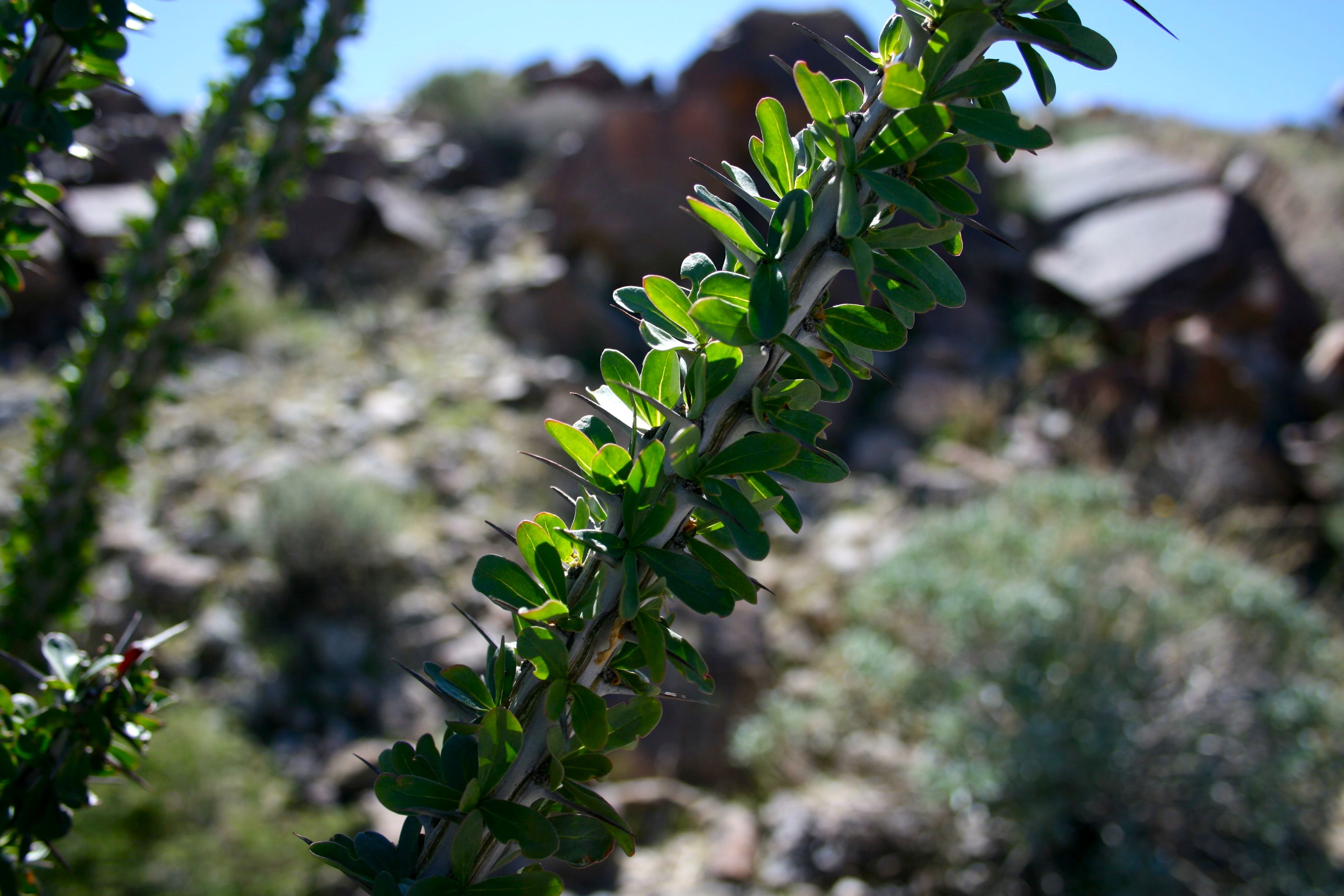
Photo by Chez Brungraber
Family: Fouquieriaceae · Type: Shrub · Native
Fouquieria splendens subsp. splendens (Ocotillo) is a native California shrub in the Fouquieriaceae family, recognized by Represents a unique desert-adapted family (Fouquieriaceae) with limited distribution in southwestern North America.
Ocotillo is a native shrub found in the southern desert regions of California in dry, generally rocky soils at elevations below 700 meters. Flowering from March to July, this distinctive plant produces bright red flowers in narrow, cone-shaped clusters up to 20 centimeters long. Growing as an impressive, cane-like shrub 6 to 10 meters tall with gray bark and prominent spines 1 to 4 centimeters long, it stands out dramatically in the desert landscape. Its leaves are small and seasonal, with spoon-shaped to oval blades 1 to 2 centimeters long that cluster along the stems, appearing briefly during favorable conditions. The plant's striking form features long, arching stems covered in sharp spines, creating a sculptural silhouette that is characteristic of the arid southwestern landscapes.
Identification and appearance
Key characters: Represents a unique desert-adapted family (Fouquieriaceae) with limited distribution in southwestern North America
Habitat and range
Habitat: Dry, generally rocky soils
Elevation: < 700 m
California counties: Imperial, San Bernardino, San Diego, Riverside
Outside California: to Texas, central Mexico, Baja California
Bloom period
Fouquieria splendens subsp. splendens blooms Mar-Jul.
How to tell it apart
vs Cylindropuntia: Ocotillo's stems are woody, gray-barked wands with straight spines and small green leaves after rain, tipped with scarlet tubular flowers; cholla stems are green, fleshy, jointed cylinders sheathed in barbed spine clusters.; vs Koeberlinia: Ocotillo's spines sit on leaf-bearing canes and it flushes true leaves seasonally; Koeberlinia (crucifixion thorn) is a green, essentially leafless tangle of rigid thorn-tipped branchlets.; vs Yucca: Ocotillo is a fountain of slender cane stems tipped with red flower panicles and drops its small leaves; Yucca has a rosette of stiff sword-shaped leaves and a large panicle of white flowers.; vs Canotia: Ocotillo bears true spoon-shaped leaves and showy scarlet flowers; Canotia and other crucifixion thorns are nearly leafless green spiny shrubs with tiny inconspicuous flowers.; vs Chilopsis: Both have showy tubular flowers, but ocotillo's are small and scarlet on spiny, mostly leafless canes; desert willow is a leafy willow-like shrub or tree with large pink trumpet flowers.
Frequently asked questions
Is Fouquieria splendens subsp. splendens native to California?
Yes. Fouquieria splendens subsp. splendens is native to California (recorded as native).
When does Fouquieria splendens subsp. splendens bloom?
Fouquieria splendens subsp. splendens blooms Mar-Jul.
Where in California does Fouquieria splendens subsp. splendens grow?
Fouquieria splendens subsp. splendens occurs in Imperial, San Bernardino, San Diego, Riverside, at elevations of < 700 m.
What plant family does Fouquieria splendens subsp. splendens belong to?
Fouquieria splendens subsp. splendens is in the Fouquieriaceae family, genus Fouquieria.
What habitat does Fouquieria splendens subsp. splendens grow in?
Fouquieria splendens subsp. splendens grows in Dry, generally rocky soils.
Related species
Other California species in the same genus, family, or bioregion.
Sources: Jepson eFlora · Index of California Plant Names · CalPhotos
Last updated 2026-09-30
Data from The California Species Project — 14,000+ California species with verified data from CNPS, CDFW, USFWS, Cal-IPC, and more.