Frangula purshiana subsp. ultramafica
Caribou coffee berry, Caribou Coffee Berry
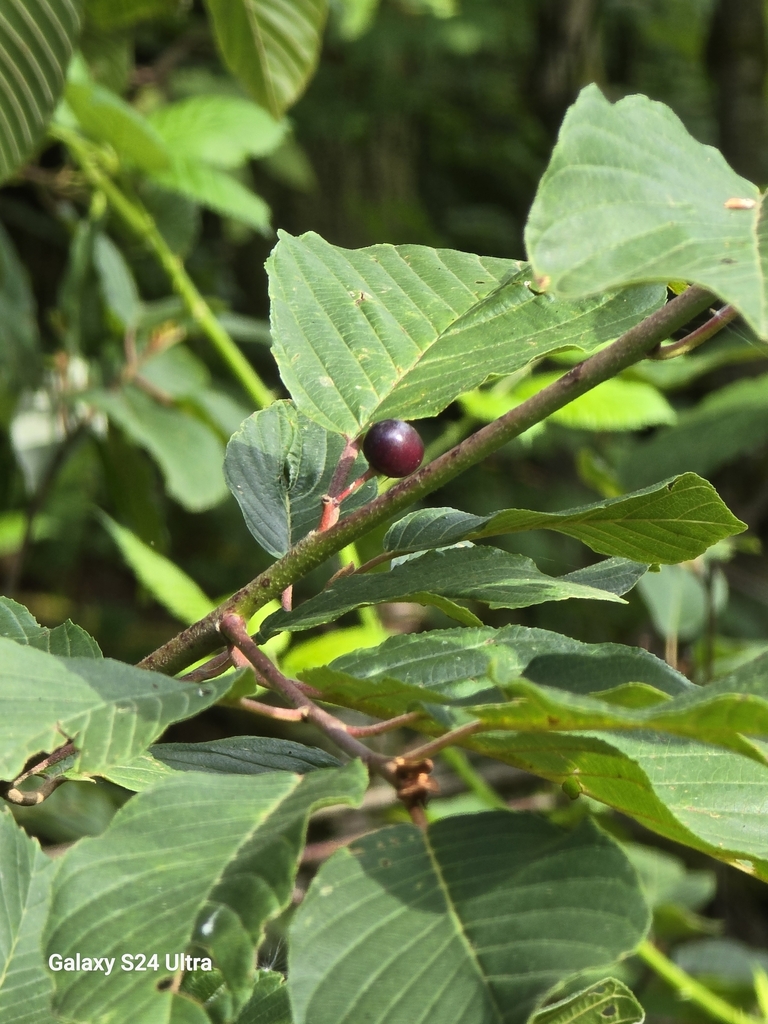
Photo: parent species Frangula purshiana · no rights reserved · CC0
Family: Rhamnaceae · Type: Shrub · Native
Conservation status: CNPS 1B.2
Frangula purshiana subsp. ultramafica (Caribou coffee berry) is a native California shrub in the Rhamnaceae family, recognized by glaucous papillate leaves and serpentine habitat restriction.
Caribou coffee berry is a rare (CNPS 1B.2) California native shrub found in northern Sierra Nevada (Plumas County) in open conifer forest, montane chaparral, and serpentine seeps at elevations of 820 to 1,950 meters. Flowering from April to June, this plant produces small white to greenish-white flowers clustered near branch tips. Growing to less than 2 meters tall with twigs that range from green to gray or dull brown and are densely hairy, it forms a compact shrubby structure. Its leaves are widely oblong or ovate, leathery and blue- or green-gray, with a papillate surface that can be sparsely to densely hairy, featuring obtuse or notched tips and entire to slightly serrated margins. The shrub's distinctive velvety leaf texture and blue-gray coloration make it well-adapted to its serpentine habitat.
Identification and appearance
Key characters: 7 sympatric species; key features are glaucous papillate leaves and serpentine habitat restriction
Habitat and range
Habitat: Open conifer forest, montane chaparral, seeps, serpentine
Elevation: 820-1950 m
Bloom period
Frangula purshiana subsp. ultramafica blooms Apr-Jun.
Conservation status
CNPS 1B.2
How to tell it apart
vs Heteromeles: Frangula has simple leaves and naked buds; Heteromeles has toothed leaves and scaly buds.; vs Prunus: Frangula berries turn from red to black; Prunus fruits are uniform colored when ripe.; vs Rhamnus: Frangula buds are naked (no scales); Rhamnus buds have protective scales.; vs Quercus: Frangula has opposite or alternate smooth leaves; Quercus has spiral lobed or toothed leaves.; vs Umbellularia: Frangula leaves lack strong aroma; Umbellularia leaves smell strongly spicy when crushed.
Frequently asked questions
Is Frangula purshiana subsp. ultramafica native to California?
Yes. Frangula purshiana subsp. ultramafica is native to California (recorded as native).
When does Frangula purshiana subsp. ultramafica bloom?
Frangula purshiana subsp. ultramafica blooms Apr-Jun.
What plant family does Frangula purshiana subsp. ultramafica belong to?
Frangula purshiana subsp. ultramafica is in the Rhamnaceae family, genus Frangula.
Is Frangula purshiana subsp. ultramafica rare or endangered?
Frangula purshiana subsp. ultramafica carries California Rare Plant Rank 1B.2, state rank S2S3.
What habitat does Frangula purshiana subsp. ultramafica grow in?
Frangula purshiana subsp. ultramafica grows in Open conifer forest, montane chaparral, seeps, serpentine.
Related species
Other California species in the same genus, family, or bioregion.
Sources: Jepson eFlora · CalPhotos · CDFW CNDDB
Last updated 2026-10-07
Data from The California Species Project — 14,000+ California species with verified data from CNPS, CDFW, USFWS, Cal-IPC, and more.