Fraxinus latifolia
Oregon ash
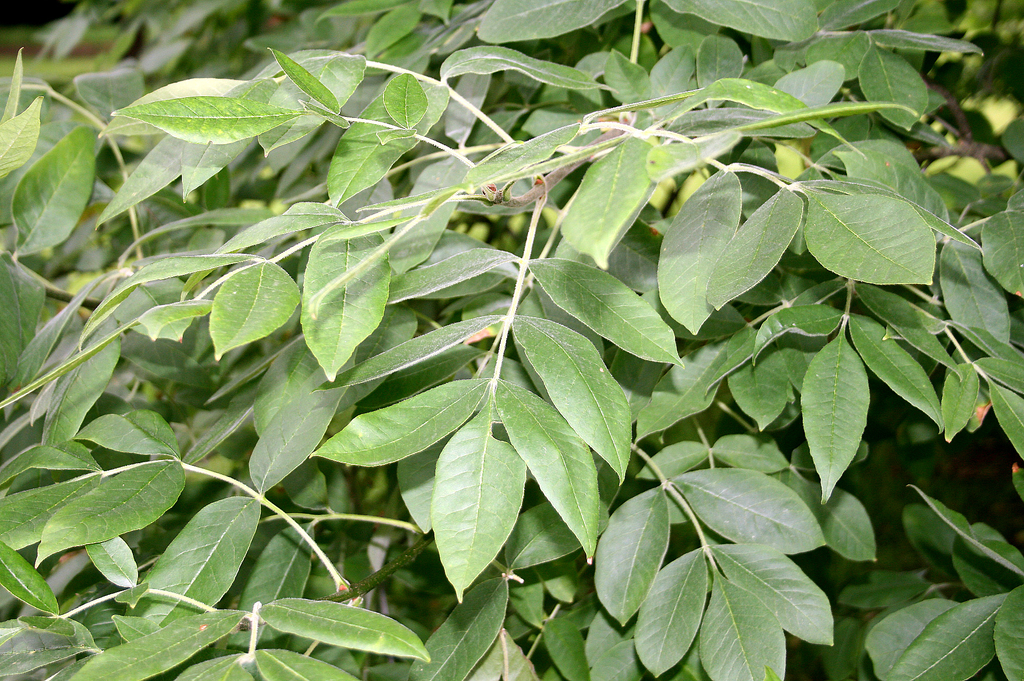
(c) Jean-Pol GRANDMONT, some rights reserved (CC BY-SA) · licence
Family: Oleaceae · Type: Tree · Native
Fraxinus latifolia (Oregon ash) is a native California tree in the Oleaceae family, recognized by . Tree habit and large size diagnostic vs shrubby relatives.
Oregon ash is a native tree found in northwestern California, the California Cascade Range, Sierra Nevada, Central Valley, San Francisco Bay Area, and North Coast Ranges in canyons, streambanks, and woodlands at elevations below 1,700 meters. Flowering from March to May, this tree produces small greenish flowers without petals in distinctive clusters. Growing up to 25 meters tall with a trunk diameter of 1.5 meters, it features gray-brown bark with deep furrows and cylindrical twigs. Its compound leaves have 5 to 7 leaflets, each 4 to 11 centimeters long and ovate or oblong-ovate, with a terminal leaflet slightly larger than the lateral ones. The fruit is a distinctive winged samara 25 to 50 millimeters long, with a flat wing extending down half to three-quarters of the seed body.
Identification and appearance
Key characters: 2 sympatric species. Tree habit and large size diagnostic vs shrubby relatives.
Habitat and range
Habitat: Canyons, streambanks, woodland
Elevation: < 1700 m
California counties: Shasta, Kern, Mendocino, Lake, Tulare, Nevada, Napa, San Joaquin, Merced, Madera, Humboldt, Fresno, Siskiyou, Del Norte, Alameda, Butte, Marin, Trinity, Amador, San Mateo, Tuolumne, Sonoma, Santa Clara, Riverside, Plumas, Modoc, El Dorado, Stanislaus, Sutter, Los Angeles, Calaveras, San Diego, Solano, Tehama, Yuba, Colusa, Mariposa, Sacramento, Contra Costa, Yolo, Glenn, Lassen, San Bernardino, Santa Barbara
Outside California: to British Columbia
Bloom period
Fraxinus latifolia blooms Mar-May.
How to tell it apart
vs Sambucus: Fraxinus has winged paddle fruits; Sambucus has clusters of small round berries.; vs Acer: Fraxinus fruits have one wing each; Acer fruits have paired wings joined at base.; vs Quercus: Fraxinus has opposite compound leaves; Quercus has alternate simple leaves and acorns.; vs Juglans: Fraxinus fruits are flat winged paddles; Juglans fruits are round walnuts in green husks.; vs Ailanthus: Fraxinus has opposite leaves with toothed leaflets; Ailanthus has alternate leaves with smooth-edged leaflets.
Frequently asked questions
Is Fraxinus latifolia native to California?
Yes. Fraxinus latifolia is native to California (recorded as native).
When does Fraxinus latifolia bloom?
Fraxinus latifolia blooms Mar-May.
Where in California does Fraxinus latifolia grow?
Fraxinus latifolia occurs in Shasta, Kern, Mendocino, Lake, Tulare, Nevada, Napa, San Joaquin and other counties, at elevations of < 1700 m.
What plant family does Fraxinus latifolia belong to?
Fraxinus latifolia is in the Oleaceae family, genus Fraxinus.
What habitat does Fraxinus latifolia grow in?
Fraxinus latifolia grows in Canyons, streambanks, woodland.
Related species
Other California species in the same genus, family, or bioregion.
Sources: Jepson eFlora · Index of California Plant Names · CalPhotos
Last updated 2026-10-07
Data from The California Species Project — 14,000+ California species with verified data from CNPS, CDFW, USFWS, Cal-IPC, and more.