Fraxinus parryi
Chaparral ash
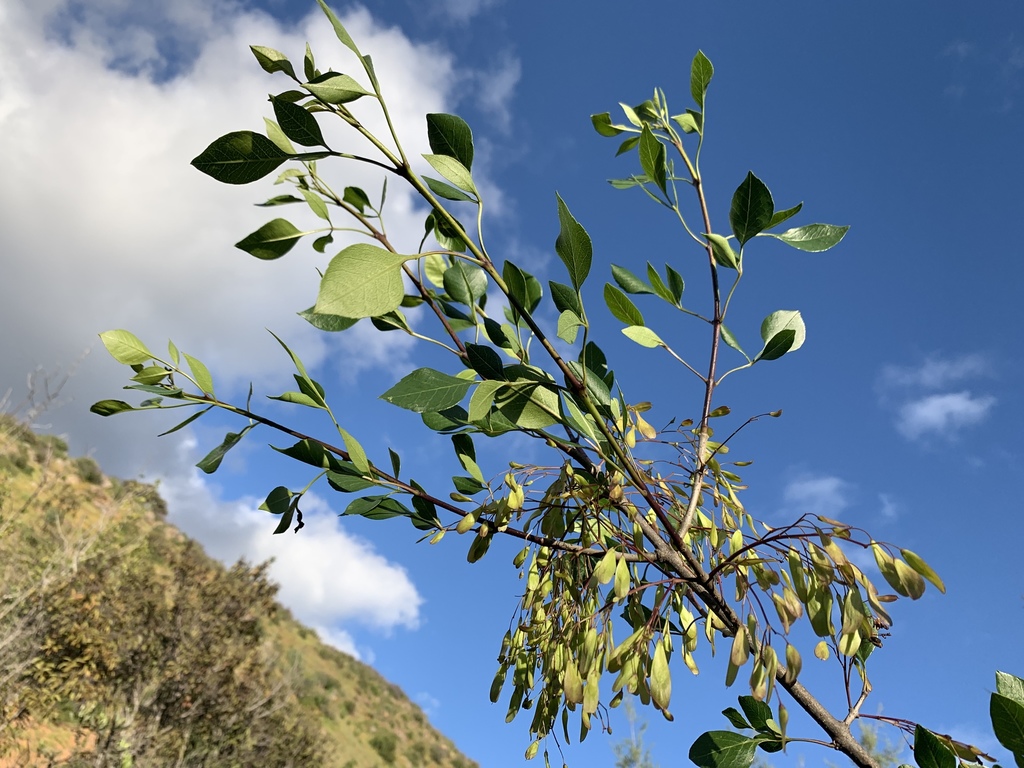
no rights reserved · CC0
Family: Oleaceae · Type: Shrub · Native
Conservation status: CNPS 2B.2
Fraxinus parryi (Chaparral ash) is a native California shrub in the Oleaceae family, recognized by . Small leaf size and often simple leaves plus southern range diagnostic.
Chaparral ash is a rare (CNPS 2B.2) California native shrub found in southern San Diego County in canyon and chaparral slope habitats at elevations around 600 meters. Flowering from February to March, this plant produces cream-white flowers in clusters with delicate, glandular-puberulent bracts. Growing as a multi-stemmed shrub to 3 meters tall with smooth gray bark and cylindric to four-angled twigs, it develops an attractive branching structure. Its leaves are simple or compound with three leaflets, each 2 to 5 centimeters long, ovate to rounded, with green upper surfaces and pale undersides. The distinctive fruit is a broad, flat wing-like structure 22 to 30 millimeters long, creating an elegant silhouette against chaparral landscapes.
Identification and appearance
Key characters: 2 sympatric species. Small leaf size and often simple leaves plus southern range diagnostic.
Habitat and range
Habitat: Canyons, slopes, margins of mixed chaparral
Elevation: 600 m
Outside California: Baja California
Bloom period
Fraxinus parryi blooms Feb-Mar.
Conservation status
CNPS 2B.2
How to tell it apart
vs Sambucus: Fraxinus has winged paddle fruits; Sambucus has clusters of small round berries.; vs Acer: Fraxinus fruits have one wing each; Acer fruits have paired wings joined at base.; vs Quercus: Fraxinus has opposite compound leaves; Quercus has alternate simple leaves and acorns.; vs Juglans: Fraxinus fruits are flat winged paddles; Juglans fruits are round walnuts in green husks.; vs Ailanthus: Fraxinus has opposite leaves with toothed leaflets; Ailanthus has alternate leaves with smooth-edged leaflets.
Frequently asked questions
Is Fraxinus parryi native to California?
Yes. Fraxinus parryi is native to California (recorded as native).
When does Fraxinus parryi bloom?
Fraxinus parryi blooms Feb-Mar.
What plant family does Fraxinus parryi belong to?
Fraxinus parryi is in the Oleaceae family, genus Fraxinus.
Is Fraxinus parryi rare or endangered?
Fraxinus parryi carries California Rare Plant Rank 2B.2, state rank S1.
What habitat does Fraxinus parryi grow in?
Fraxinus parryi grows in Canyons, slopes, margins of mixed chaparral.
Related species
Other California species in the same genus, family, or bioregion.
Sources: Jepson eFlora · CalPhotos · CDFW CNDDB
Last updated 2026-10-06
Data from The California Species Project — 14,000+ California species with verified data from CNPS, CDFW, USFWS, Cal-IPC, and more.