Galium andrewsii subsp. andrewsii
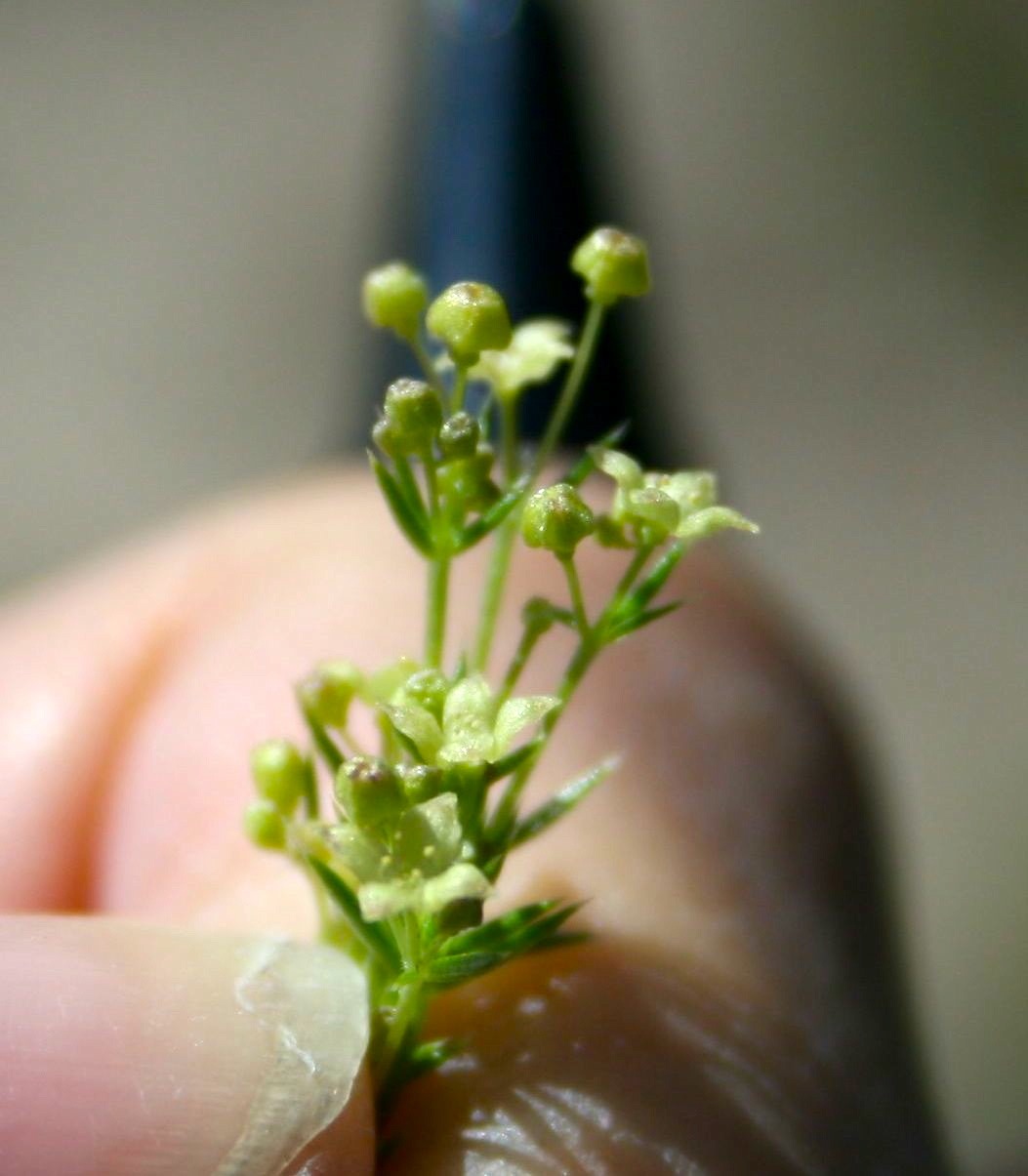
Photo: parent species Galium andrewsii · Photo by Chez Brungraber
Family: Rubiaceae · Type: Subshrub · Native
Galium andrewsii subsp. andrewsii is a native California subshrub in the Rubiaceae family, recognized by Dense cushion, main stem obscure; awl-like keeled leaves longer than internodes, sharp.
Andrews' bedstraw is a California native perennial found in northern Coast Ranges, southern Sierra Nevada foothills, southern Coast Ranges, Transverse Ranges, and Peninsular Ranges in high chaparral and open woodland, often on serpentine or sandy-loam soils at elevations of 250 to 2,580 meters. Flowering from April to June, this plant produces small white flowers in delicate clusters. Growing as a low, dense, cushion-like plant with stems 5 to 15 centimeters tall, it forms compact mats close to the ground. Its leaves are awl-like, slightly keeled, and generally ascending, growing longer than the internodal spaces between stem segments. The plant's glabrous texture and tightly compact growth form make it well-adapted to its often harsh, exposed habitats.
Identification and appearance
Key characters: Dense cushion, main stem obscure; awl-like keeled leaves longer than internodes, sharp
Habitat and range
Habitat: High chaparral, open woodland, generally serpentine or sandy-loam soil
Elevation: 250-2580 m
California counties: San Luis Obispo, San Diego, Los Angeles, Riverside, Kern, Ventura, Santa Barbara, Lake, Napa, Tehama, Monterey, San Benito, Santa Clara, Colusa, Fresno, Glenn, San Bernardino, Stanislaus, Sonoma
Outside California: mountains of Baja California
Bloom period
Galium andrewsii subsp. andrewsii blooms Apr-Jun.
How to tell it apart
vs Eriogonum: Galium has whorled leaves and tiny flowers; Eriogonum has alternate/basal leaves and dense flower clusters with papery bracts.; vs Sherardia: Galium flowers have stalks and no sepals; Sherardia flowers lack stalks and have six prominent sepals.; vs Baccharis: Galium has whorled leaves and tiny four-petaled flowers; Baccharis has alternate leaves and composite flower heads.; vs Lupinus: Galium has whorled narrow leaves and tiny rotate flowers; Lupinus has palmate compound leaves and pea-like flowers.; vs Euphorbia: Galium has whorled leaves and four-petaled flowers; Euphorbia has alternate leaves and milky sap with specialized flower cups.
Frequently asked questions
Is Galium andrewsii subsp. andrewsii native to California?
Yes. Galium andrewsii subsp. andrewsii is native to California (recorded as native).
When does Galium andrewsii subsp. andrewsii bloom?
Galium andrewsii subsp. andrewsii blooms Apr-Jun.
Where in California does Galium andrewsii subsp. andrewsii grow?
Galium andrewsii subsp. andrewsii occurs in San Luis Obispo, San Diego, Los Angeles, Riverside, Kern, Ventura, Santa Barbara, Lake and other counties, at elevations of 250-2580 m.
What plant family does Galium andrewsii subsp. andrewsii belong to?
Galium andrewsii subsp. andrewsii is in the Rubiaceae family, genus Galium.
What habitat does Galium andrewsii subsp. andrewsii grow in?
Galium andrewsii subsp. andrewsii grows in High chaparral, open woodland, generally serpentine or sandy-loam soil.
Related species
Other California species in the same genus, family, or bioregion.
Sources: Jepson eFlora · Index of California Plant Names · CalPhotos
Last updated 2026-10-07
Data from The California Species Project — 14,000+ California species with verified data from CNPS, CDFW, USFWS, Cal-IPC, and more.