Galium andrewsii subsp. gatense
Phlox-leaf serpentine bedstraw, Phlox-Leaf Serpentine Bedstraw
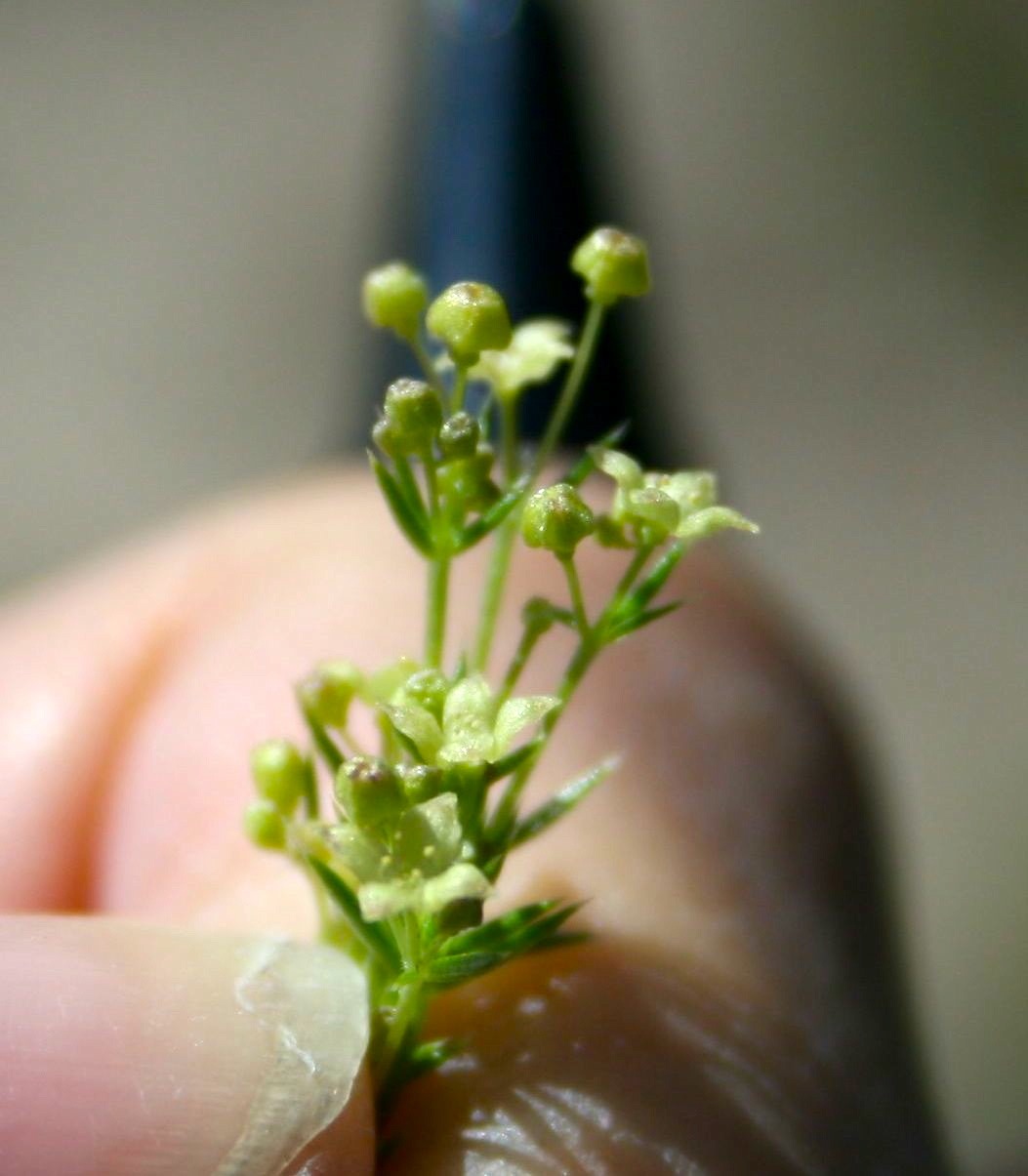
Photo: parent species Galium andrewsii · Photo by Chez Brungraber
Family: Rubiaceae · Type: Subshrub · Native
Conservation status: CNPS 4.2
Galium andrewsii subsp. gatense (Phlox-leaf serpentine bedstraw) is a native California subshrub in the Rubiaceae family, recognized by distinctive open habit with obvious main stem and flat leaves shorter than internodes.
Phlox-leaf serpentine bedstraw is a rare (CNPS 4.2) California native perennial found in the San Francisco Bay and south-central coastal ranges in dry, rocky serpentine areas of chaparral and open oak or pine woodland at elevations of 220 to 1,450 meters. Flowering from April to June, this plant produces small white flowers in delicate, spreading clusters. Growing with open stems less than 22 centimeters tall, it has a distinctive low-spreading habit with thin, occasional hairy stems. Its leaves are linear to lanceolate, generally shorter than the stem internodes, flat and spreading across the plant's surface. The plant's unique adaptation to serpentine soil makes it a specialized and interesting component of California's native plant communities.
Identification and appearance
Key characters: 19 sympatric species; distinctive open habit with obvious main stem and flat leaves shorter than internodes
Habitat and range
Habitat: Dry, rocky places in serpentine soil, chaparral or open oak/pine woodland
Elevation: 220-1450 m
California counties: San Benito, Monterey, Contra Costa, Fresno, Santa Clara, Alameda, San Bernardino, San Luis Obispo, Stanislaus, Santa Cruz
Bloom period
Galium andrewsii subsp. gatense blooms Apr-Jun.
Conservation status
CNPS 4.2
How to tell it apart
vs Eriogonum: Galium has whorled leaves and tiny flowers; Eriogonum has alternate/basal leaves and dense flower clusters with papery bracts.; vs Sherardia: Galium flowers have stalks and no sepals; Sherardia flowers lack stalks and have six prominent sepals.; vs Baccharis: Galium has whorled leaves and tiny four-petaled flowers; Baccharis has alternate leaves and composite flower heads.; vs Lupinus: Galium has whorled narrow leaves and tiny rotate flowers; Lupinus has palmate compound leaves and pea-like flowers.; vs Euphorbia: Galium has whorled leaves and four-petaled flowers; Euphorbia has alternate leaves and milky sap with specialized flower cups.
Frequently asked questions
Is Galium andrewsii subsp. gatense native to California?
Yes. Galium andrewsii subsp. gatense is native to California (recorded as native).
When does Galium andrewsii subsp. gatense bloom?
Galium andrewsii subsp. gatense blooms Apr-Jun.
Where in California does Galium andrewsii subsp. gatense grow?
Galium andrewsii subsp. gatense occurs in San Benito, Monterey, Contra Costa, Fresno, Santa Clara, Alameda, San Bernardino, San Luis Obispo and other counties, at elevations of 220-1450 m.
What plant family does Galium andrewsii subsp. gatense belong to?
Galium andrewsii subsp. gatense is in the Rubiaceae family, genus Galium.
Is Galium andrewsii subsp. gatense rare or endangered?
Galium andrewsii subsp. gatense carries California Rare Plant Rank 4.2, state rank S3.
Related species
Other California species in the same genus, family, or bioregion.
Sources: Jepson eFlora · CNPS Rare Plant Inventory · Index of California Plant Names · CalPhotos · CDFW CNDDB
Last updated 2026-10-07
Data from The California Species Project — 14,000+ California species with verified data from CNPS, CDFW, USFWS, Cal-IPC, and more.