Galium divaricatum
Lamarck's bedstraw, Lamarck's Bedstraw
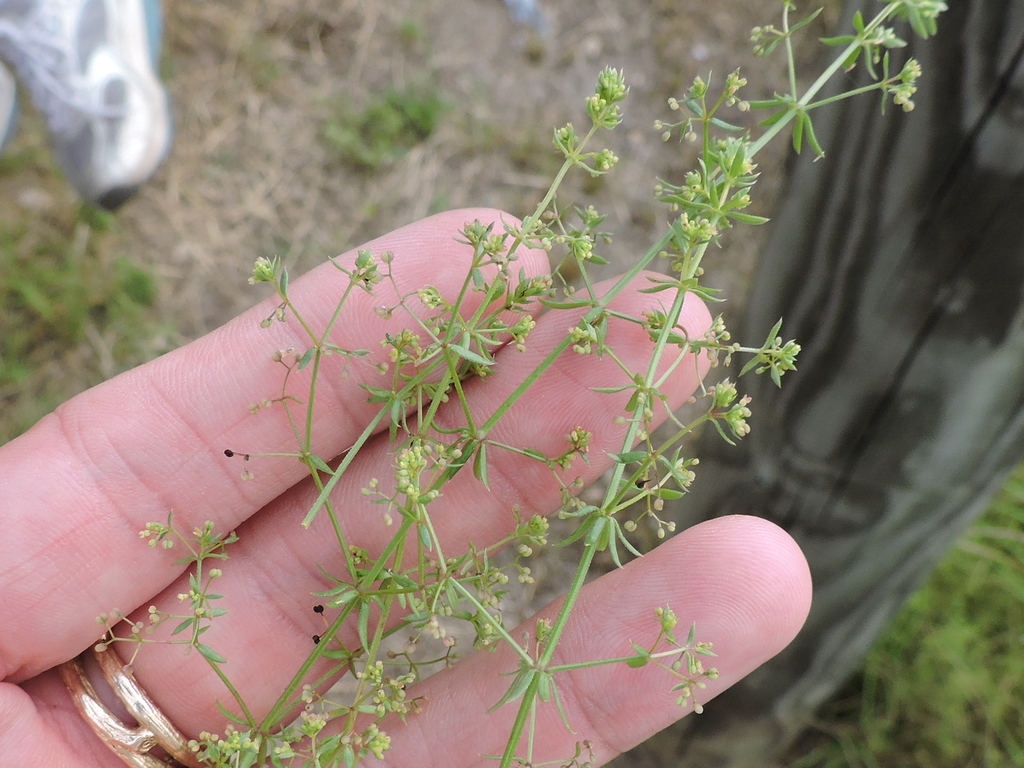
(c) Sam Kieschnick, some rights reserved (CC BY) · licence
Family: Rubiaceae · Type: Herb · Not Native
Galium divaricatum (Lamarck's bedstraw) is a non-native California herb in the Rubiaceae family, recognized by non-native annual status, 5-8 leaves per whorl, and open branching inflorescence.
Lamarck's bedstraw is a naturalized annual herb found in northern Coast Ranges, northern Sierra Nevada foothills, and San Francisco Bay Area in fields and slopes at elevations of 10 to 700 meters. Flowering from May to July, this plant produces small white flowers in open terminal panicles with erect corolla lobes. Growing with slender, erect, and spreading stems less than 30 centimeters tall, the plant is glabrous to short-hairy. Its leaves grow in tight whorls of 5 to 8, typically weak-reflexed and less than 7 millimeters long, with a delicate lanceolate to oblanceolate shape. The plant produces smooth nutlets without accompanying hairs.
Identification and appearance
Key characters: 20 sympatric species; key features are non-native annual status, 5-8 leaves per whorl, and open branching inflorescence
Habitat and range
Habitat: Fields, slopes
Elevation: 10-700 m
California counties: Trinity, Sonoma, Mendocino, El Dorado, Napa, Marin, Del Norte, Yuba, Humboldt, San Mateo, San Francisco, Butte, Alameda, Santa Cruz, Calaveras, Contra Costa, San Luis Obispo, Mariposa
Outside California: native to Mediterranean
Bloom period
Galium divaricatum blooms May-Jul.
How to tell it apart
vs Eriogonum: Galium has whorled leaves and tiny flowers; Eriogonum has alternate/basal leaves and dense flower clusters with papery bracts.; vs Sherardia: Galium flowers have stalks and no sepals; Sherardia flowers lack stalks and have six prominent sepals.; vs Baccharis: Galium has whorled leaves and tiny four-petaled flowers; Baccharis has alternate leaves and composite flower heads.; vs Lupinus: Galium has whorled narrow leaves and tiny rotate flowers; Lupinus has palmate compound leaves and pea-like flowers.; vs Euphorbia: Galium has whorled leaves and four-petaled flowers; Euphorbia has alternate leaves and milky sap with specialized flower cups.
Frequently asked questions
Is Galium divaricatum native to California?
No. Galium divaricatum is not native to California (recorded as not native).
When does Galium divaricatum bloom?
Galium divaricatum blooms May-Jul.
Where in California does Galium divaricatum grow?
Galium divaricatum occurs in Trinity, Sonoma, Mendocino, El Dorado, Napa, Marin, Del Norte, Yuba and other counties, at elevations of 10-700 m.
What plant family does Galium divaricatum belong to?
Galium divaricatum is in the Rubiaceae family, genus Galium.
What habitat does Galium divaricatum grow in?
Galium divaricatum grows in Fields, slopes.
Related species
Other California species in the same genus, family, or bioregion.
Sources: Jepson eFlora · Index of California Plant Names · CalPhotos
Last updated 2026-10-07
Data from The California Species Project — 14,000+ California species with verified data from CNPS, CDFW, USFWS, Cal-IPC, and more.