Galium hilendiae subsp. carneum
Panamint mountains bedstraw, Panamint Mountains Bedstraw
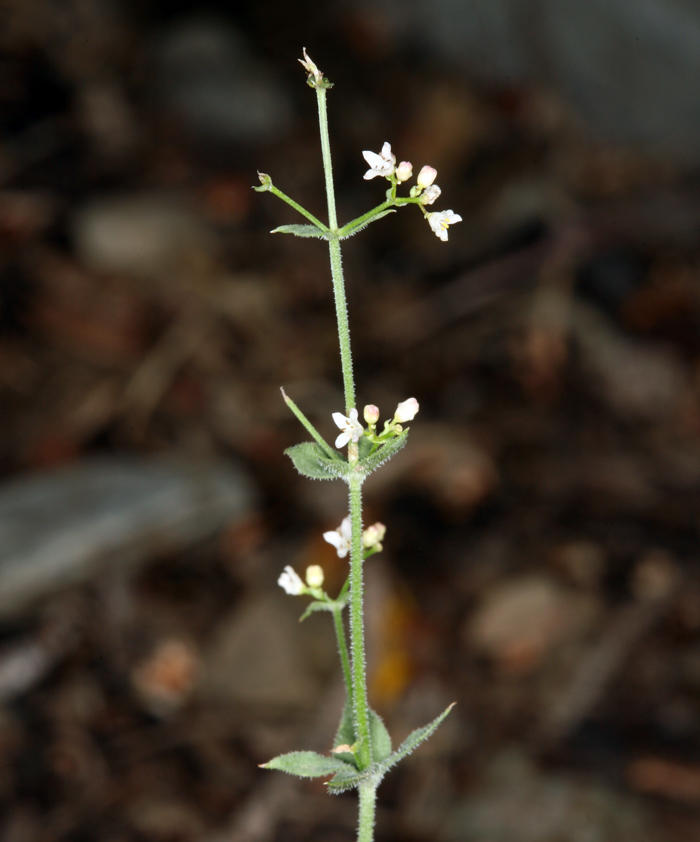
(c) Steve Matson, some rights reserved (CC BY), uploaded by Steve Matson · licence
Family: Rubiaceae · Type: Subshrub · Native
Conservation status: CNPS 1B.3
Galium hilendiae subsp. carneum (Panamint mountains bedstraw) is a native California subshrub in the Rubiaceae family, recognized by Panamint Range location, erect stiff habit with long internodes.
Panamint mountains bedstraw is a rare (CNPS 1B.3) California native perennial found in the Panamint Mountains in rocky eastern slopes, open flats, pinyon-pine woodland, and sagebrush scrub at elevations of 1,650 to 3,400 meters. Flowering from May to July, this plant produces white to pink flowers with a bell-shaped corolla in open, glabrous to sparsely hairy clusters. Growing with stiff, nearly erect stems 13 to 45 centimeters tall, its internodes are two to six times the length of its leaves. Its leaves are unequal, 7 to 11 millimeters long, with lanceolate to ovate blades that taper to a sharp or acute tip. The fruit is 4.5 to 5.5 millimeters long, including its delicate hairs.
Identification and appearance
Key characters: 18 sympatric species; key features are Panamint Range location, erect stiff habit with long internodes
Habitat and range
Habitat: Rocky eastern slopes, open flats, pinyon-pine woodland, sagebrush scrub
Elevation: 1650-3400 m
California counties: Inyo, San Bernardino
Bloom period
Galium hilendiae subsp. carneum blooms May-Jul.
Conservation status
CNPS 1B.3
How to tell it apart
vs Eriogonum: Galium has whorled leaves and tiny flowers; Eriogonum has alternate/basal leaves and dense flower clusters with papery bracts.; vs Sherardia: Galium flowers have stalks and no sepals; Sherardia flowers lack stalks and have six prominent sepals.; vs Baccharis: Galium has whorled leaves and tiny four-petaled flowers; Baccharis has alternate leaves and composite flower heads.; vs Lupinus: Galium has whorled narrow leaves and tiny rotate flowers; Lupinus has palmate compound leaves and pea-like flowers.; vs Euphorbia: Galium has whorled leaves and four-petaled flowers; Euphorbia has alternate leaves and milky sap with specialized flower cups.
Frequently asked questions
Is Galium hilendiae subsp. carneum native to California?
Yes. Galium hilendiae subsp. carneum is native to California (recorded as native).
When does Galium hilendiae subsp. carneum bloom?
Galium hilendiae subsp. carneum blooms May-Jul.
Where in California does Galium hilendiae subsp. carneum grow?
Galium hilendiae subsp. carneum occurs in Inyo, San Bernardino, at elevations of 1650-3400 m.
What plant family does Galium hilendiae subsp. carneum belong to?
Galium hilendiae subsp. carneum is in the Rubiaceae family, genus Galium.
Is Galium hilendiae subsp. carneum rare or endangered?
Galium hilendiae subsp. carneum carries California Rare Plant Rank 1B.3, state rank S3.
Related species
Other California species in the same genus, family, or bioregion.
Sources: Jepson eFlora · CNPS Rare Plant Inventory · Index of California Plant Names · CalPhotos · CDFW CNDDB
Last updated 2026-10-07
Data from The California Species Project — 14,000+ California species with verified data from CNPS, CDFW, USFWS, Cal-IPC, and more.