Garrya elliptica
Coast silk tassel
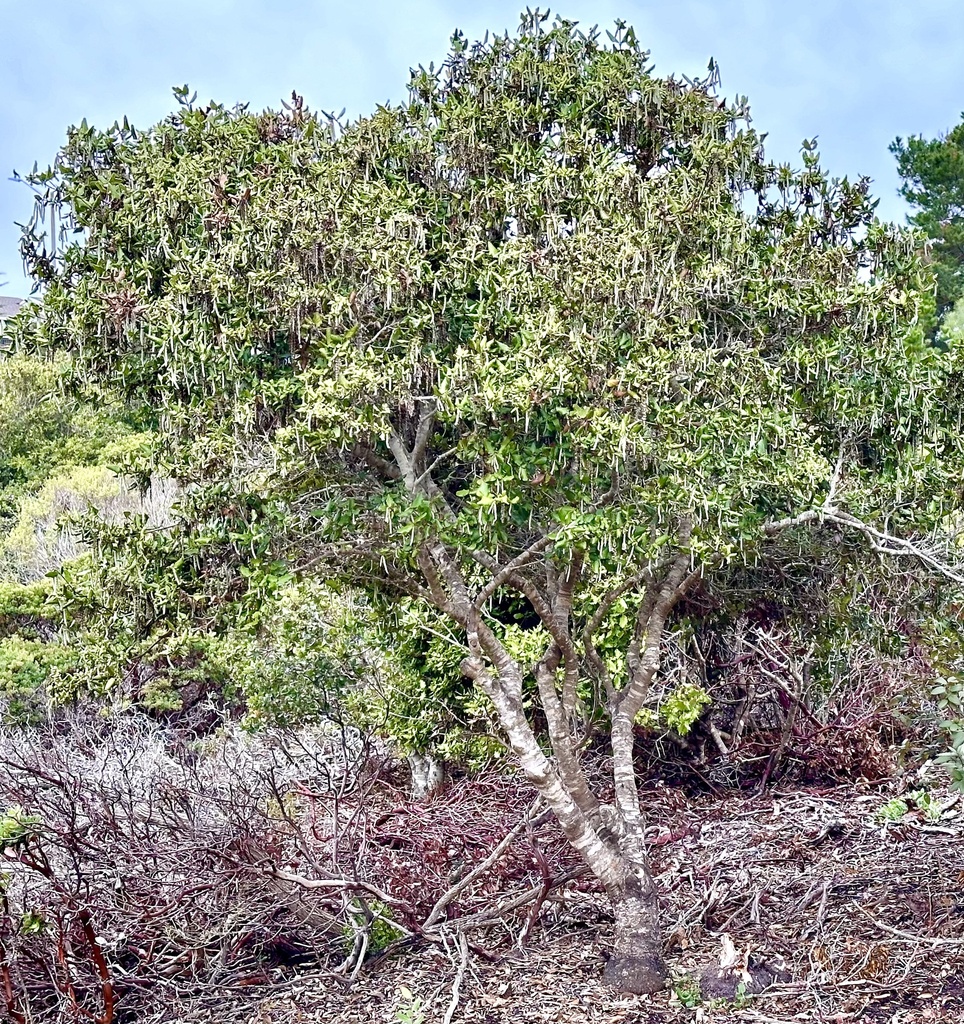
(c) Henrik Kibak, some rights reserved (CC BY), uploaded by Henrik Kibak · licence
Family: Garryaceae · Type: Shrub / Tree · Native
Garrya elliptica (Coast silk tassel) is a native California shrub / tree in the Garryaceae family, recognized by distinctive size and wavy leaf margins.
Coast silk tassel is a California native shrub found in northern coastal, Klamath Range, northern coastal redwood, northern Sierra Nevada foothill, and central western regions in seacliffs, sand dunes, chaparral, and foothill-pine woodland at elevations below 800 meters. Flowering from January to March, this plant produces white to grayish flowers in distinctive hanging catkin-like clusters. Growing up to 8 meters tall with a spreading, multi-stemmed form, it develops dense, wavy-margined elliptical leaves with curly, interwoven hairs on the underside. Its leaves are broadly elliptical, 18 to 107 millimeters long, with margins often rolled under and appearing slightly scalloped or toothed. The shrub produces dense, hairy fruits in clusters up to 28 millimeters wide, creating a distinctive winter landscape presence.
Identification and appearance
Key characters: 5 sympatric species; distinctive size and wavy leaf margins
Habitat and range
Habitat: Seacliffs, sand dunes, chaparral, foothill-pine woodland
Elevation: < 800 m
California counties: Marin, Monterey, Santa Clara, Mendocino, Sonoma, Ventura, Alameda, Napa, Santa Cruz, San Mateo, San Luis Obispo, Humboldt, Del Norte, Santa Barbara, Kern, Los Angeles, El Dorado, Shasta, Contra Costa, Glenn, San Benito, Tehama, Siskiyou, Trinity, Lake, Yolo, Riverside
Outside California: western Oregon
Bloom period
Garrya elliptica blooms Jan-Mar.
How to tell it apart
vs Quercus: Garrya has opposite leaves and hanging catkins; Quercus has alternate leaves and acorns.; vs Arctostaphylos: Garrya has opposite leaves; Arctostaphylos has alternate leaves and smooth red bark.; vs Lonicera: Garrya has long drooping catkins; Lonicera has tubular flowers in pairs or clusters.; vs Simmondsia: Garrya has drooping catkins several inches long; Simmondsia has tiny inconspicuous flowers.; vs Rhus: Garrya has opposite simple leaves; Rhus has alternate compound leaves with multiple leaflets.
Frequently asked questions
Is Garrya elliptica native to California?
Yes. Garrya elliptica is native to California (recorded as native).
When does Garrya elliptica bloom?
Garrya elliptica blooms Jan-Mar.
Where in California does Garrya elliptica grow?
Garrya elliptica occurs in Marin, Monterey, Santa Clara, Mendocino, Sonoma, Ventura, Alameda, Napa and other counties, at elevations of < 800 m.
What plant family does Garrya elliptica belong to?
Garrya elliptica is in the Garryaceae family, genus Garrya.
What habitat does Garrya elliptica grow in?
Garrya elliptica grows in Seacliffs, sand dunes, chaparral, foothill-pine woodland.
Related species
Other California species in the same genus, family, or bioregion.
Sources: Jepson eFlora · Index of California Plant Names · CalPhotos
Last updated 2026-10-07
Data from The California Species Project — 14,000+ California species with verified data from CNPS, CDFW, USFWS, Cal-IPC, and more.