Garrya flavescens
Ashy silk tassel
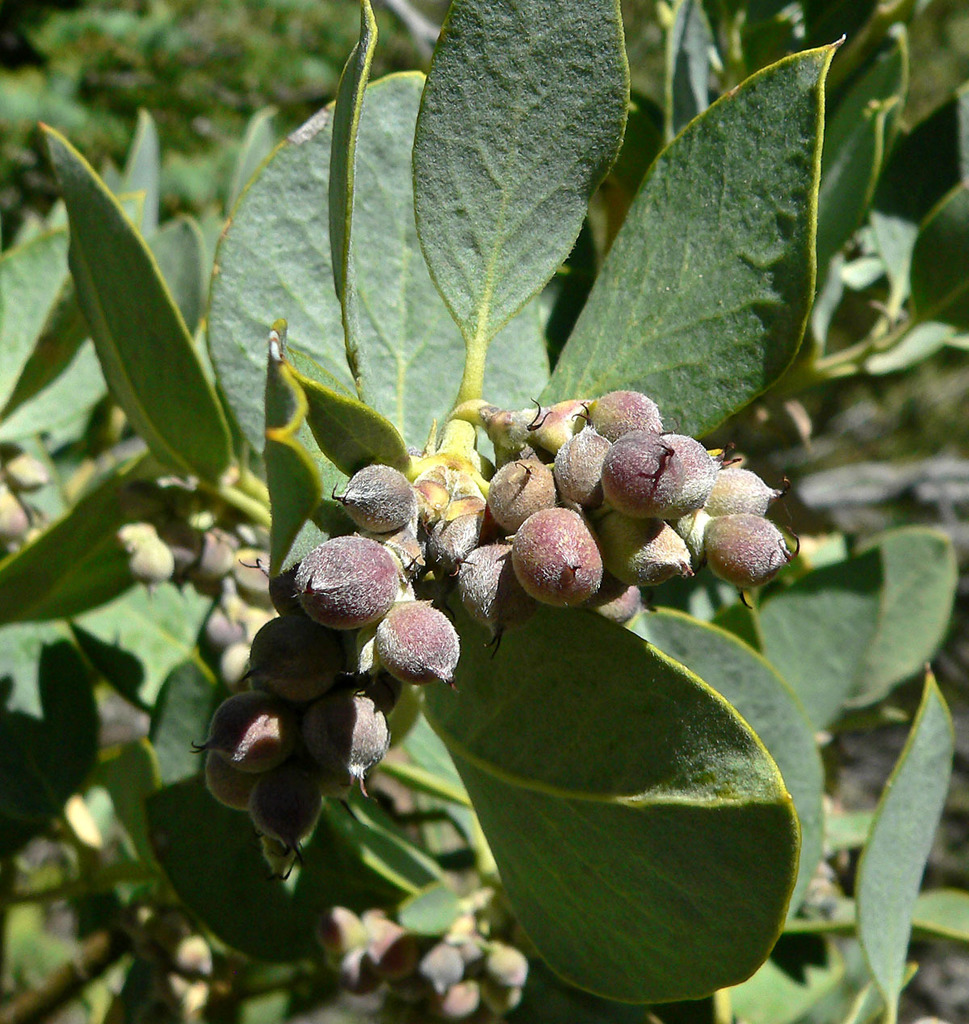
(c) Stan Shebs, some rights reserved (CC BY-SA) · licence
Family: Garryaceae · Type: Shrub / Tree · Native
Garrya flavescens (Ashy silk tassel) is a native California shrub / tree in the Garryaceae family, recognized by broad range makes ID challenging without habitat context.
Ashy silk tassel is a California native shrub found in northwestern California, Sierra Nevada, southern San Joaquin Valley, central western California, southwestern California, and Mojave Desert regions in desert slopes, chaparral, and pine/oak woodland at elevations of 650 to 2,350 meters. Flowering from February to April, this plant produces pale flowers in distinctive elongated tassel-like clusters. Growing to less than 3 meters tall with spreading branches, it forms a complex, open shrub structure. Its leaves are elliptic to obovate-elliptic, 19 to 75 millimeters long, with flat to slightly wavy margins and sparse grayish hairs that are more dense toward the leaf tips. The fruit is characterized by generally dense hairy coverings, giving the plant an ashy, textured appearance.
Identification and appearance
Key characters: 5 sympatric species; broad range makes ID challenging without habitat context
Habitat and range
Habitat: Desert slopes, chaparral, pine/oak woodland
Elevation: 650-2350 m
California counties: San Luis Obispo, Kern, San Diego, San Bernardino, Riverside, Los Angeles, Orange, Inyo, Fresno, Siskiyou, Mariposa, Tulare, Monterey, Nevada, Imperial, Alameda, Ventura, Santa Barbara, Santa Clara, Placer, Colusa, Contra Costa, El Dorado, Mendocino, Trinity, Lake, San Benito, Solano, Shasta, Santa Cruz, Marin, Napa, Sonoma, Butte, Humboldt
Outside California: to Utah, Arizona, northern Baja California
Bloom period
Garrya flavescens blooms Feb-Apr.
How to tell it apart
vs Quercus: Garrya has opposite leaves and hanging catkins; Quercus has alternate leaves and acorns.; vs Arctostaphylos: Garrya has opposite leaves; Arctostaphylos has alternate leaves and smooth red bark.; vs Lonicera: Garrya has long drooping catkins; Lonicera has tubular flowers in pairs or clusters.; vs Simmondsia: Garrya has drooping catkins several inches long; Simmondsia has tiny inconspicuous flowers.; vs Rhus: Garrya has opposite simple leaves; Rhus has alternate compound leaves with multiple leaflets.
Frequently asked questions
Is Garrya flavescens native to California?
Yes. Garrya flavescens is native to California (recorded as native).
When does Garrya flavescens bloom?
Garrya flavescens blooms Feb-Apr.
Where in California does Garrya flavescens grow?
Garrya flavescens occurs in San Luis Obispo, Kern, San Diego, San Bernardino, Riverside, Los Angeles, Orange, Inyo and other counties, at elevations of 650-2350 m.
What plant family does Garrya flavescens belong to?
Garrya flavescens is in the Garryaceae family, genus Garrya.
What habitat does Garrya flavescens grow in?
Garrya flavescens grows in Desert slopes, chaparral, pine/oak woodland.
Related species
Other California species in the same genus, family, or bioregion.
Sources: Jepson eFlora · Index of California Plant Names · CalPhotos
Last updated 2026-10-07
Data from The California Species Project — 14,000+ California species with verified data from CNPS, CDFW, USFWS, Cal-IPC, and more.