Garrya fremontii
Bearbrush
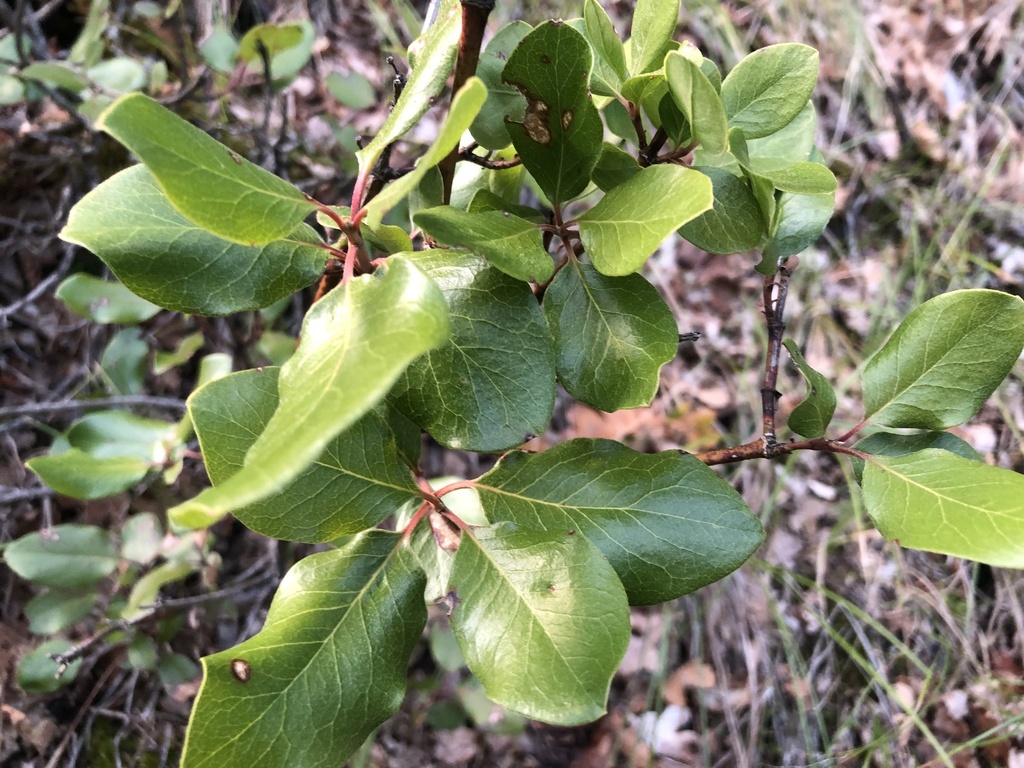
(c) armeria, some rights reserved (CC BY) · licence
Family: Garryaceae · Type: Shrub / Tree · Native
Garrya fremontii (Bearbrush) is a native California shrub / tree in the Garryaceae family, recognized by distinctive glabrous character.
Bearbrush is a California native shrub found in northwestern California, Cascade Range, northern Sierra Nevada Foothills, northern and central Sierra Nevada, Sacramento Valley, San Francisco Bay Area, Peninsular Ranges, and Warner Mountains in chaparral, foothill woodland, and montane forest at elevations of 300 to 2,300 meters. Flowering from January to April, this plant produces inconspicuous flowers with pale greenish-white catkins. Growing to less than 3 meters tall with a dense, rounded form, it develops woody, branching stems. Its leaves are broadly oval, 2 to 12 centimeters long, generally flat with smooth edges and a leathery texture. The shrub forms distinctive hanging clusters of male flowers that provide winter interest in dry, rugged landscapes.
Identification and appearance
Key characters: 5 sympatric species; distinctive glabrous character is diagnostic
Habitat and range
Habitat: Chaparral, foothill woodland, montane forest
Elevation: 300-2300 m
California counties: Sonoma, Trinity, Lake, Siskiyou, Sierra, Humboldt, Mariposa, Mendocino, San Diego, Modoc, Butte, Placer, Plumas, Santa Clara, Marin, Tuolumne, Tulare, Santa Cruz, Contra Costa, Solano, El Dorado, San Bernardino, Glenn, Napa, Nevada, Shasta, Del Norte, Monterey, Tehama, Sutter, Riverside, Orange, Alpine, Alameda, Yuba, Calaveras, Colusa, Lassen
Outside California: to Washington, western Nevada
Bloom period
Garrya fremontii blooms Jan-Apr.
How to tell it apart
vs Quercus: Garrya has opposite leaves and hanging catkins; Quercus has alternate leaves and acorns.; vs Arctostaphylos: Garrya has opposite leaves; Arctostaphylos has alternate leaves and smooth red bark.; vs Lonicera: Garrya has long drooping catkins; Lonicera has tubular flowers in pairs or clusters.; vs Simmondsia: Garrya has drooping catkins several inches long; Simmondsia has tiny inconspicuous flowers.; vs Rhus: Garrya has opposite simple leaves; Rhus has alternate compound leaves with multiple leaflets.
Frequently asked questions
Is Garrya fremontii native to California?
Yes. Garrya fremontii is native to California (recorded as native).
When does Garrya fremontii bloom?
Garrya fremontii blooms Jan-Apr.
Where in California does Garrya fremontii grow?
Garrya fremontii occurs in Sonoma, Trinity, Lake, Siskiyou, Sierra, Humboldt, Mariposa, Mendocino and other counties, at elevations of 300-2300 m.
What plant family does Garrya fremontii belong to?
Garrya fremontii is in the Garryaceae family, genus Garrya.
What habitat does Garrya fremontii grow in?
Garrya fremontii grows in Chaparral, foothill woodland, montane forest.
Related species
Other California species in the same genus, family, or bioregion.
Sources: Jepson eFlora · Index of California Plant Names · CalPhotos
Last updated 2026-10-07
Data from The California Species Project — 14,000+ California species with verified data from CNPS, CDFW, USFWS, Cal-IPC, and more.