Gastridium phleoides
Nit grass
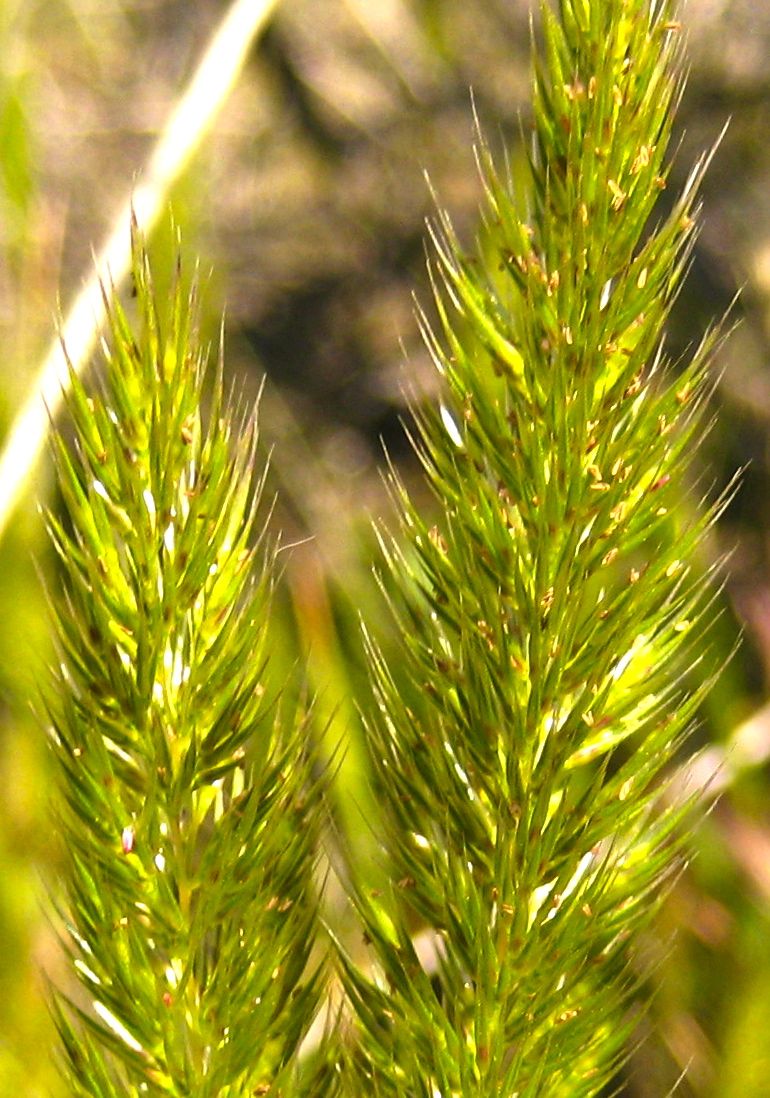
Photo by Chez Brungraber
Family: Poaceae · Type: Grass · Not Native
Gastridium phleoides (Nit grass) is a non-native California grass in the Poaceae family, recognized by 0 congeners in atlas; annual grass with shiny swollen hardened glumes in dense spike-like panicle.
Nit grass is a naturalized annual grass found in California Floristic Province and North Coast and Coast Ranges in open, generally dry, disturbed sites at elevations below 1,450 meters. Flowering from April to November, this grass produces translucent, pale green to white spikelets with delicate, thin inflorescences. Growing 20 to 70 centimeters tall with generally glabrous stems, it forms upright clumps in disturbed areas. Its leaves are narrow, 4 to 9 centimeters long and 3 to 5 millimeters wide, with ligules 1 to 7 millimeters in length. The distinctive spikelets feature lemmas with straight to curved awns 3 to 6 millimeters long, arising from beneath a truncate, toothed tip.
Identification and appearance
Key characters: 0 congeners in atlas; annual grass with shiny swollen hardened glumes in dense spike-like panicle
Habitat and range
Habitat: Open, generally dry, disturbed sites
Elevation: generally < 1450 m
California counties: Mendocino, San Luis Obispo, San Diego, Lake, Santa Barbara, Solano, Riverside, Shasta, Humboldt, Butte, Santa Cruz, Orange, Ventura, Los Angeles, Monterey, Madera, Santa Clara, San Mateo, Marin, Calaveras, Sutter, San Francisco, Sonoma, Contra Costa, El Dorado, Fresno, San Joaquin, Tehama, Tuolumne, Yuba, Tulare, Sacramento, Amador, Alameda, Mariposa, Nevada, Placer, Siskiyou, Napa, San Bernardino, Stanislaus, Colusa, Glenn, Trinity, Del Norte, Yolo, Merced, San Benito
Outside California: to Oregon, Canada, northeastern United States, native to Europe
Bloom period
Gastridium phleoides blooms Apr-Nov.
How to tell it apart
vs Phleum: Gastridium glumes are shiny and swollen or hardened at the base, tapering to a point, giving the spike a glossy scaly look; Phleum (timothy) glumes are flat-sided, blunt, and abruptly awn-tipped, and the spike feels stiffly bristly.; vs Polypogon: Gastridium has a smooth, shiny, firm spike-like panicle with awns nearly hidden; Polypogon (rabbitfoot grass) has a soft, silky, bristly head from long awns on both glumes.; vs Alopecurus: Gastridium glumes are free and hardened at the base; Alopecurus (foxtail) has glumes fused along their lower edges and a soft head.; vs Lagurus: Gastridium's spike is green, glossy and pointed; Lagurus (hare's-tail) forms a soft, woolly, egg-shaped white head.; vs Agrostis: Gastridium has a dense, contracted, spike-like panicle with swollen shiny glumes; Agrostis (bentgrass) has an open, airy, diffuse panicle of tiny spikelets.
Frequently asked questions
Is Gastridium phleoides native to California?
No. Gastridium phleoides is not native to California (recorded as not native).
When does Gastridium phleoides bloom?
Gastridium phleoides blooms Apr-Nov.
Where in California does Gastridium phleoides grow?
Gastridium phleoides occurs in Mendocino, San Luis Obispo, San Diego, Lake, Santa Barbara, Solano, Riverside, Shasta and other counties, at elevations of generally < 1450 m.
What plant family does Gastridium phleoides belong to?
Gastridium phleoides is in the Poaceae family, genus Gastridium.
What habitat does Gastridium phleoides grow in?
Gastridium phleoides grows in Open, generally dry, disturbed sites.
Related species
Other California species in the same genus, family, or bioregion.
Sources: Jepson eFlora · Index of California Plant Names · CalPhotos
Last updated 2026-10-07
Data from The California Species Project — 14,000+ California species with verified data from CNPS, CDFW, USFWS, Cal-IPC, and more.