Gaultheria humifusa
Alpine wintergreen, Alpine Wintergreen
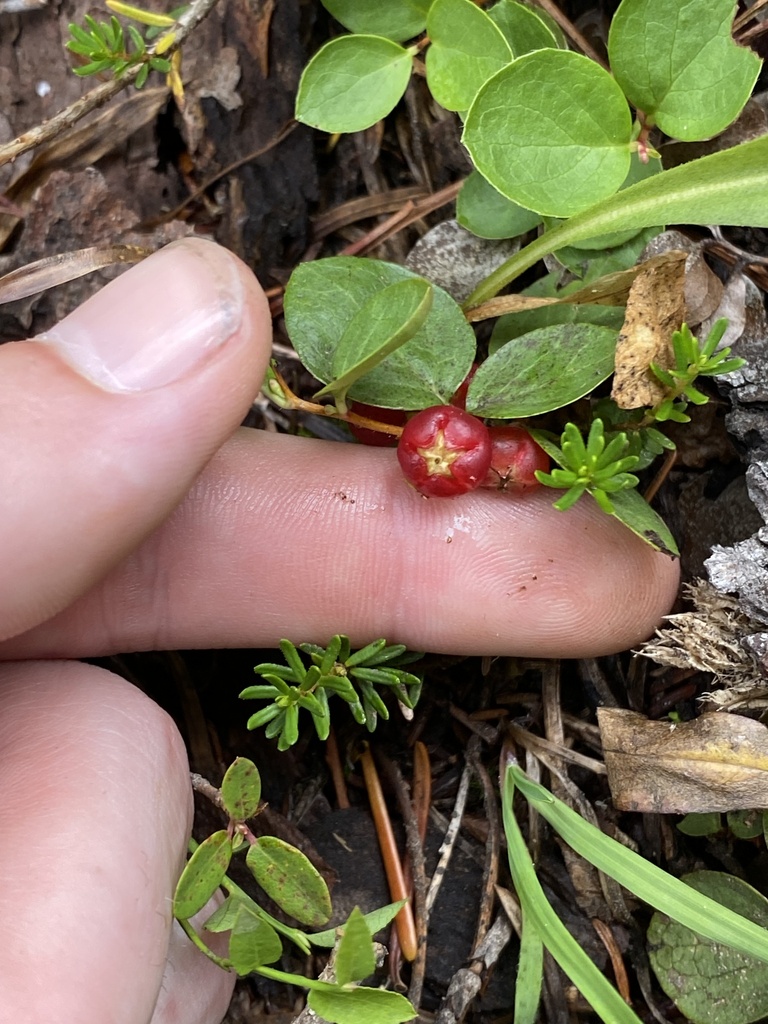
(c) Daniel Kennedy, some rights reserved (CC BY) · licence
Family: Ericaceae · Type: Shrub · Native
Gaultheria humifusa (Alpine wintergreen) is a native California shrub in the Ericaceae family, recognized by elevation range and small stature.
Alpine wintergreen is a California native shrub found in the Klamath Ranges, high Cascade Range, and Sierra Nevada in wet subalpine forests at elevations of 1,350 to 4,000 meters. Flowering from June to August, this plant produces white to pink-tinged bell-shaped flowers nestled individually in leaf axils. Growing low to the ground with stems less than 20 centimeters tall, it spreads in compact clusters with glabrous to slightly hairy branches. Its small leaves measure 0.5 to 3 centimeters long, with rounded edges and a delicate, nearly entire margin. The plant develops bright red fruits that contrast beautifully with its green foliage, creating a striking appearance in alpine and subalpine environments.
Identification and appearance
Key characters: 2 sympatric species; key features are elevation range and small stature
Habitat and range
Habitat: Wet subalpine forests
Elevation: 1350-4000 m
California counties: Tuolumne, Fresno, Tulare, Mariposa, Siskiyou, Mono, El Dorado, Madera, Inyo, Tehama, Trinity
Outside California: to British Columbia, Colorado
Bloom period
Gaultheria humifusa blooms Jun-Aug.
How to tell it apart
vs Vaccinium: Gaultheria (salal) has thick, sharply pointed, minutely toothed leaves and a fleshy purple-black fruit that is really a swollen calyx over a capsule; Vaccinium (huckleberry/blueberry) has thinner leaves and a true berry crowned by the calyx.; vs Arctostaphylos: Gaultheria has finely serrate leaves and glandular-hairy flower stalks; manzanita has entire leaves, smooth red bark, and dry mealy fruits.; vs Comarostaphylis: Gaultheria leaves are minutely serrate and green beneath; Comarostaphylis (summer holly) has revolute, sharply toothed leaves that are white-woolly beneath, and warty red fruits.; vs Leucothoe: Gaultheria fruit is fleshy and berry-like; Leucothoe has similar leathery leaves but produces a dry capsule.; vs Menziesia: Gaultheria is evergreen with leathery toothed leaves and fleshy fruit; Menziesia is deciduous with thin, hairy leaves and a dry capsule.
Frequently asked questions
Is Gaultheria humifusa native to California?
Yes. Gaultheria humifusa is native to California (recorded as native).
When does Gaultheria humifusa bloom?
Gaultheria humifusa blooms Jun-Aug.
Where in California does Gaultheria humifusa grow?
Gaultheria humifusa occurs in Tuolumne, Fresno, Tulare, Mariposa, Siskiyou, Mono, El Dorado, Madera and other counties, at elevations of 1350-4000 m.
What plant family does Gaultheria humifusa belong to?
Gaultheria humifusa is in the Ericaceae family, genus Gaultheria.
What habitat does Gaultheria humifusa grow in?
Gaultheria humifusa grows in Wet subalpine forests.
Related species
Other California species in the same genus, family, or bioregion.
Sources: Jepson eFlora · Index of California Plant Names · CalPhotos
Last updated 2026-10-07
Data from The California Species Project — 14,000+ California species with verified data from CNPS, CDFW, USFWS, Cal-IPC, and more.