Gayophytum eriospermum
Coville's gayophytum
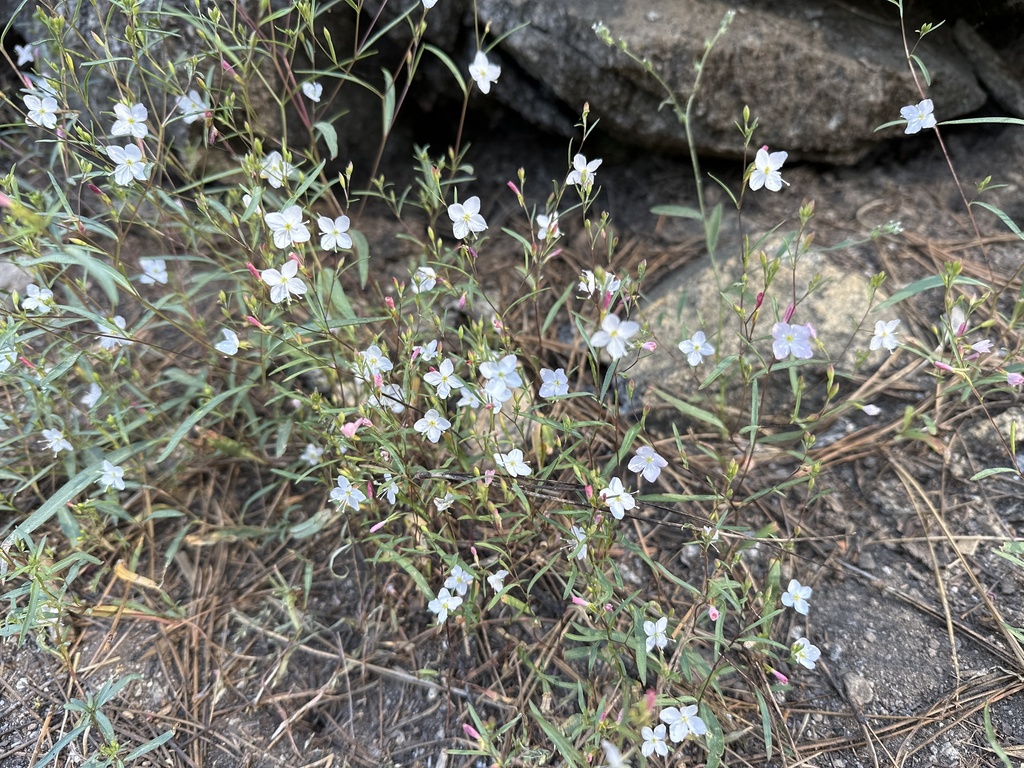
(c) Pieter Pelser, some rights reserved (CC BY) · licence
Family: Onagraceae · Type: Herb · Native
Gayophytum eriospermum (Coville's gayophytum) is a native California herb in the Onagraceae family, recognized by . Key features: tall stem to 1m, large petals 4-8mm, no basal branching.
Coville's gayophytum is a California native annual found in the southern Sierra Nevada Mountains in open montane forest at elevations of 100 to 3,200 meters. Flowering from June to October, this delicate plant produces small white to pale pink flowers 4 to 8 millimeters long with petals that emerge from forked branches near the stem's upper portions. Growing with slender stems less than one meter tall, it develops branches primarily in the upper stem sections. Its leaves are relatively long, measuring 2 to 7.5 centimeters, and become progressively smaller and more reduced towards the stem's upper regions. The plant produces distinctive fruits 4 to 16 millimeters long that are slightly knobby and typically longer than their supporting pedicels.
Identification and appearance
Key characters: 7 sympatric species. Key features: tall stem to 1m, large petals 4-8mm, no basal branching
Habitat and range
Habitat: Open montane forest
Elevation: 100-3200 m
California counties: Fresno, Tuolumne, Tulare, Kern, Amador, Madera, Mariposa, Siskiyou, San Bernardino, Inyo, Alpine, El Dorado, Calaveras, Plumas
Bloom period
Gayophytum eriospermum blooms Jun-Oct.
How to tell it apart
vs Epilobium: Gayophytum is a wiry, much-branched annual with tiny flowers and short straight capsules whose seeds lack plumes; Epilobium has long linear capsules that split to release seeds tufted with hairs (coma).; vs Camissonia: Gayophytum has a very short or absent floral tube, so the petals appear to sit right on the ovary; the Camissonia group has a distinct floral tube above the ovary and generally yellow flowers.; vs Oenothera: Gayophytum is a slender diffuse annual with minute (1-2 mm) flowers; Oenothera (evening primrose) has large showy flowers on a long floral tube.; vs Clarkia: Gayophytum flowers are tiny with plain entire petals; Clarkia has larger, often lobed or clawed petals and 4-grooved capsules.; vs Eremothera: Gayophytum has a threadlike branching habit with short capsules held along the stem; Eremothera and Chylismia have basal rosette leaves and longer tubular-based flowers.
Frequently asked questions
Is Gayophytum eriospermum native to California?
Yes. Gayophytum eriospermum is native to California (recorded as native).
When does Gayophytum eriospermum bloom?
Gayophytum eriospermum blooms Jun-Oct.
Where in California does Gayophytum eriospermum grow?
Gayophytum eriospermum occurs in Fresno, Tuolumne, Tulare, Kern, Amador, Madera, Mariposa, Siskiyou and other counties, at elevations of 100-3200 m.
What plant family does Gayophytum eriospermum belong to?
Gayophytum eriospermum is in the Onagraceae family, genus Gayophytum.
What habitat does Gayophytum eriospermum grow in?
Gayophytum eriospermum grows in Open montane forest.
Related species
Other California species in the same genus, family, or bioregion.
Sources: Jepson eFlora · Index of California Plant Names · CalPhotos
Last updated 2026-10-07
Data from The California Species Project — 14,000+ California species with verified data from CNPS, CDFW, USFWS, Cal-IPC, and more.